CORNELIS KICK (Amsterdam 1634 – 1681 Amsterdam)
Cornelis Kick (Amsterdam 1634 – 1681 Amsterdam)
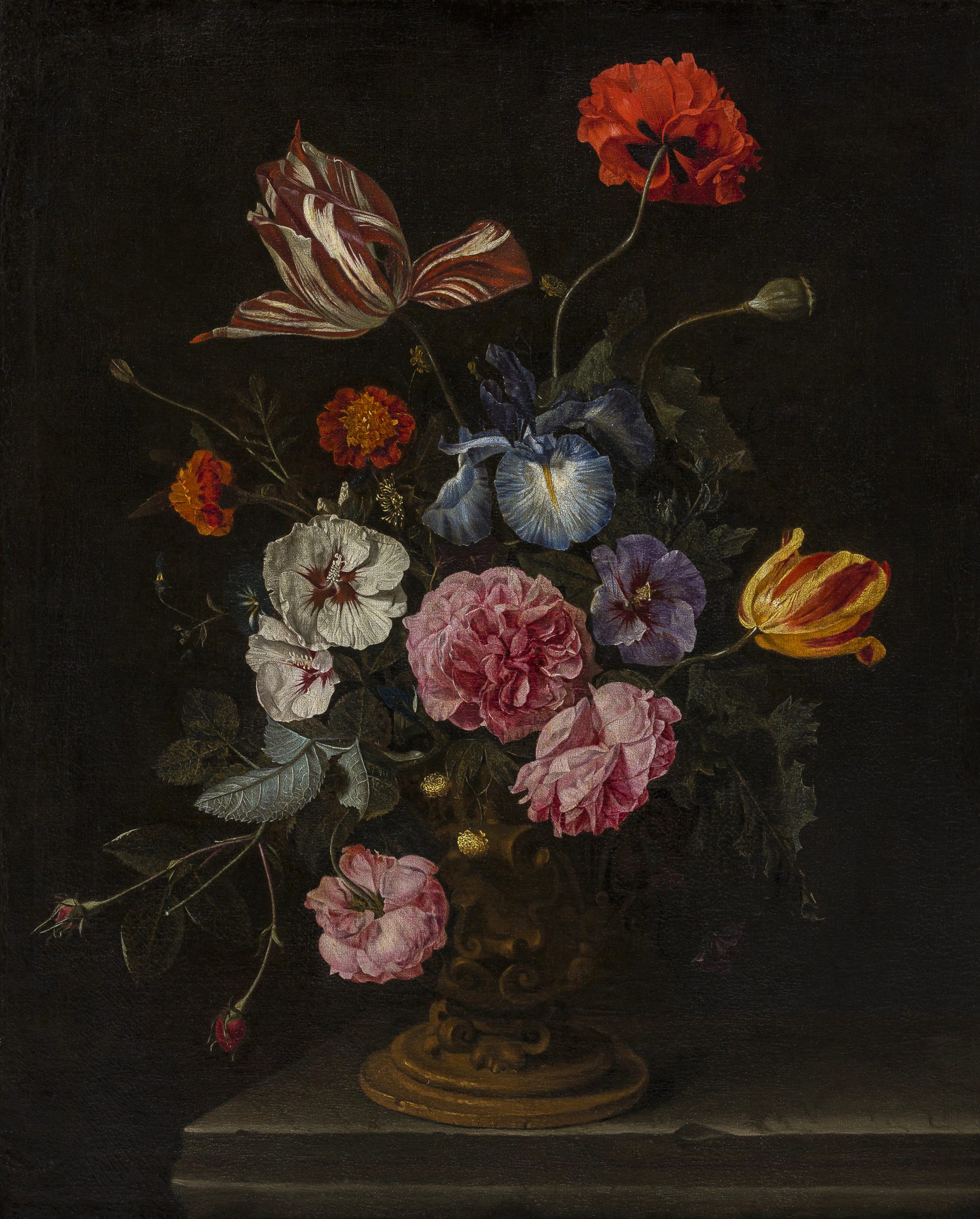
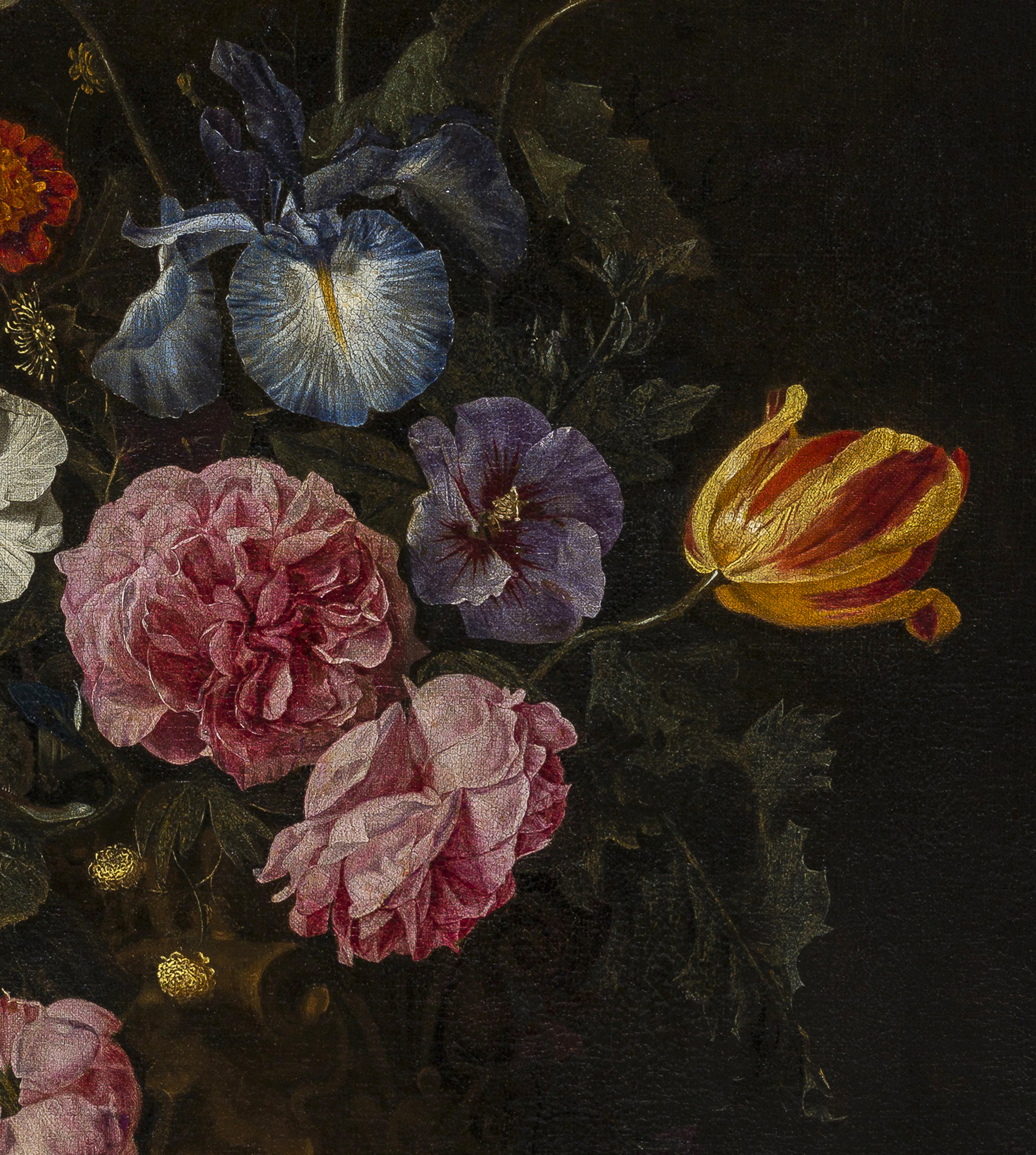
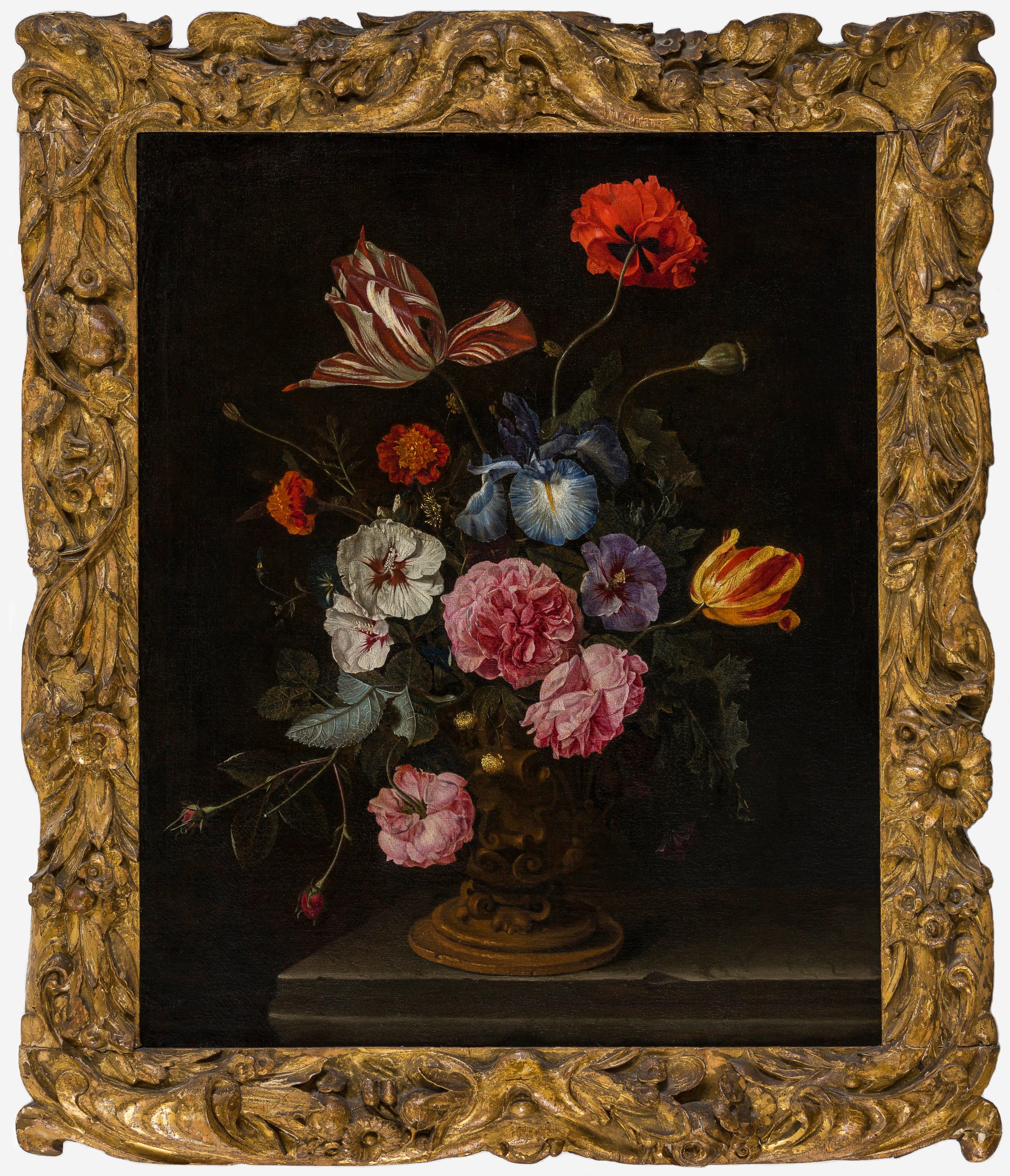
Still Life of Parrot Tulips, Roses, Poppies and other Flowers in a Terracotta Vase
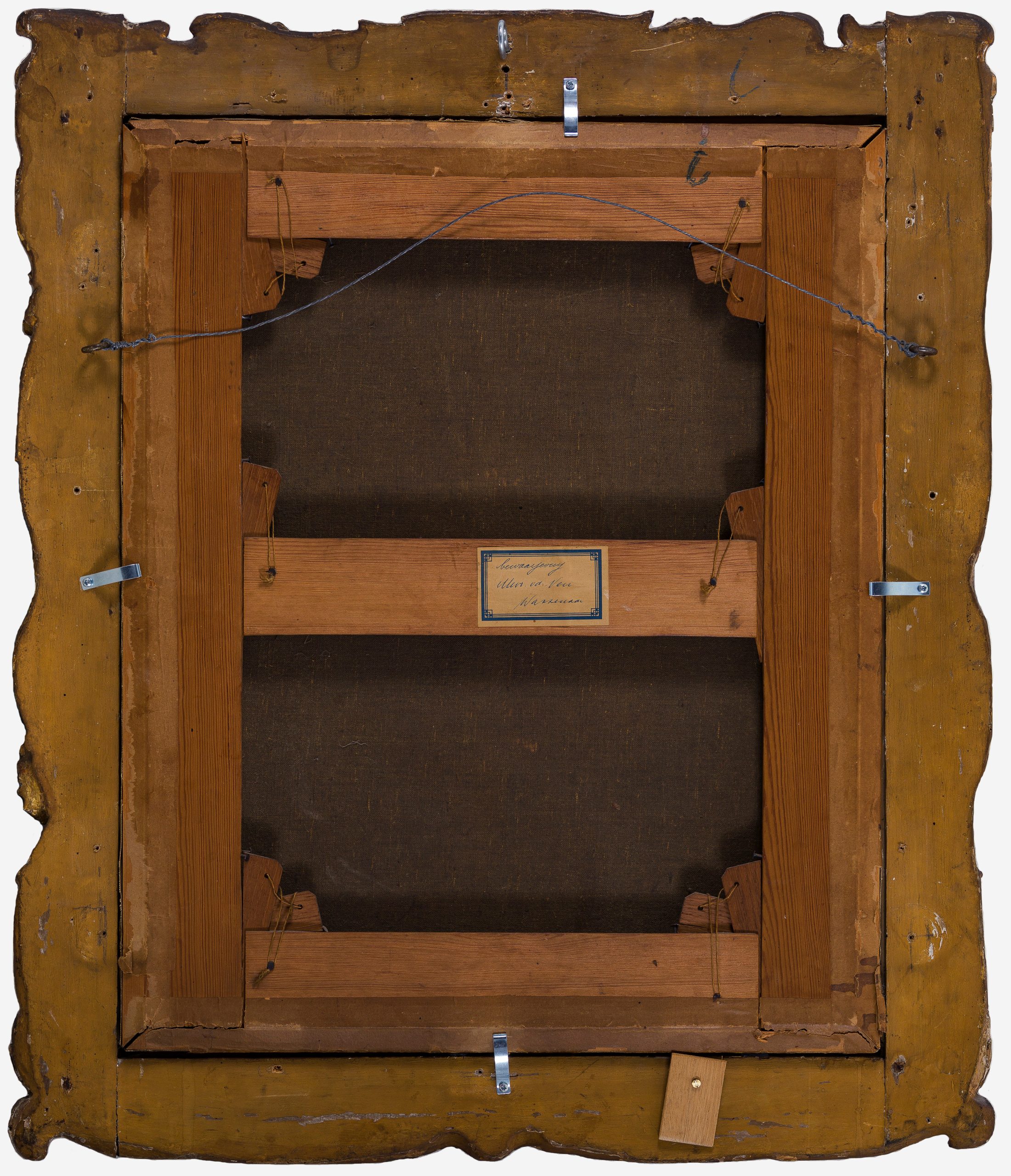
Oil on canvas, 65.5 x 53.5 cm (25.8 x 21.1 inch), contained in the original Auricular frame of c.1660-70
Provenance
Private collection, The Netherlands, since at least the end of the nineteenth century, and by descent
***
Cornelis Kick was baptised in Amsterdam on 12 March 1634, the son of the genre painter Simon Kick (1603–1652) and Christina Cornelisdr Duyster, the sister of the painter Willem Duyster.1 Cornelis was initially educated in the art of painting by his father – he is likely to have taken up still-life painting later in life, it is thought because he was attracted by the success of the flower painter Jan Davidsz de Heem (1606–1683/84). In May 1661 Kick married Cornelia Spaeroogh, daughter of an affluent pawnbroker, who had an estate outside the city walls of Amsterdam, beyond the Anthonis Gate, where Cornelis and Cornelia lived for some years. The gardens there had an abundance of flowers, studied and painted by Kick and his pupils Jacob van Walscapelle and Elias van den Broeck. Interestingly, the contract betwee Elias’s father Johan van den Broeck survives, in which Kick promised to train Elias for a period of four years for a considerable fixed sum of money.
Kick was forced to replace the estate and gardens due to the expansions of the built area of the town of Amsterdam, as was recounted in the artist’s biography by Arnold Houbraken.2 Kick later moved to Loenen aan de Vecht and spent his last years back in Amsterdam. His daughter, Maria Kick, moved to the Dutch Cape Colony, now South Africa, where she married Friederich Botha; their great-grandsons became Presidents of the Republics of Swellendam and the Graaff-Reinet in the late eighteenth century. In addition to painting, Kick also provided drawings for two engravings of sprigs with blooms in vases for Johannes Commelin’s Nederlantze Hesperides (Amsterdam 1676).
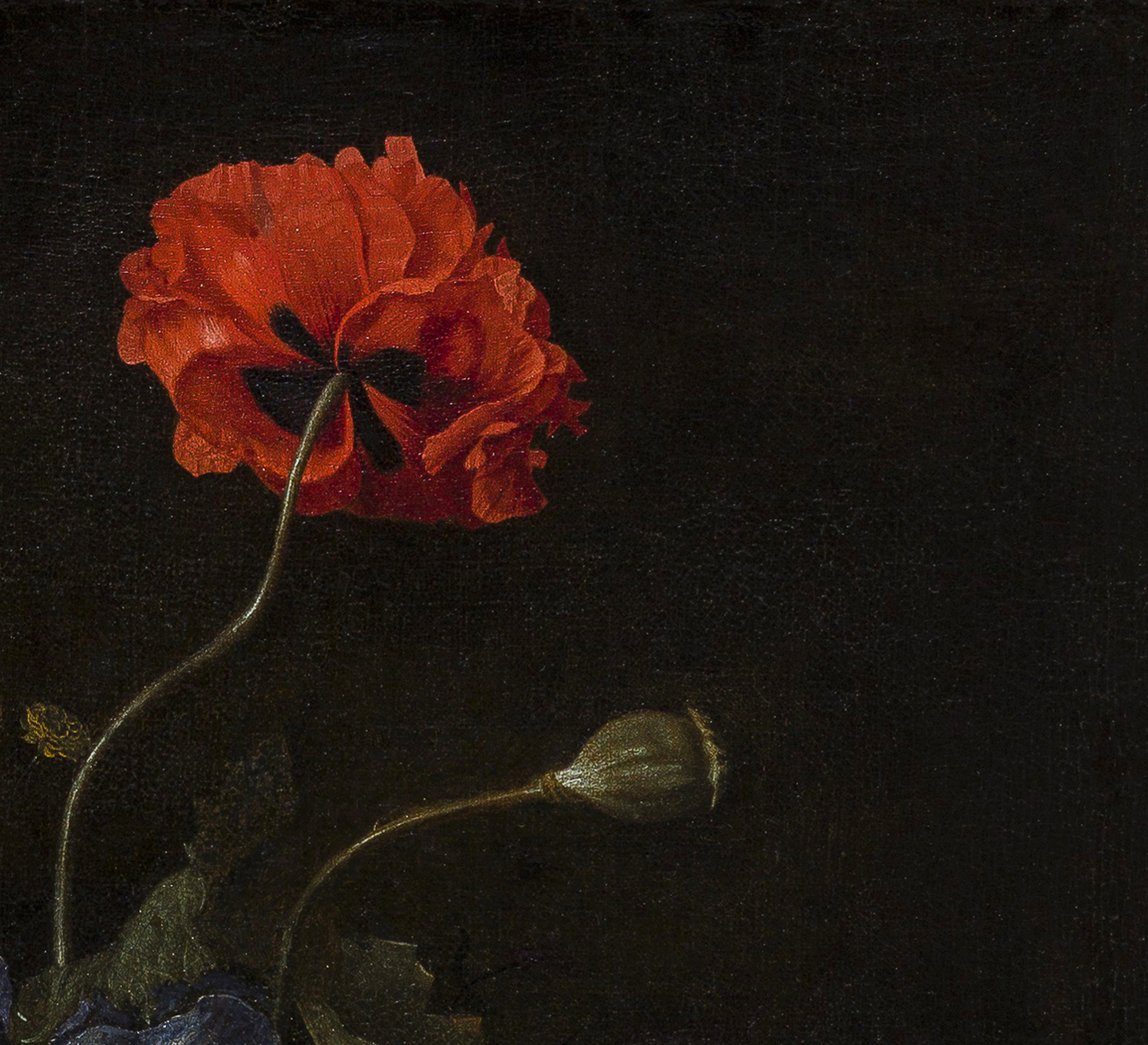
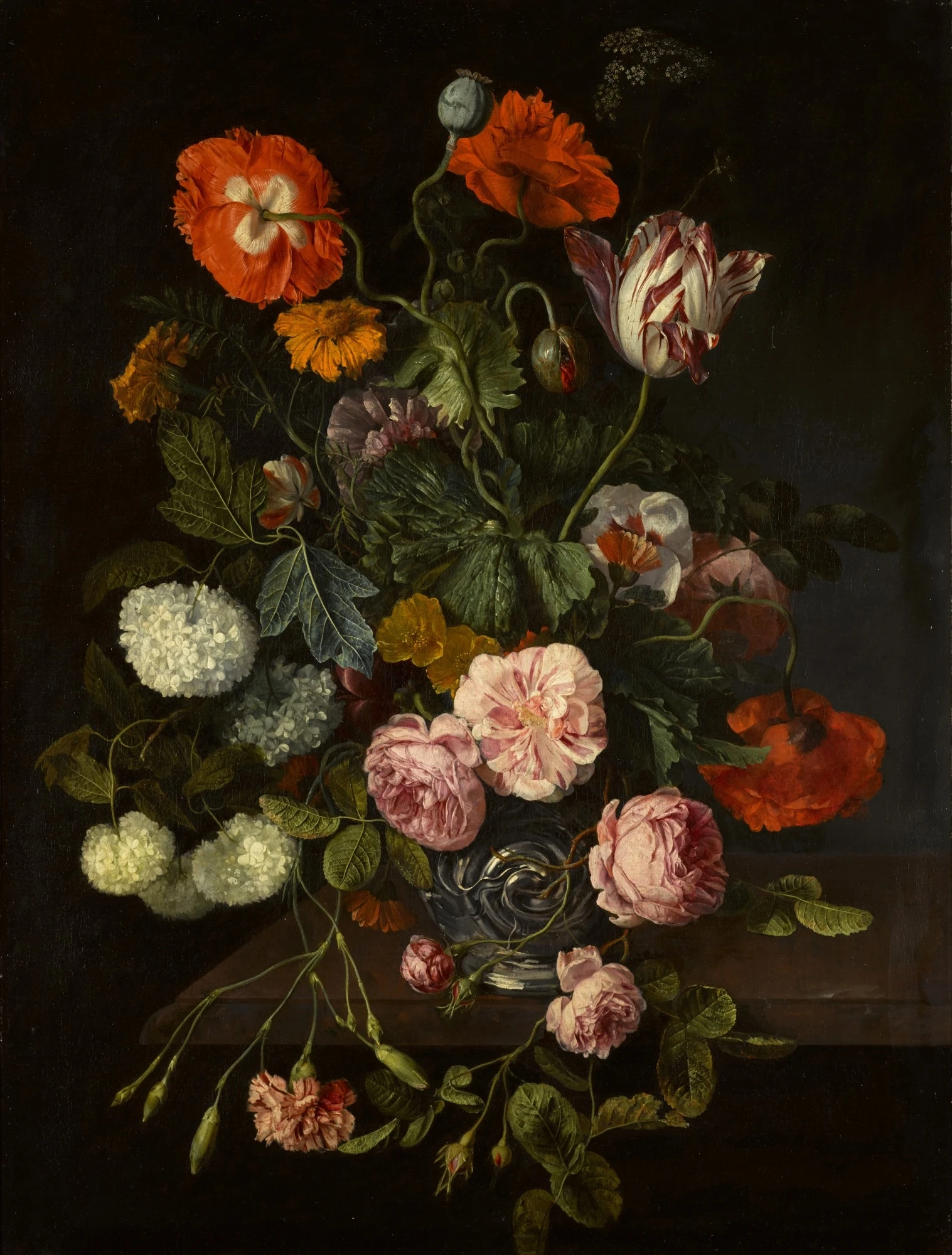
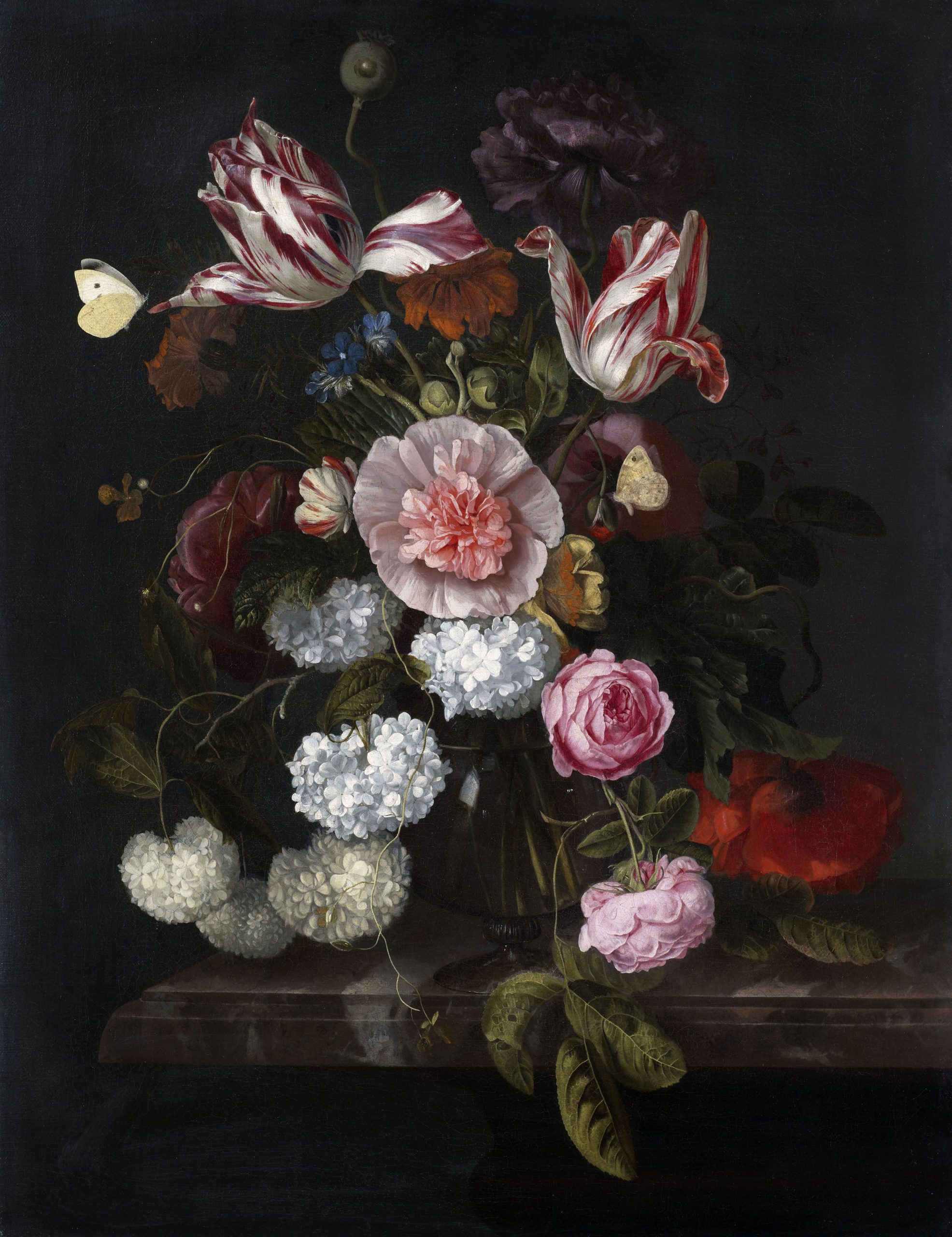
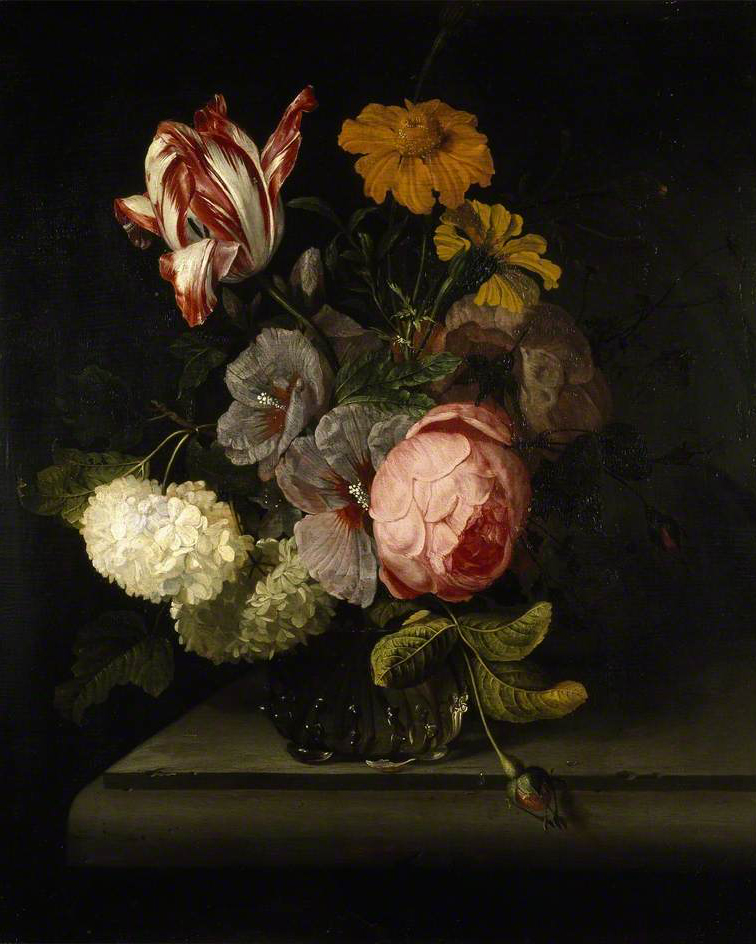
Works by Cornelis Kick are rare, only around two dozen paintings are currently known, all still-lifes of flowers and fruits, the majority unsigned, which accounts for his relative obscurity. It can be speculated that the artist was not required to paint for financial reasons, as he had married a wealthy wife. Kick’s flower still-lifes are mostly composed of groups of a relatively small range of flowers arranged in vases placed on stone- or marble-topped tables. Typical for Kick are roses that are placed in the centre of the bouquet, poppies with twisted stems and hanging branches and leaves. Sam Segal and Klara Alen noted ‘the overly flamboyant or excessively curling stems’, further observing that ‘he bestowed much attention on the foliage, which is heavily veined, something that is particularly noticeable on the undersides of the leaves.’3
Although the present flower still-life had been known to scholars, it has not been on the art market for more than a century, passing down in family ownership for generations, possibly centuries. It is probably because of these circumstances, not having passed through the art trade, that the painting retains its original frame, a virtually unique survival for a Dutch seventeenth-century flower piece. The gilded frame is carved in the Auricular style, known as “Kwab” in Dutch, known for its undulating organic and asymmetrical shapes, reminiscent of shells and indeed of the side view of the human ear, from which the style takes its name, hugely admired during the middle of the seventeenth century. Both painting and frame can be dated around 1670, and it is interesting to note that Auricular motifs can also be preserved in the terracotta vase in which the flowers are arranged. Auricular frames rather regularly survive on portraits, and may have been especially favoured for these.4 Auricular frames of very comparable design survive on the portraits of an unknown man and woman by Ludolf de Jongh, dated 1661.5 The present painting may well be the only extant seventeenth-century still-life in the original Auricular frame. One can speculate that Kick was interested in the novel Auricular style and may have commissioned the frame himself: besides the Auricular ornamentation on the vase in our painting, the artist also used an extraordinary silver vase in the Auricular style for a comparable still-life of flowers that appeared on the art market a few years ago (fig.).6
Our painting is particularly close to a still-life by Kick that was formerly in the art trade (fig.).7 A further comparable still-life is in the Ashmolean Museum in Oxford (fig.).8 Other paintings are in the collections of the Victoria and Albert Museum in London, The Princeton University Museum of Art and the Liechtenstein Princely Collections.
The authenticity of this painting has been confirmed by both Dr Fred Meijer and Marina Aarts.9
1. For Kick, see the biographies in Sam Segal and Klara Alen, Dutch and Flemish flower pieces, Leiden/Boston 2020, vol. I, pp. 399-402, A. van der Willigen and F. Meijer, A Dictionary of Dutch and Flemish Still Life Painters in Oils, Leiden 2003, p. 125 and Saur Allgemeines Künstlerlexikon: die bildenden Künstler aller Zeiten und Völker, Munich 1992-, vol. 80 (2014), p. 200 and
2. Arnold Houbraken, De Groote Schouburgh der Nederlantsche konstschilders en schilderessen (…), The Hague 1718–1721, vol. II (1719), pp. 333-334.
3. Segal and Alen, op. cit. p. 399.
4. P.J.J. van Thiel and C.J. de Bruyn Kops, Prijst de lijst. De Hollandse schilderijlijst in de zeventiende eeuw, exh. cat. Amsterdam (Rijksmuseum) 1981, pp. 164-183, cat. nos. 33-39.
5. Oil on canvas, sight size 72.4 x 58.2 cm, formerly Sotheby’s, Amsterdam, 5 November 2002, lot 99, repr. (without the frames). The frames are on loan to the Rijksmuseum, inv. no. SK-L-1006, while the portraits are still privately owned; see Hubert Baija, ‘Modern materials and practice in gilding conservation’, Papers presented at the 42nd annual meeting of the American Institute for Conservation of Historic and Artistic Works, San Francisco CA 2014, p. 35, figs 5-6.
6. Oil on canvas, 84.9 x 64.8 cm, Sotheby’s, London, 9 December 2021, lot 155, repr. (sold GBP 226,800 / US$ 300,085).
7. Oil on canvas, 66 x 51 cm; with Johnny van Haeften, TEFAF, 2006. A. van der Willigen and Meijer, op. cit., p. 125.
8. Oil on panel, 46 x 36 cm, signed ‘C. Kick’, inv. no. WA1940.2.49; Meijer, Fred G., The Ashmolean Museum, Oxford. Catalogue of the Collection of Paintings. The Collection of Dutch and Flemish Still-Life Paintings bequeathed by Daisy Linda Ward, Zwolle 2003, cat. no. 50, repr.
9. Correspondence with previous owner, 17 June 2006.