Attributed to HANS WITDOECK (Antwerp 1615 – after 1639 Antwerp)
Attributed to Hans Witdoeck (Antwerp 1615 – after 1639 Antwerp)
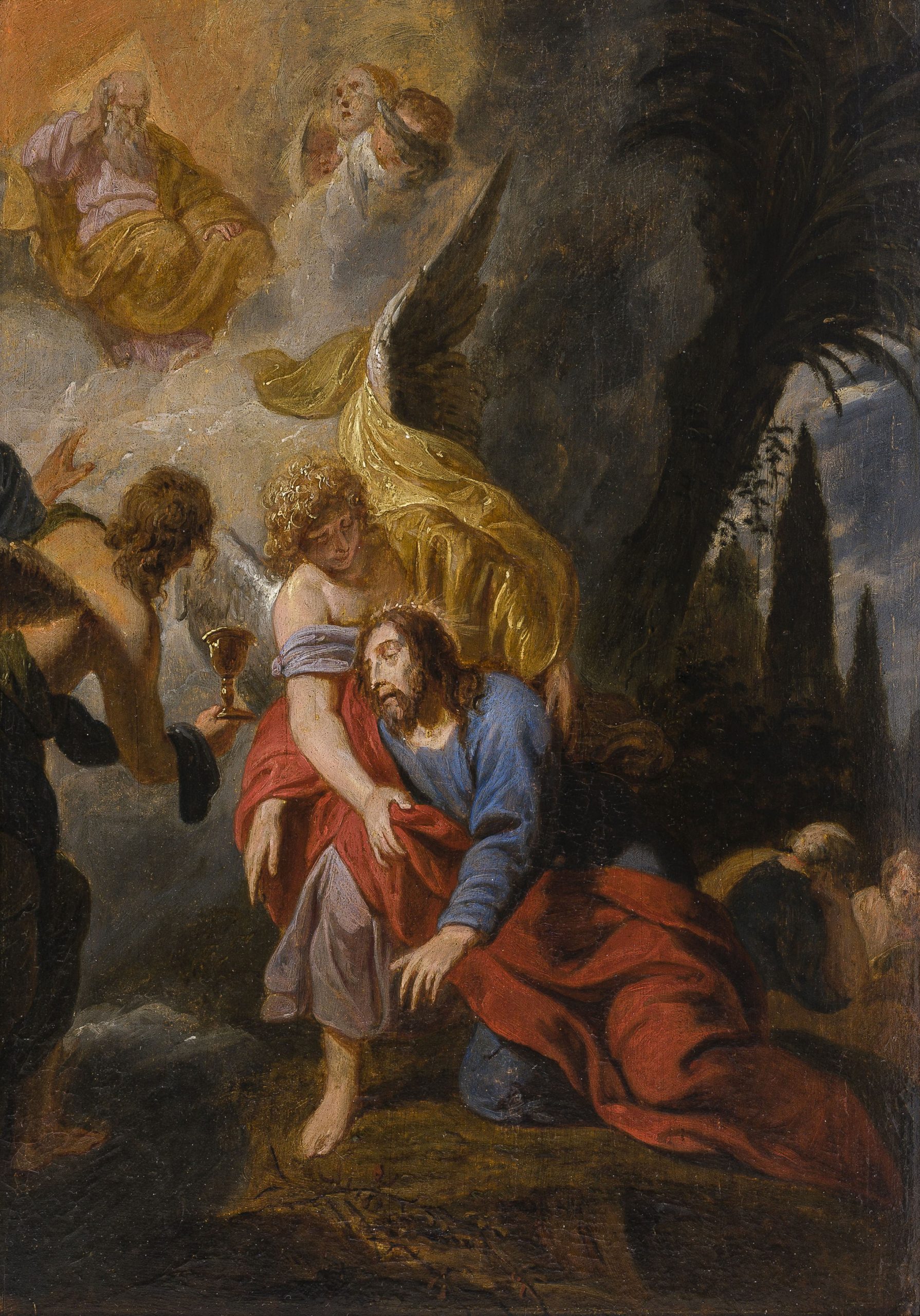
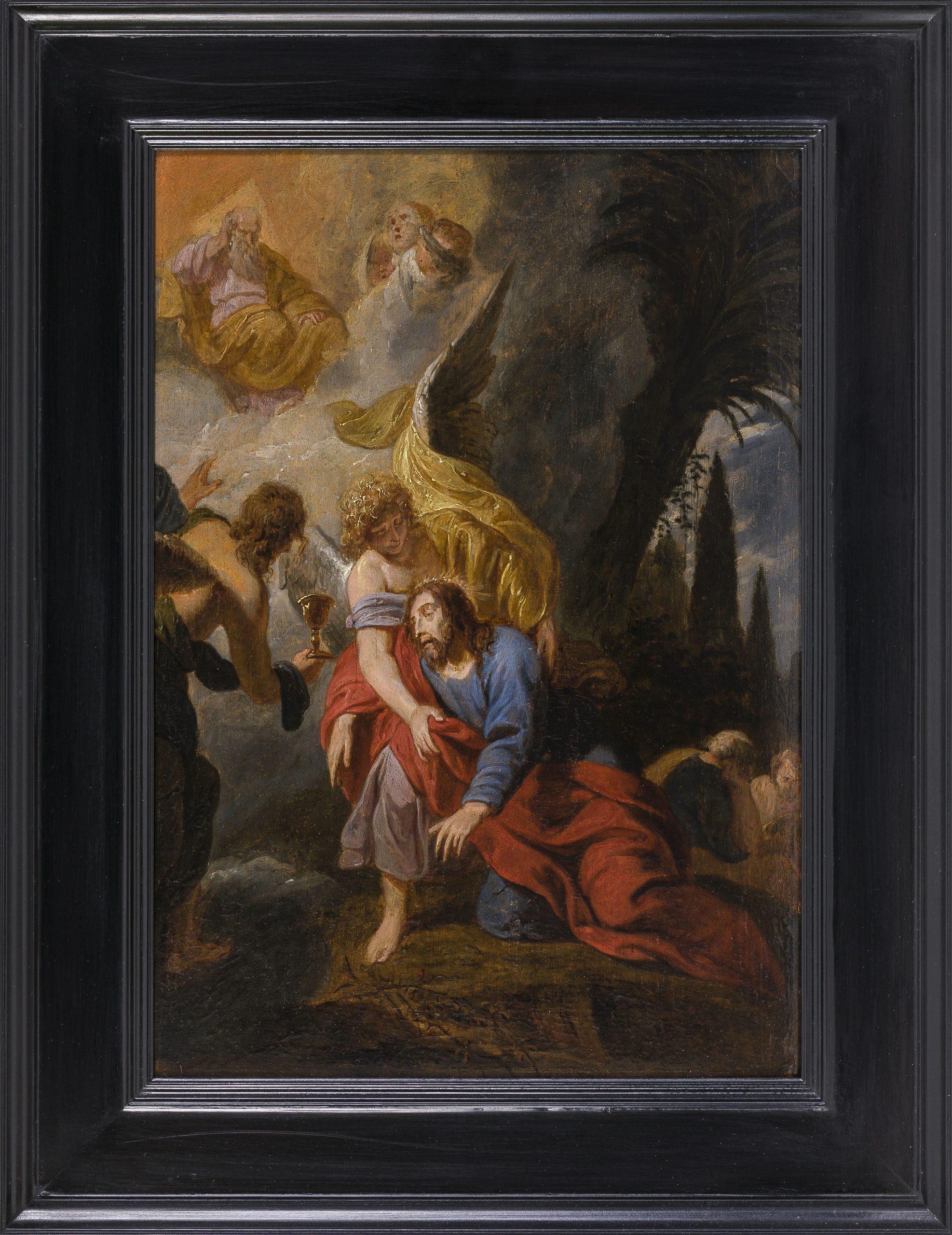
The Agony in the Garden
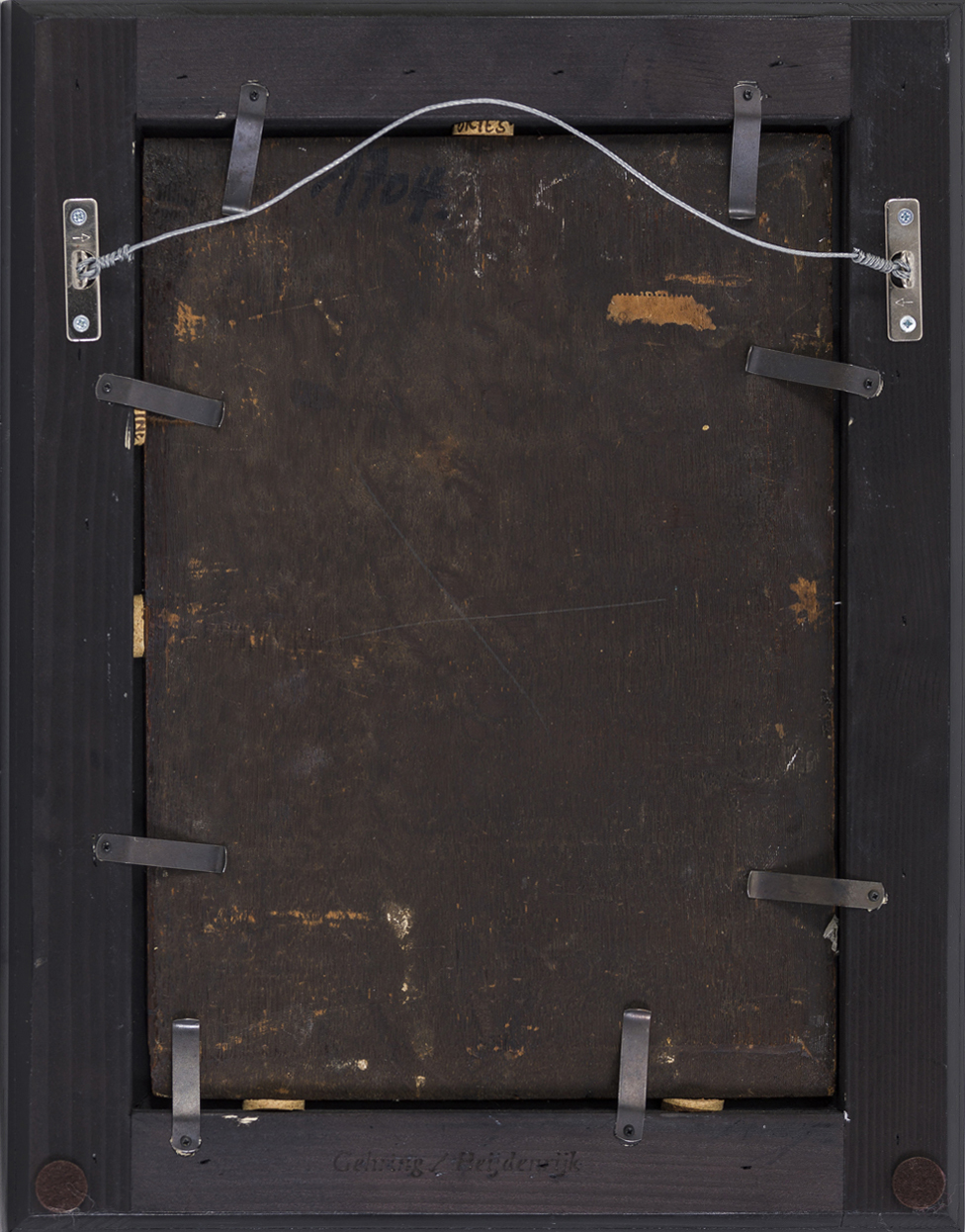
Oil on panel, 34.5 x 24 cm (13.6 x 9.4 inch)
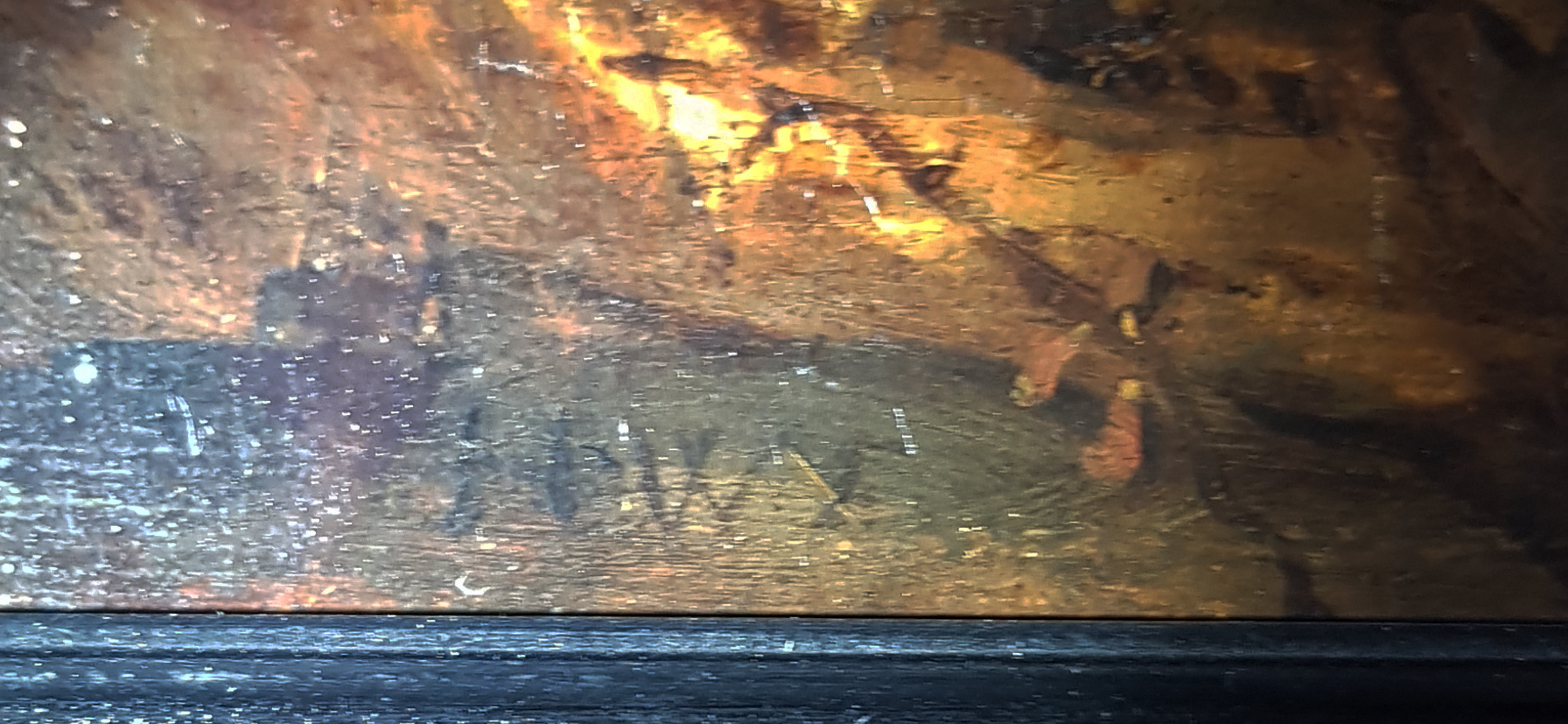
Monogrammed ‘HWF’ (lower centre)
Provenance
Private collection, The Netherlands
***
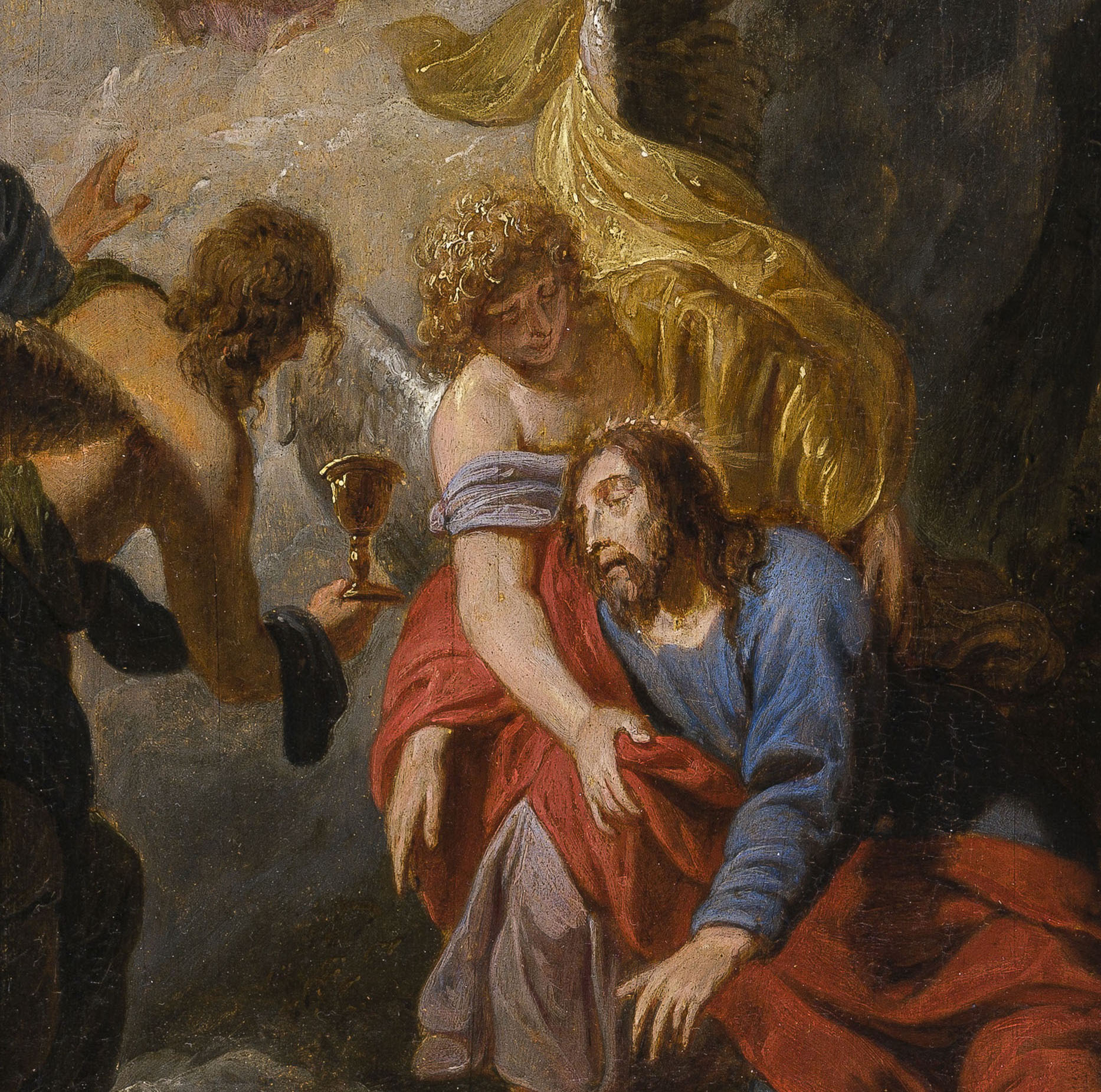
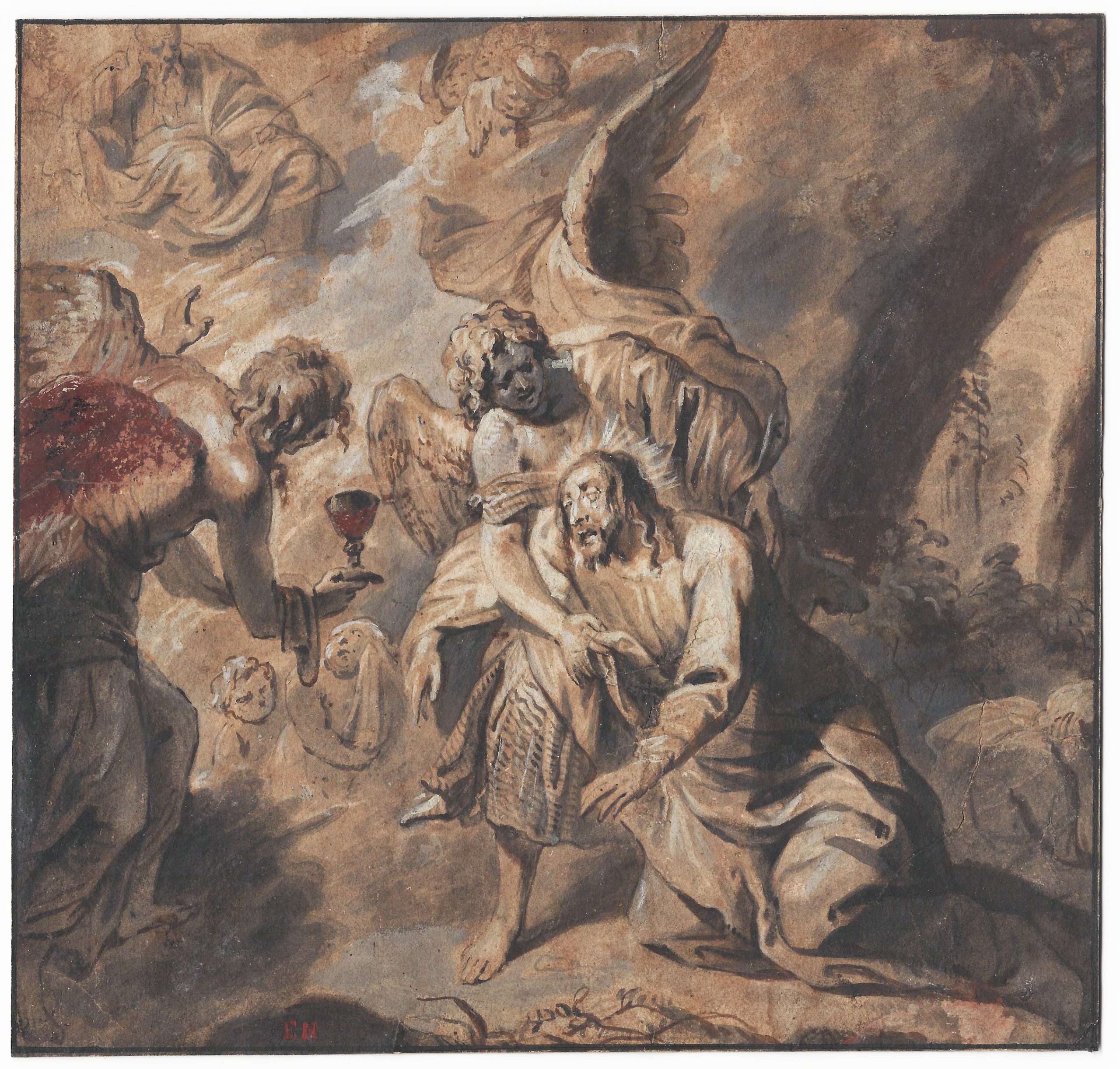
This recently discovered painting is related to a drawing that was sold by ourselves a few years ago (fig.).1 The drawing had been studied at the time by Professor Hans Vlieghe, who noted that it was close to works by Cornelis Schut (Antwerp 1597 – 1655 Borgerhout), but did not quite fit in with his known oeuvre, and concluded that it should be described as an anonymous work by an Antwerp artist of around 1650.2 The painting, which also appears to be Flemish and from the middle of the seventeenth century, adds valuable information as it bears the monogram ‘HWF’, the ‘F’ probably an abbreviation of ‘Fecit’ (‘made’). The drawing would appear to be preparatory to the painting, rather than copying it, because of various compositional changes, notably the differing shape or format, and the occurrence of the heads of two putti in the drawing to the left of Christ, but not in the painting, and differences in the landscape background.
There are two artists in Flanders around this period with the initials HW, Hendrick Watele (Antwerp 1640 – 1677 Paris) and Hans Witdoeck (Antwerp 1615 – after 1639 Antwerp). We know little about Watele, who seems to have been mostly active as a printmaker,3 but more is known about Witdoeck, who was also mostly active as an engraver, and whose life dates accord better with the apparent ages of the painting and drawing under discussion here.4 Witdoeck, born in Antwerp in 1615, was initially apprenticed to Lucas Vorsterman (1595–1675) for three years, but the contract was broken after eighteen months by the apprentice’s father and Hans continued his studies with Cornelis Schut I, who had just returned from Italy. From 1634 he worked in the studio of Peter Paul Rubens, specialising in reproductive engravings and etchings, his prints increasingly more ambitious in size and virtuosity of handling.5 Witdoeck is believed to have been much favoured for his skills in engraving by Rubens towards the end of his life, even to the point of becoming his preferred reproductive artist. Witdoeck’s advancing fame was cut short by his early death during his mid-twenties, having died in 1639 or shortly afterwards.
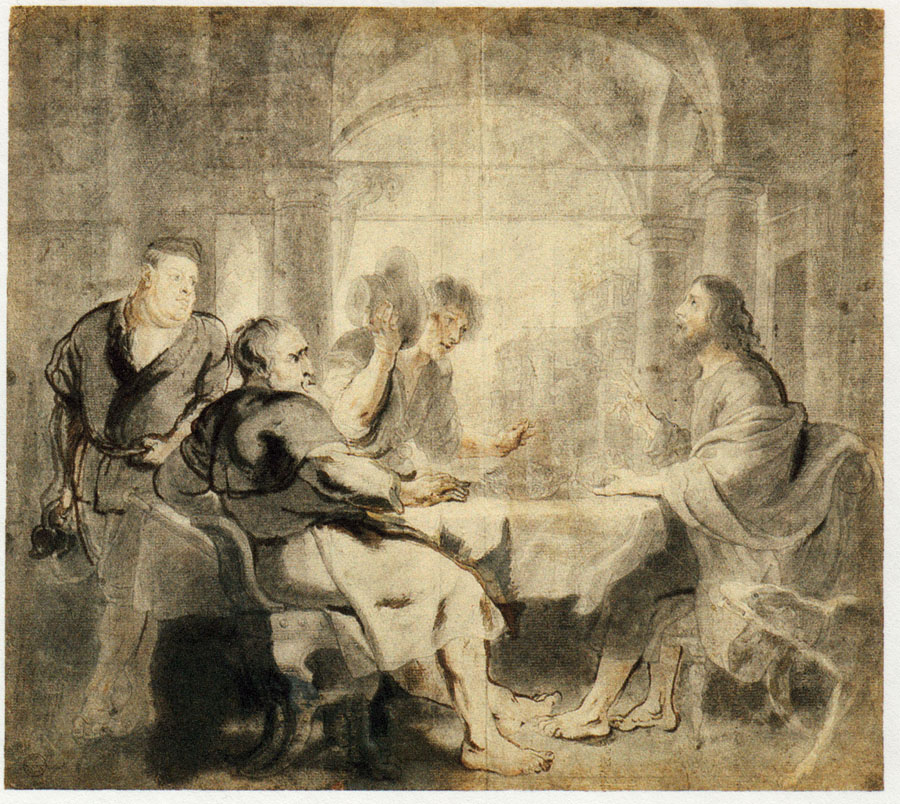
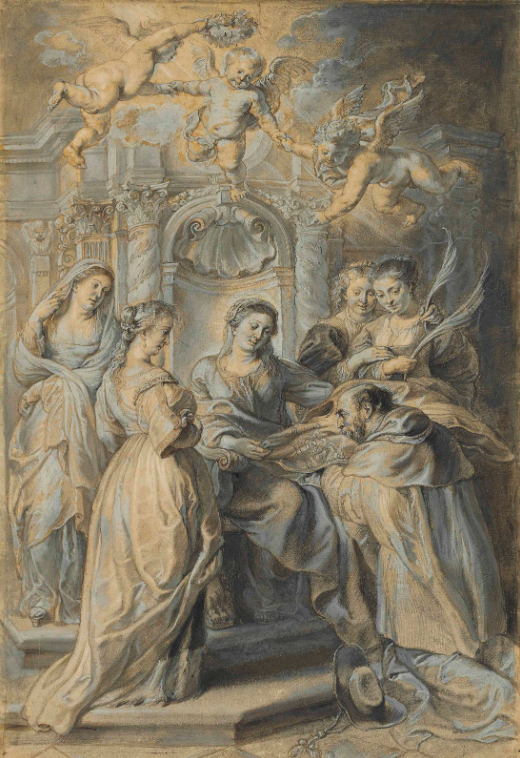
Apart from his engravings, very few original works by Witdoeck are known today. A drawing of the Supper at Emmaus is preserved in the Uffizi, Florence, drawn after a painting by Rubens in the Prado, Madrid, in preparation for an engraving (fig.).6 Another drawing attributed to Witdoeck is thought to have been extensively reworked by Rubens himself, representing Saint Ildefonso Receiving the Chasuble from the Virgin, again preparatory to an engraving, and was on the art market in 2014 (fig.).7 Both drawings show a combination of techniques, as can also be seen in the White Rose Fine Art drawing, which is close in handling to the Uffizi sheet, especially in the execution of the heads of Christ.
The occurrence of the monogram on the newly discovered painting and the relation with the preparatory drawing formerly with White Rose Fine Art make an interesting case for the authorship of Hans Witdoeck, and the oil panel would be his only known painting. Although more finished in execution than oil sketches by his master Rubens, it is clearly influenced by such oil sketches – it could be argued that the painting was executed around the time that Witdoeck started working for Rubens, circa 1635.
1. Pen and brown and grey ink, grey wash, red bodycolour, heightened in white, black ink framing lines, 211 x 220 mm; sold to a private collector.
2. Email correspondence 3 February 2017.
3. Ulrich Thieme and Felix Becker, Allgemeines Lexikon der bildenden Künstler (…), Leipzig 1907–1950, vol. 35 (1947), p. 179.
4. For Witdoeck, see the biography in Saur Allgemeines Künstlerlexikon: die bildenden Künstler aller Zeiten und Völker, Munich 1992- , vol. 116 (2022), p. 501 and Hollstein Dutch and Flemish Etchings, engravings and woodcuts ca. 1450-1700, Amsterdam 1949-2010, vol. 53 (1999), pp. 85-154.
5. See I. Pohlen, Untersuchungen zur Reproduktionsgraphik der Rubenswerkstatt, Munich 1985, pp. 130–40 and pp. 283–301.
6. Black and red chalk, brown ink, 421 x 472 mm, inv. no. 2373 F; Corpus Rubenianum Ludwig Burchard, Brussels 1968 – , vol. VII (1984), pp. 48-52, cat. no. 9.
7. Black and white chalk, pen and black ink, grey wash, heightened with white, 525 x 358 mm; Christie’s, New York, 30 January 2014, lot 29, repr.; B. Py, Everhard Jabach collectionneur (1618-1695): Les dessins de l’inventaire de 1695, notes et documents des museés de France, Paris, 2001, p. 238, no. 1004.