ROELANT ROGHMAN (Amsterdam 1627 – 1692 Amsterdam)
Roelant Roghman (Amsterdam 1627 – 1692 Amsterdam)
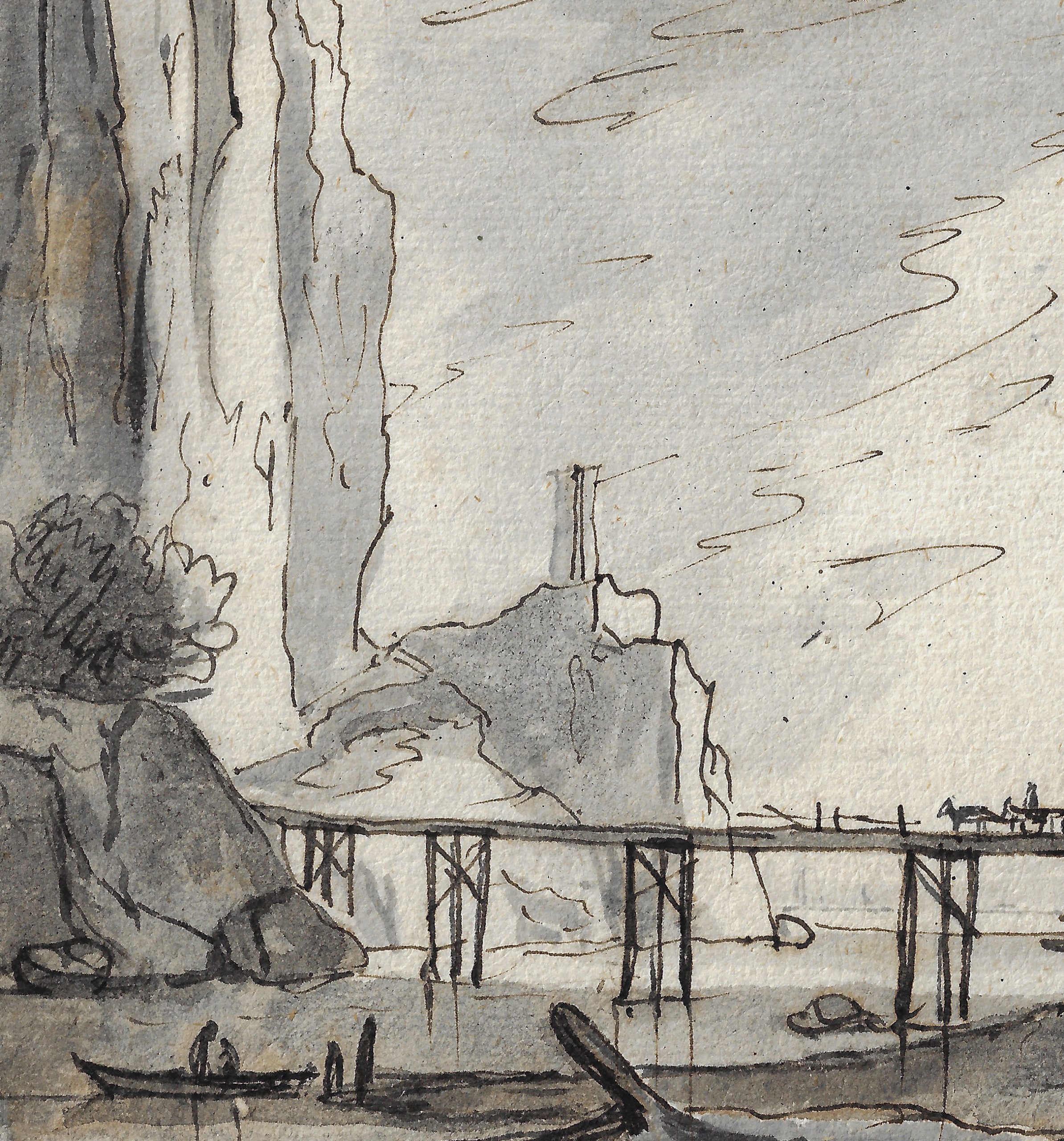
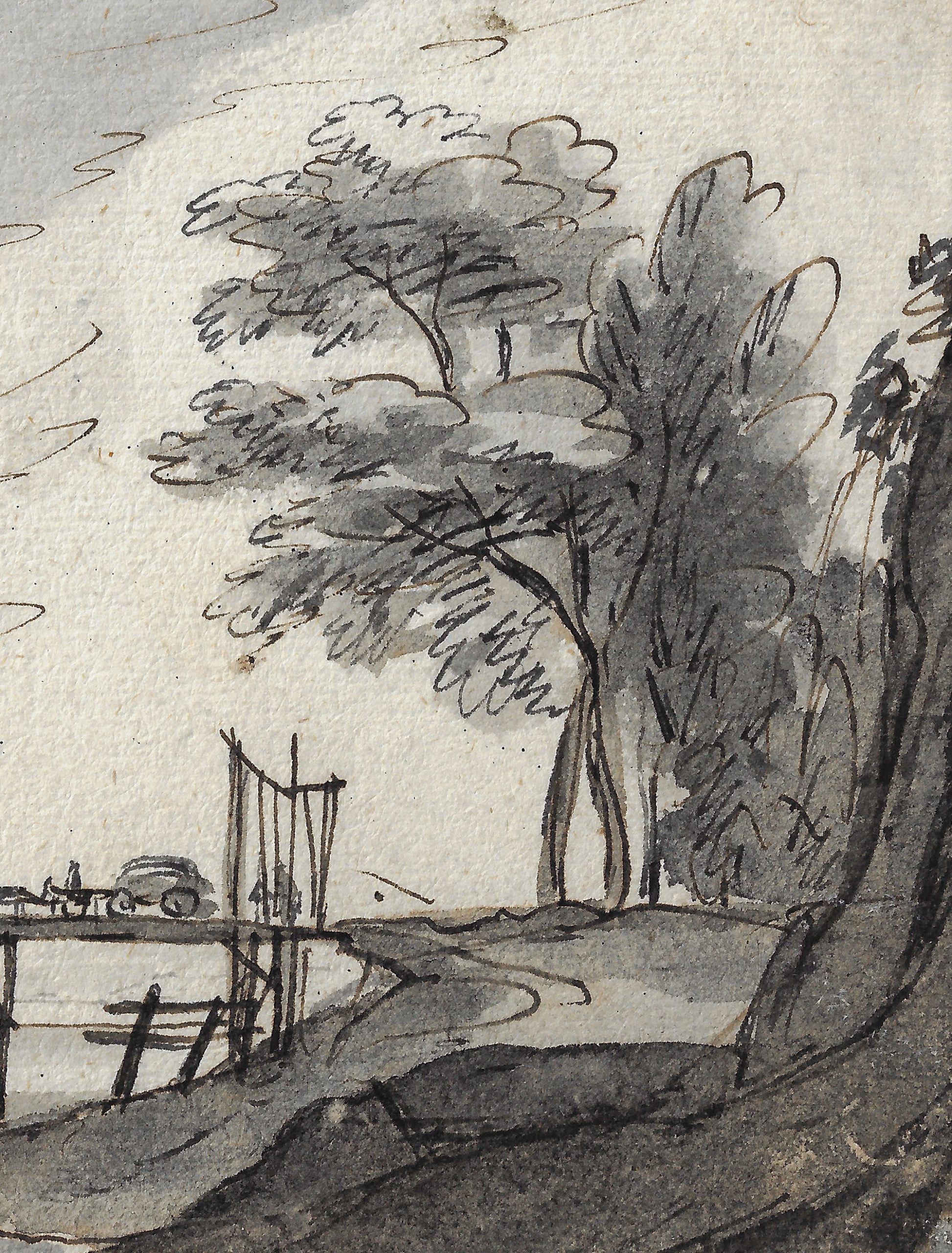
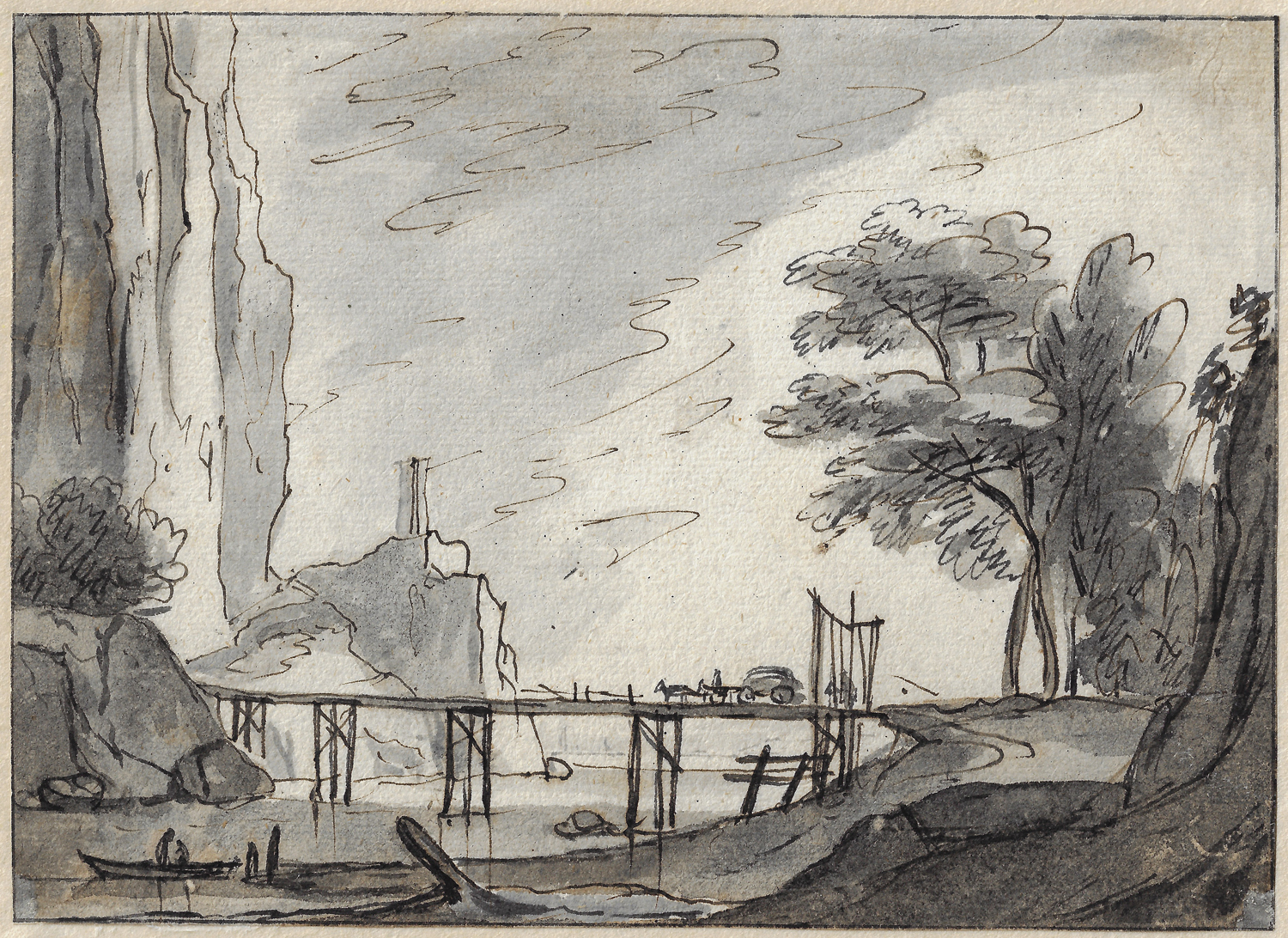
Mountainous Landscape with a Carriage Crossing a Bridge
Pen and black ink, grey wash, traces of black chalk, black ink framing lines, 131 x 182 mm (5.2 x 7.2 inch)
Provenance
~ Collection Jonkheer Johann Goll van Franckenstein (1722–1785) (Lugt 2987, associated number ‘N 3518’ in brown ink on verso)
~ Sotheby Mak van Waay, Amsterdam, 26 April 1983, lot 92, repr.
~ Collection George und Maida Abrams, Boston
~ With Robert Noortman, Maastricht, where acquired by:
~ Private collection, Germany, until 2025
Literature
Werner Sumowski, Drawings of the Rembrandt School, New York 1992, vol. 10, pp. 5096-97, cat. no. 2257ax.
***
Roelant was born as the son of Hendrick Lambertsz Roghman and Maritje Savery, daughter of the painter Jacob Savery I.1 Roelant’s sisters Geertruyd and Magdalena also became artstis, as did his cousin, Roelant Savery. Roelant had his first lessons in drawing and engraving from his father, who was an engraver. He was only eleven years old when his great-uncle Roelandt Savery died at Utrecht and the assumption of teaching by his great-uncle seems a bit far-fetched. He continued his studies in the workshop of his townsman Rembrandt, and is one of the latter’s lesser known pupils.
Roghman is first known by a remarkable series of drawings he did in 1646 and 1647 of the castles and manor houses in the provinces of North and South Holland, Utrecht and Gelderland, possibly commissioned by Adriaan Pauw.2 No dated paintings are known but it should be remembered that most of his engravings depict Dutch landscapes. The first sign of mountains comes in a drawing, signed and dated 1654, of an Alpine landscape preserved at Rotterdam. In Augsburg he drew a village landscape on 30 August 1657 and another drawing is known with the inscription ‘gedaen in Oûisborgh 1657 den 9 ijûnij’ (made in Augsburg June 9 1657).3 In the same year the Augsburg publisher Jeremias Wolff published eight engravings of Roghman with mountain landscapes. To all appearances he travelled in those years, probably mostly in Tyrol like his great-uncle Savery had done.
In his report about Roghman, Houbraken erred in a major way about the life data; but he had seen the drawings of the castles, he did mention the connection via Gerbrand van den Eeckhout with Rembrandt and he quoted a dictum by Roghman that ‘by the time one gets to know, one is worn’ (‘als men de dingen komt te weten, is men versleten’).4 Altogether it seems safe to say that his major mountain landscapes will have been painted after his return to Amsterdam in 1658.
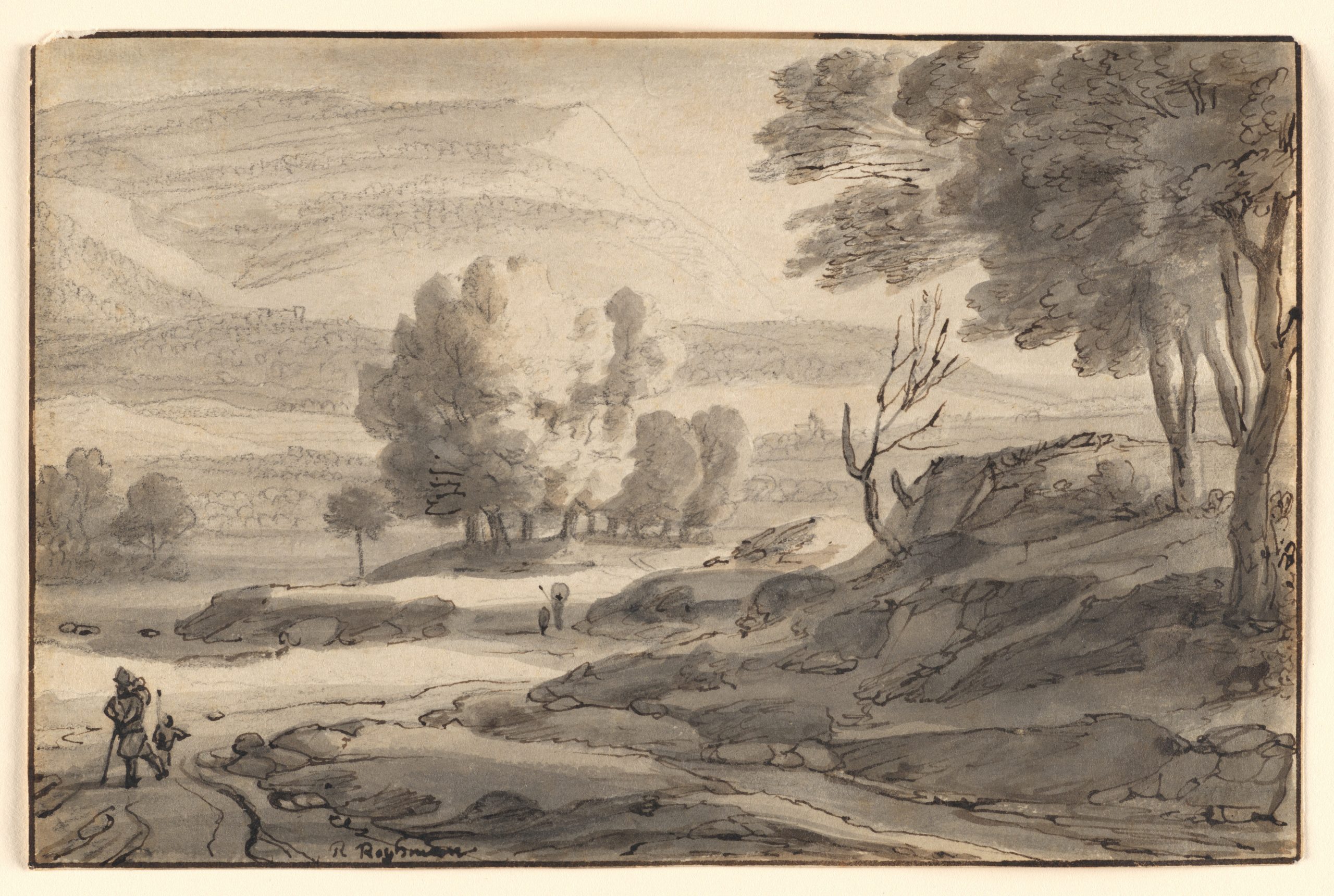
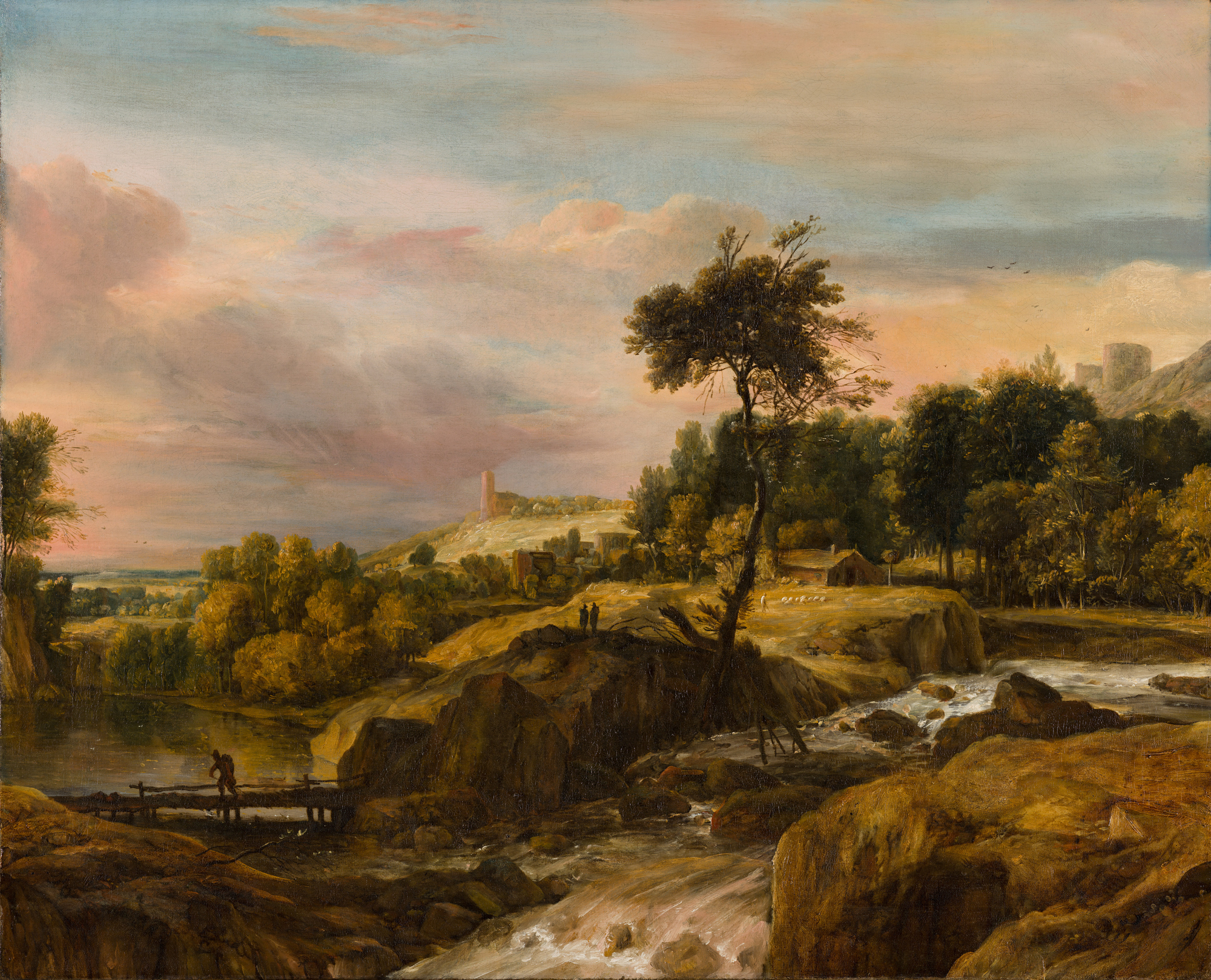
Sumowski noted the ‘impulsive manner’ of our sheet and compared it to a drawing in the Hannema de Stuers Foundation.5 Our powerful drawing can also be compared to Roghman’s sheet Mountainous River Landscape in the Metropolitan Museum, New York (fig.).6 A painting by Roghman with a similar composition of a Wooded Landscape with a Bridge is in the collection of the Mauritshuis, The Hague (fig.).7
1. For the artist, see the biography by I.M. Veldman in Saur Allgemeines Künstlerlexikon: die bildenden Künstler aller Zeiten und Völker, Munich 1992- , vol. 99 (2018), p. 256 and W.H.M. van der Wyck and W. Kloek, De kasteeltekeningen van Roelant Roghman, Alphen aan den Rijn 1989-1990, 2 vols.
2. Van der Wyck and Kloek, op. cit.
3. Van der Wyck and Kloek, op. cit., p. 2. See also Horst Gerson, Ausbreitung und Nachwirking der holländischen Malerei des 17. Jahrhunderts, Amsterdam 1983 (reprint of 1942 edition), p. 49.
4. Arnold Houbraken, De groote schouburgh …, The Hague 1718-1721, vol. 1 (1718), p. 173-174; vol. 2 (1719), p. 8, vol. 3 (1721), p. 358.
5. Werner Sumowski, Drawings of the Rembrandt School, New York 1992, vol. 10, pp. 5096-97, cat. no. 2257ax (our drawing) and 2258x (Hannema de Stuers Foundation).
6. Pen and brown ink, grey wash, 153 x 234 mm, inv. no. 1975.1.807. https://www.metmuseum.org/art/collection/search/459333
7. Oil on canvas, 83 x 102.3 cm, inv. no. 1124.