DANIËL MAROT (Paris c.1661 – 1752 The Hague)
Daniël Marot (Paris c.1661 – 1752 The Hague)
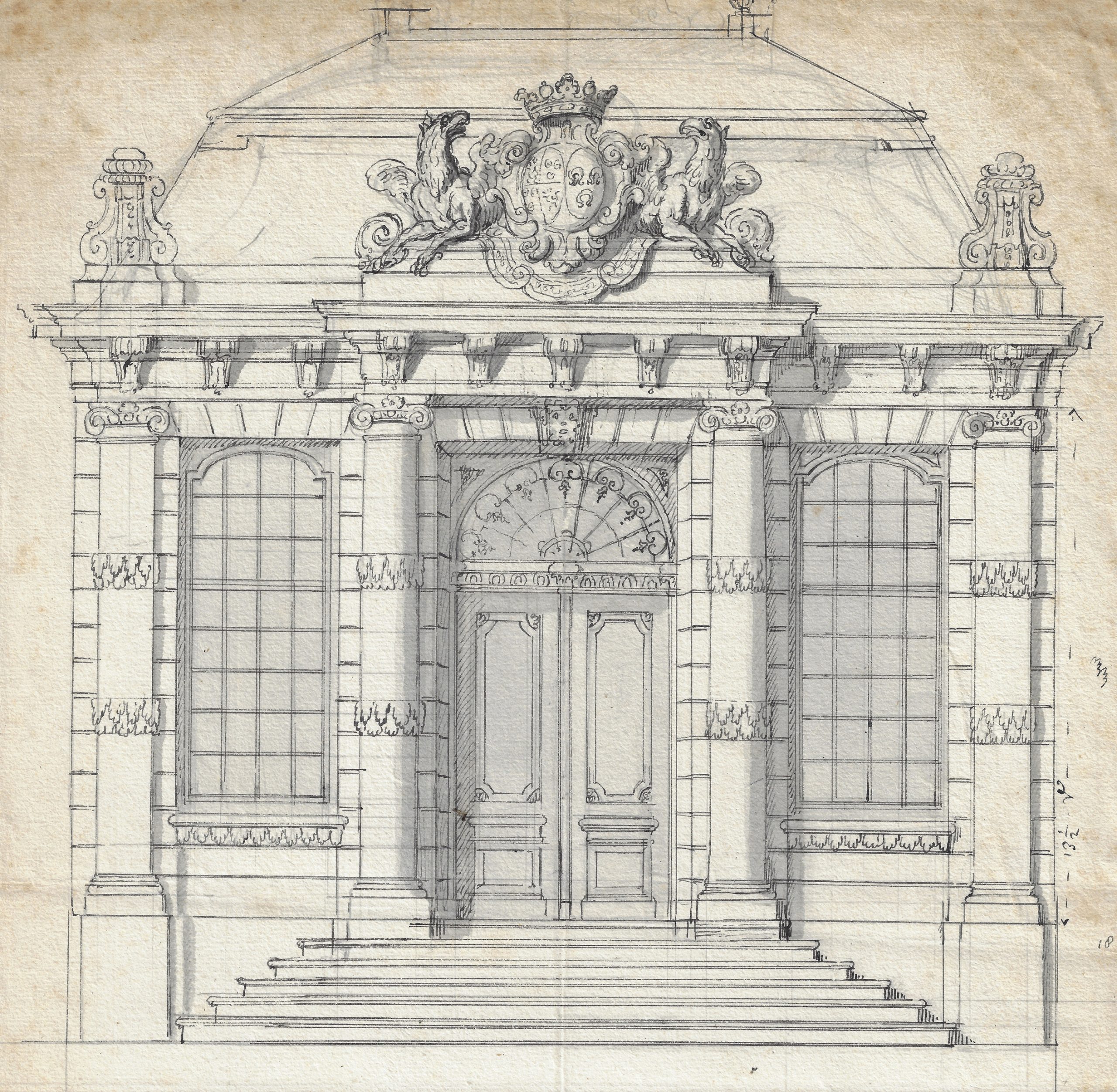
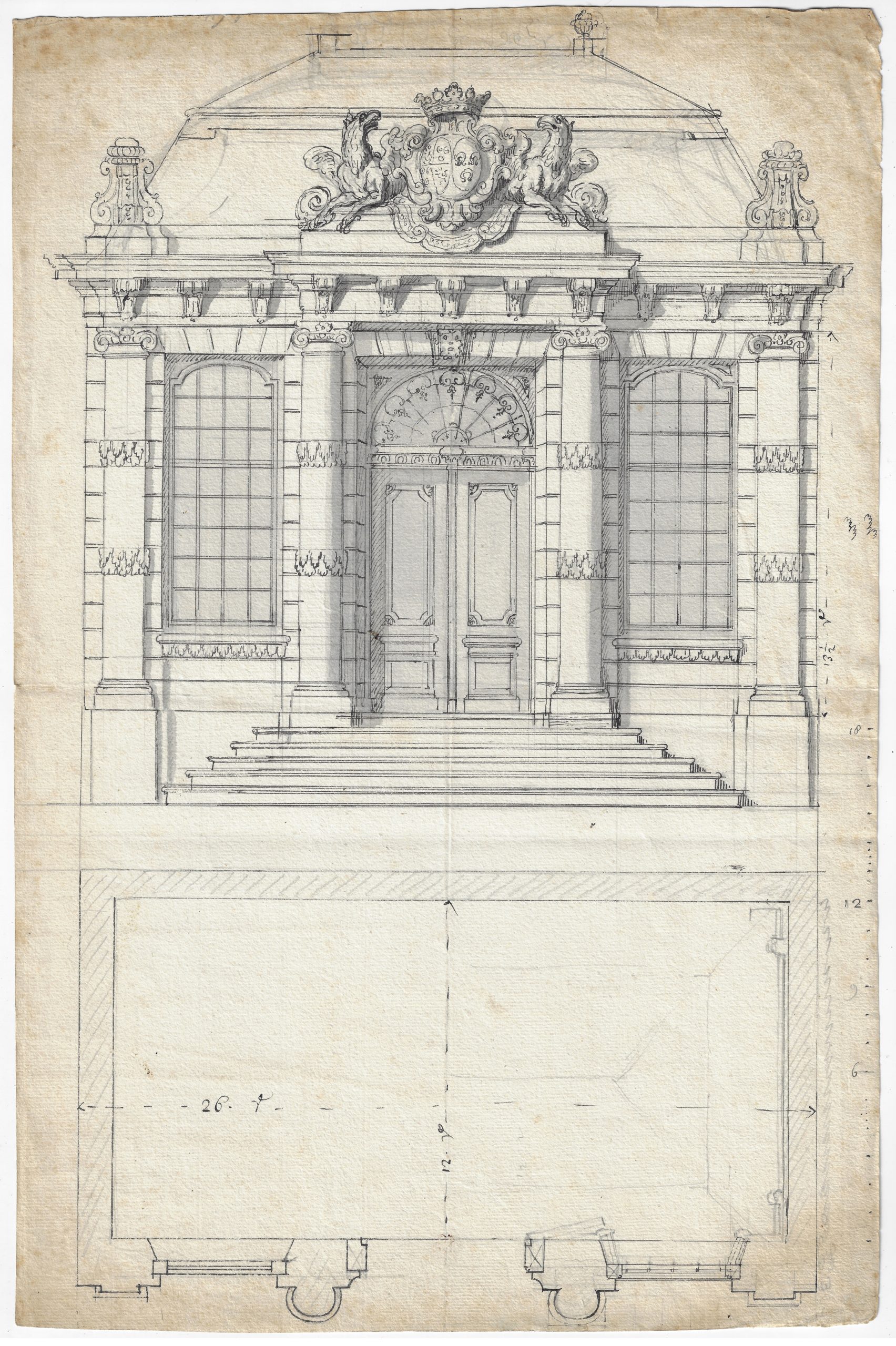
Design for a Garden House
Graphite, pen and grey ink, grey wash, countermark ‘CDC’ (?), 425 x 278 mm (16.7 x 10.9 inch)
Annnotated with various measurements in pen and grey ink
Provenance
Private collection, Germany
***
This recently discovered design for a garden house is an important addition to the drawn oeuvre of Daniël Marot, the architect and designer who was at the forefront of the Late Baroque Louis XIV style in Holland and England in the early years of the eighteenth century, specialising in architecture, interior architecture, gardens, furniture and decorative arts.1
Daniël was born into a family of artists and craftsmen. His grandfather, Girard Marot, was a cabinetmaker and his father, Jean Marot was named architect of King Louis XIV. Jean Marot is well known today for his contribution to seventeenth-century French architecture. In 1686, Daniël assisted his father with the publication of the Grand Marot, a series of 185 prints that undoubtedly served as an important educational tool for the young designer. Daniël Marot spent the first years of his career in France working with the most prominent figures in interior and garden design, and architecture. Some of his early influences include the engravings of Jean Le Pautre, a French designer and engraver who worked at the Gobelin manufactory, and André-Charles Boulle, the famous cabinetmaker to Louis XIV, for who he designed amongst others bracket clocks. By 1680, Marot had become one of the leading designers of his time.
In 1685, his career took an international turn, when he was ordered to emigrate to the Netherlands because of his Huguenot Protestant religion. Under Louis XIV’s new law revoking the Edict of Nantes, Catholicism was the only tolerated religion in France. In Holland, Marot was commissioned to design apartments at Slot Zeist for the cousin of Willem III of Orange and a former ambassador of France. He was then hired by the Stadtholder himself who entrusted him with the design of the Het Loo interiors. In 1689 he was working for Willem in London, who had by then become King of England by marrying Mary Stuart, and he was rewarded one prestigious commission after the other by the monarchs and their courtiers. The genius of Marot lies in his ability to adapt the French style for the Dutch interior, using a unique and luxurious Baroque expression.
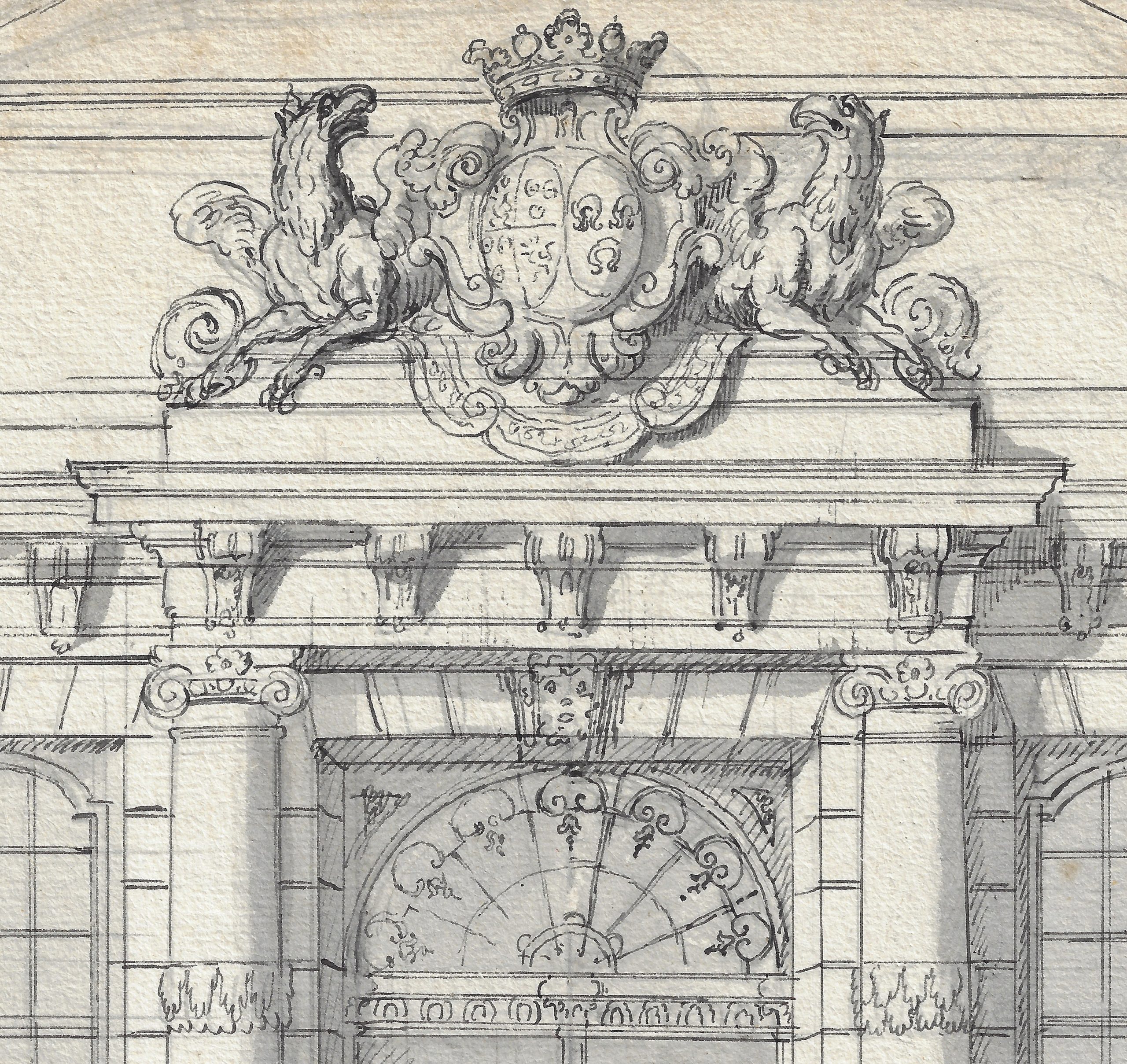
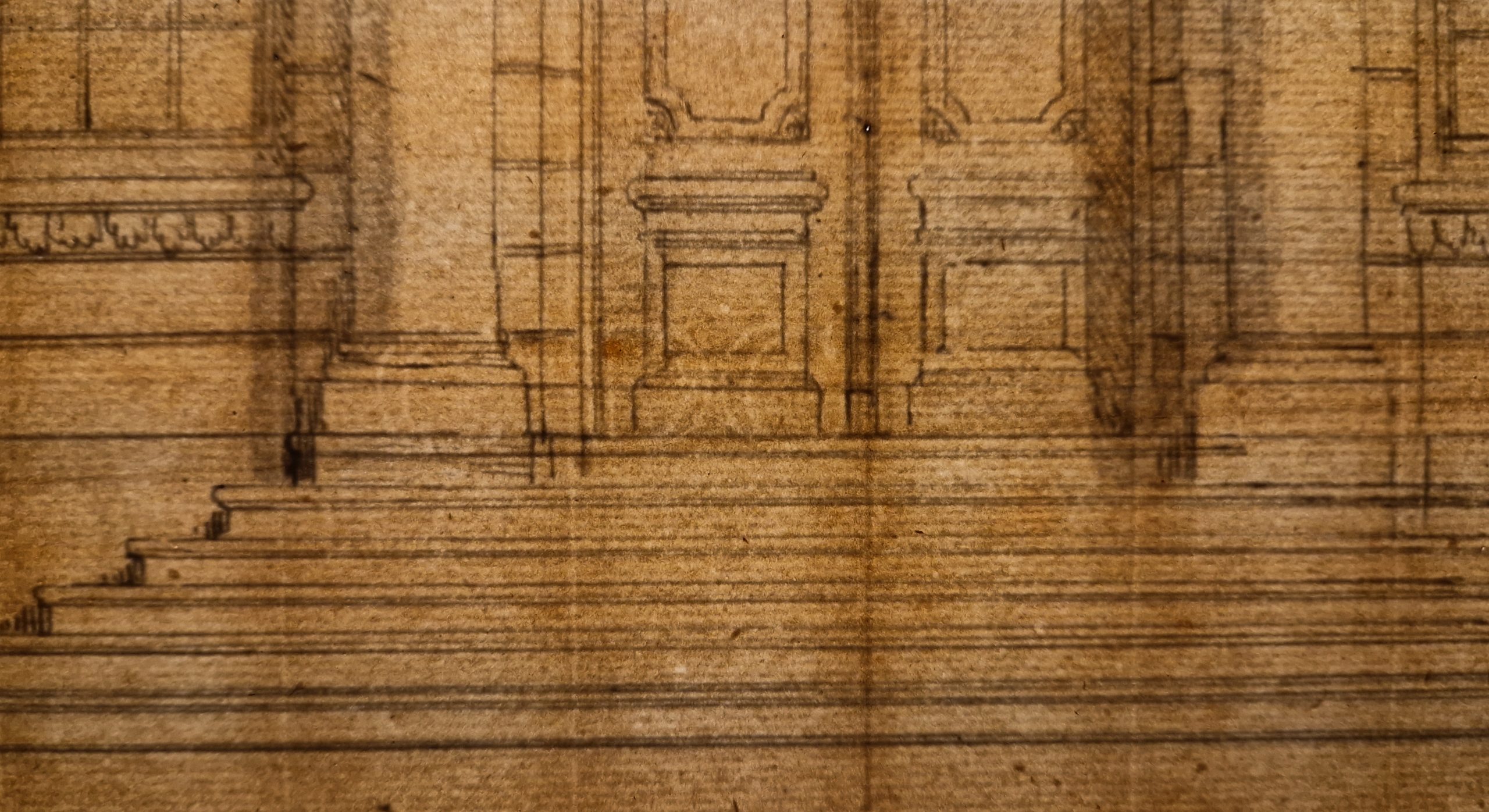
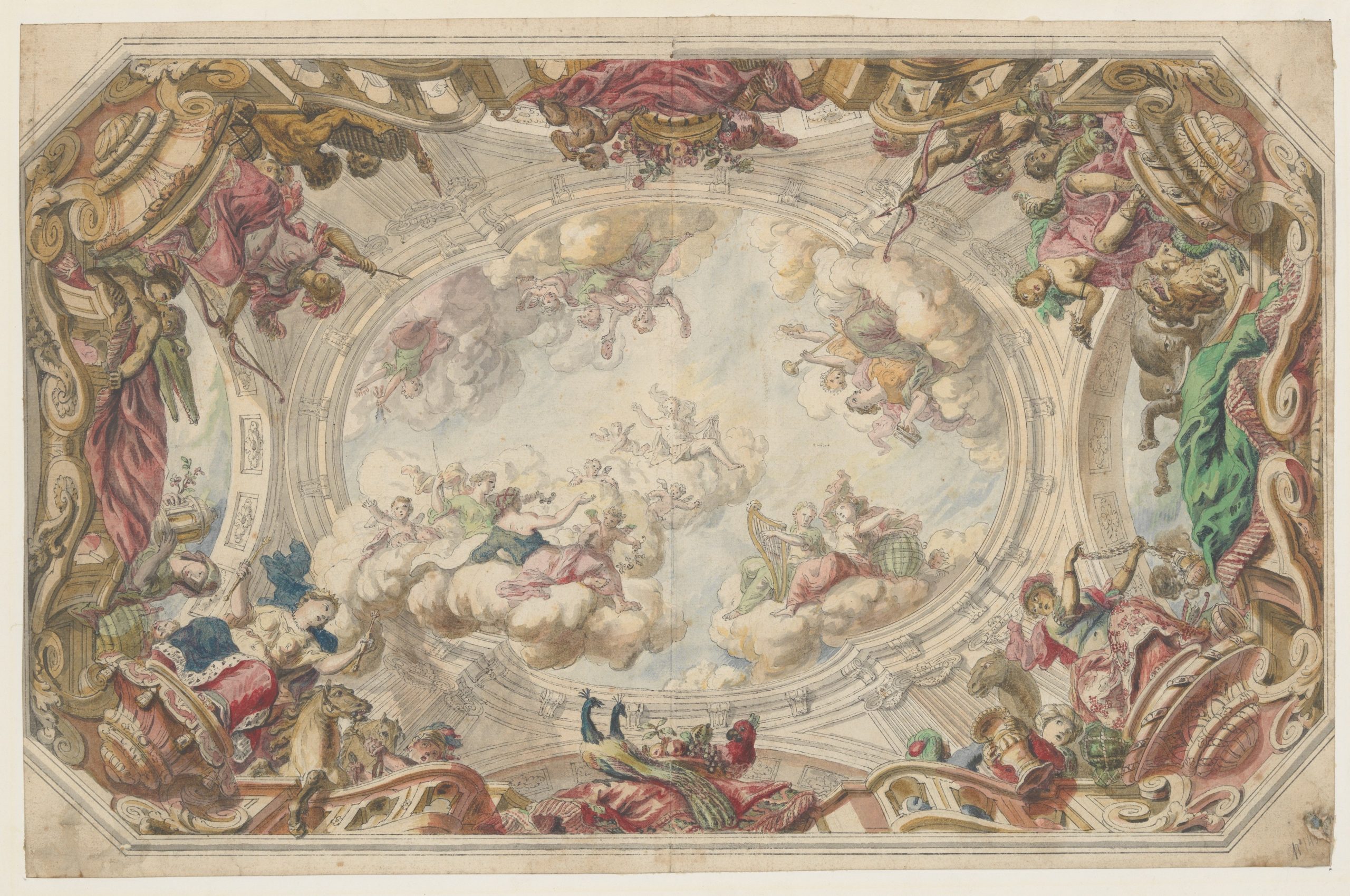
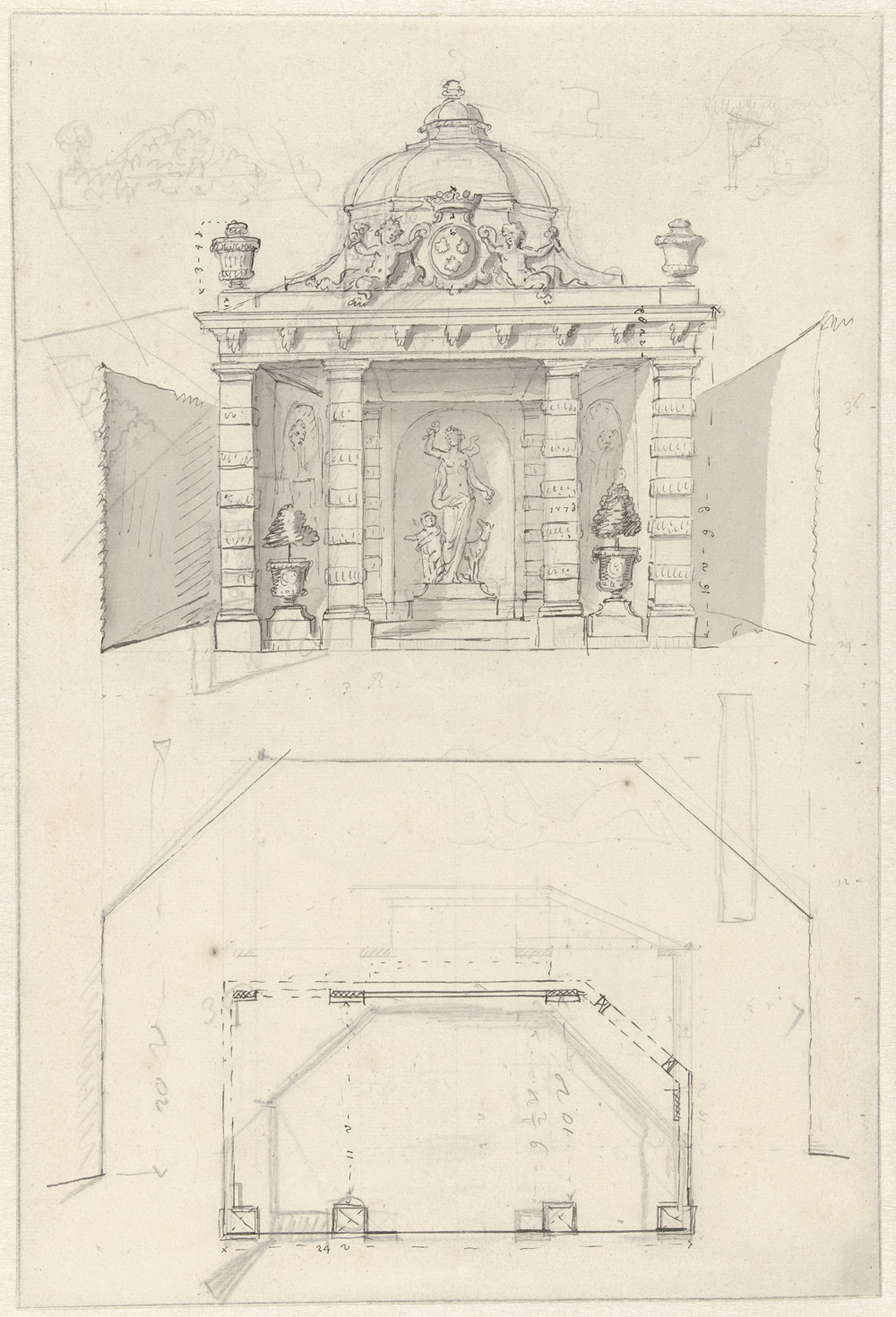
Few original drawings by Marot have survived, mostly highly finished and frequently coloured designs intended for as modellos for presentation to potential clients, such as the watercolour Design for a Ceiling in the Metropolitan Museum, New York (fig.).2 For many of these finished drawings it can be presumed that Marot’s large and active workshop probably had a share in the execution, and that therefore they are possibly not wholly by the hand of Marot. The present drawing however is a working design, in which architectural decisions are still being worked out, such as the shape of the roof and the wainscoting and shutter cupboards, quickly worked out in graphite or pencil, and then the finished version is drawn in pen and ink. These creative changes can only be by Marot himself, thus giving a unique insight into his working methods and creative thought processes. Very few of such creative designs have survived, an exception being Marot’s drawing Design for a Garden Pavilion with the arms of the Van Keppel family in the Rijksmuseum, which also shows changes to the curvature of the roof (fig.).3
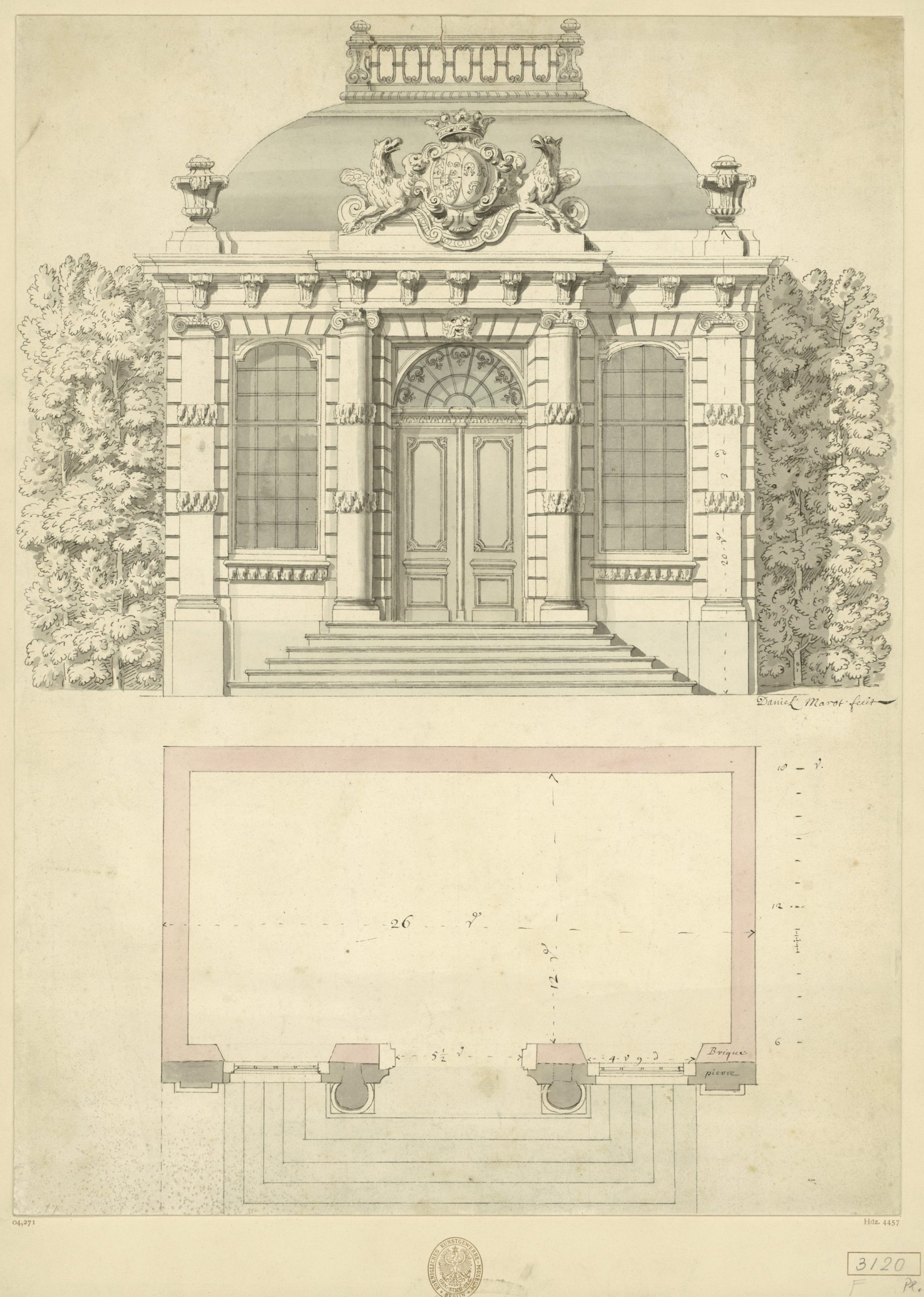
A finished ‘modello’ version of our design is preserved in the collection of the Staatliche Museen in Berlin (fig.).4 The signature ‘Daniel Marot fecit’ on the Berlin drawing also indicates it was intended for presentation to a client. Although the crest on the architrave includes an alliance coat-of-arms of husband and wife, it has thus for not been possible to identify the clients,5 and as no architectural building of corresponding form survives, it is not clear if the design was ever executed.
1. For the artist, see K. Ottenheym (ed.), Daniel Marot. Vormgever van een deftig bestaan, Amsterdam/Zutphen 1988, and the upcoming monograph by Doris Hattink, Eloy Koldeweij and Richard Harmanni, Daniel Marot: ontwerper voor paleizen, kastelen en buitenplaatsen, Zwolle 2026 (expected in September 2026).
2. Pen and grey ink, brown, grey, and coloured wash, 316 x 479 mm, inv. no. 1971.513.48, Mary L. Myers, French Architectural and Ornament Drawings of the Eighteenth Century, exh. cat. New York (The Metropolitan Museum of Art) 1991, cat. no. 71, pp. 116-117, repr.
3. Pen and grey ink, grey wash, graphite, 352 x 238 mm, inv. no. RP-T-1897-A-3466.
4. Pen and grey ink, coloured washes, 480 x 354 mm, inv. no. Hdz04457.
5. We are grateful to Olivier Mertens for kindly looking into this.