CORNELIS BORSTEEGH (Ameide 1773 – 1834 Gouda)
Cornelis Borsteegh (Ameide 1773 – 1834 Gouda)
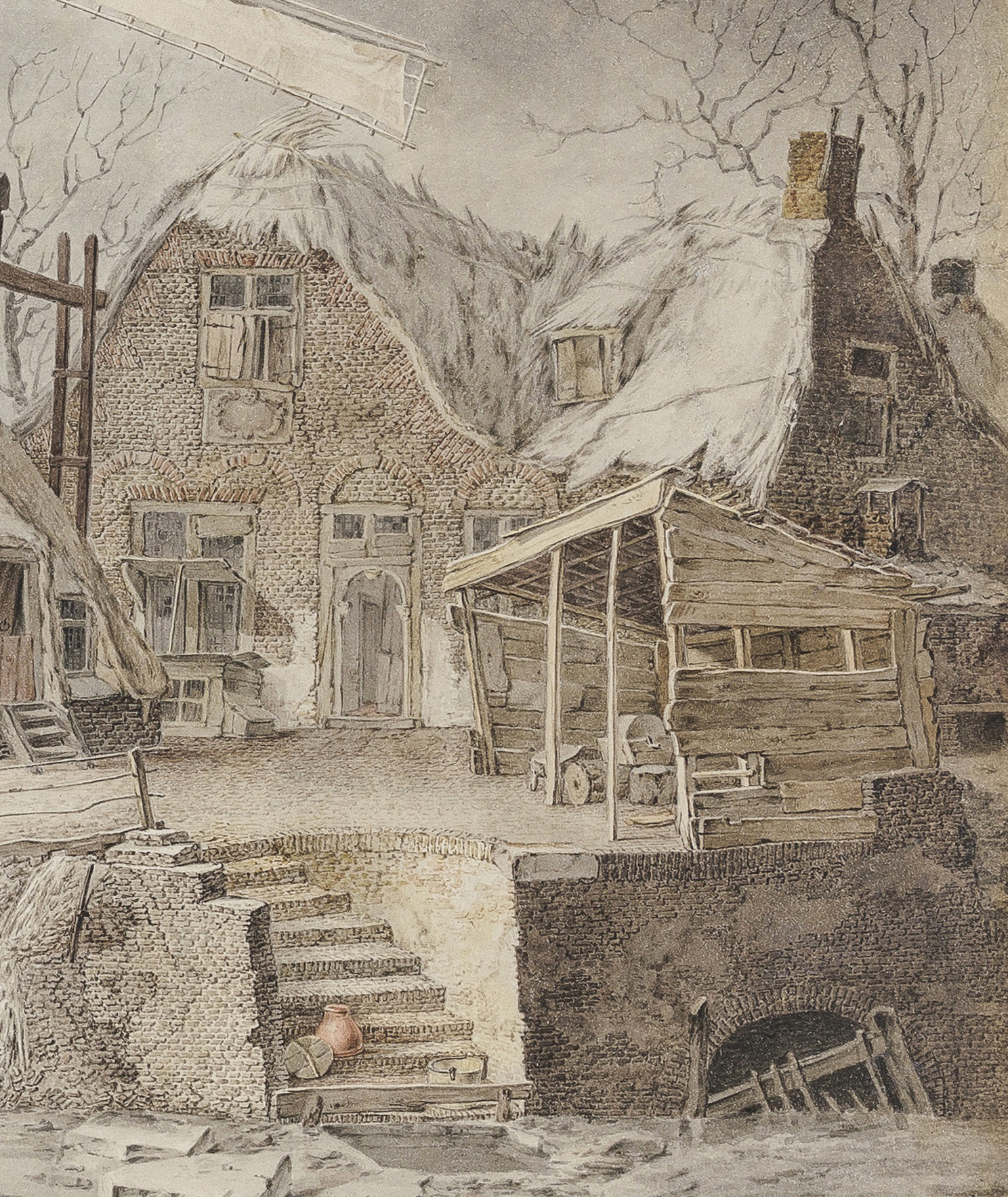
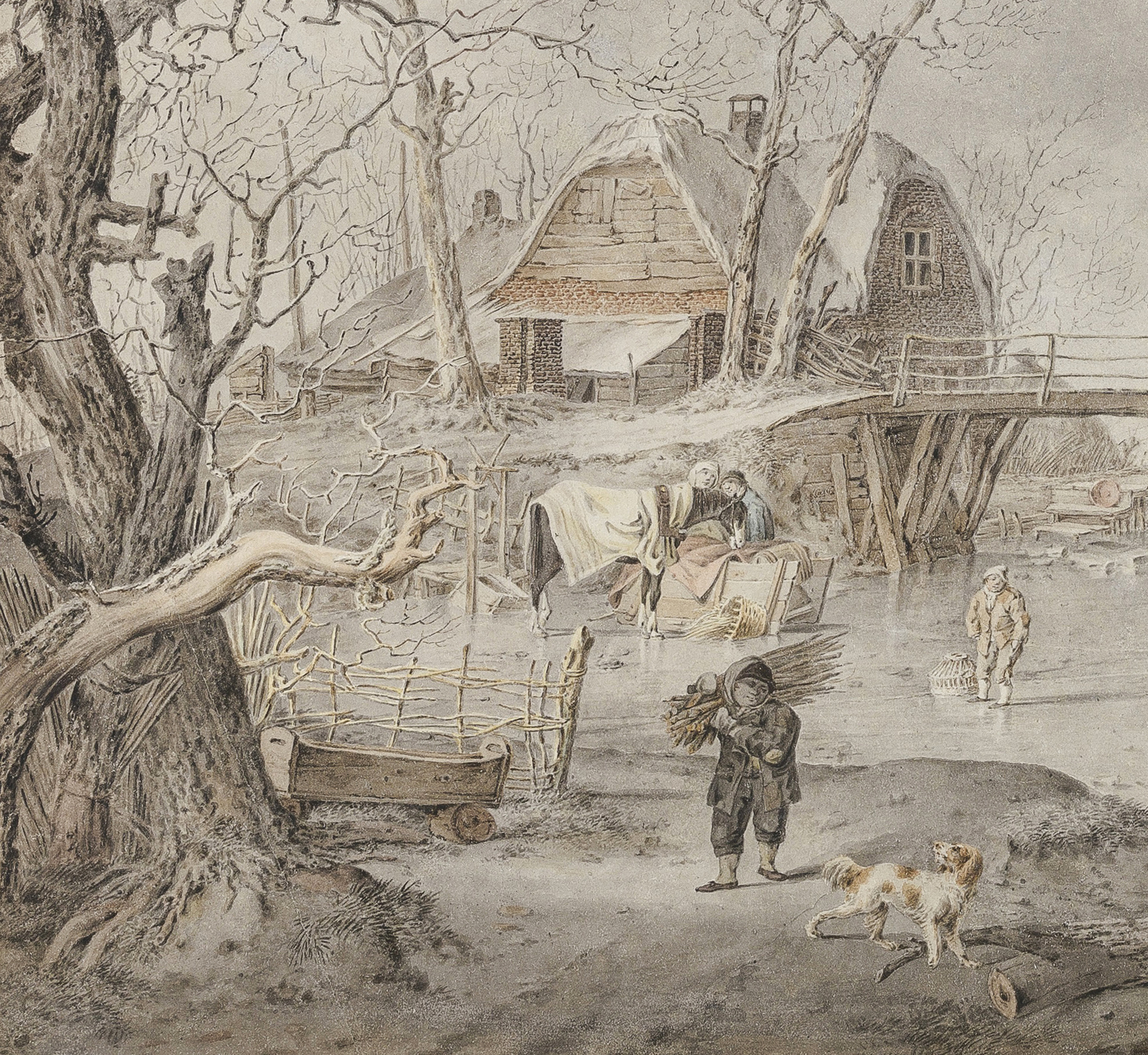
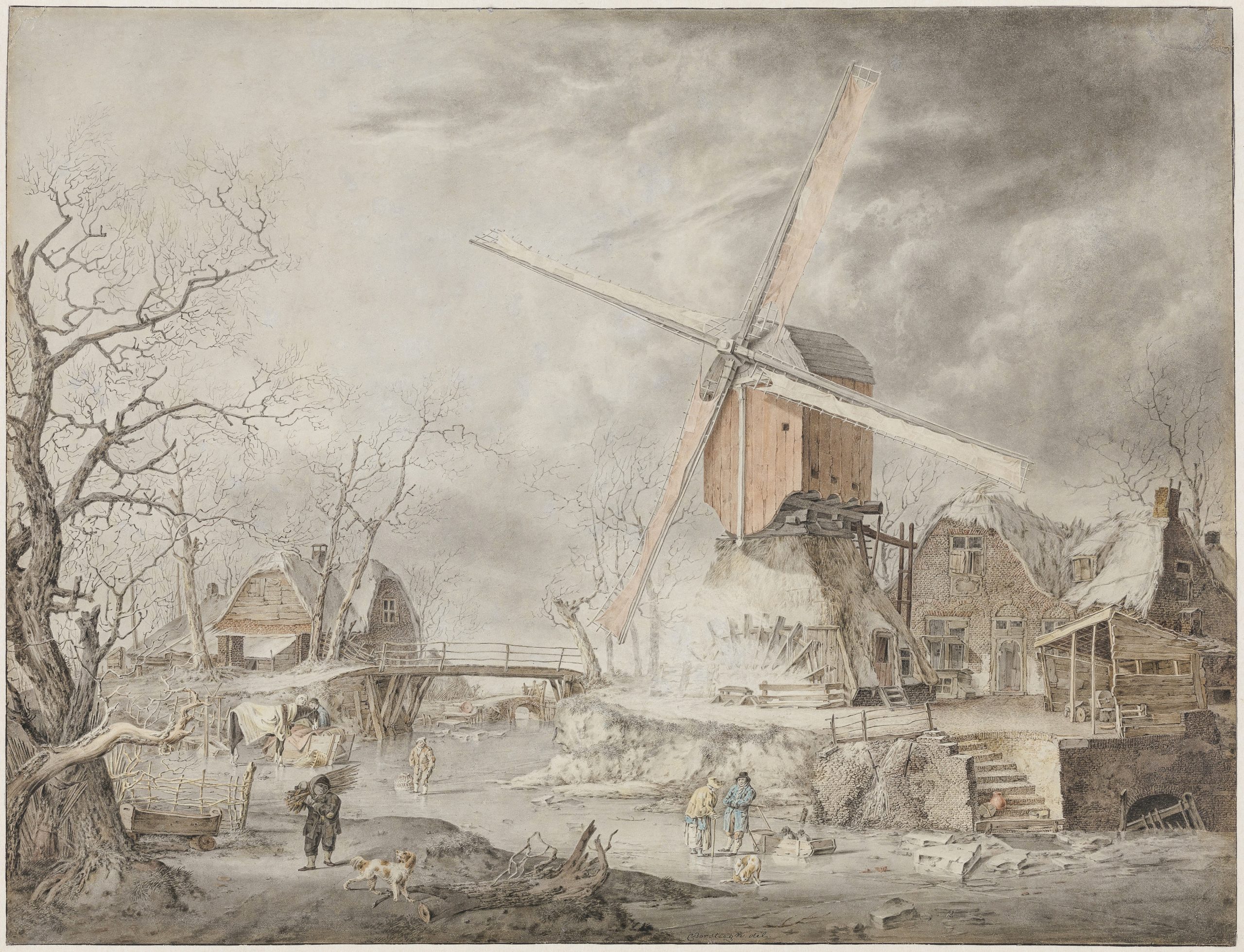
Winter Landscape with Figures on the Ice near a Windmill
Pencil, pen and grey ink, watercolour, black ink framing lines, 468 x 607 mm (18.4 x 23.9 inch)
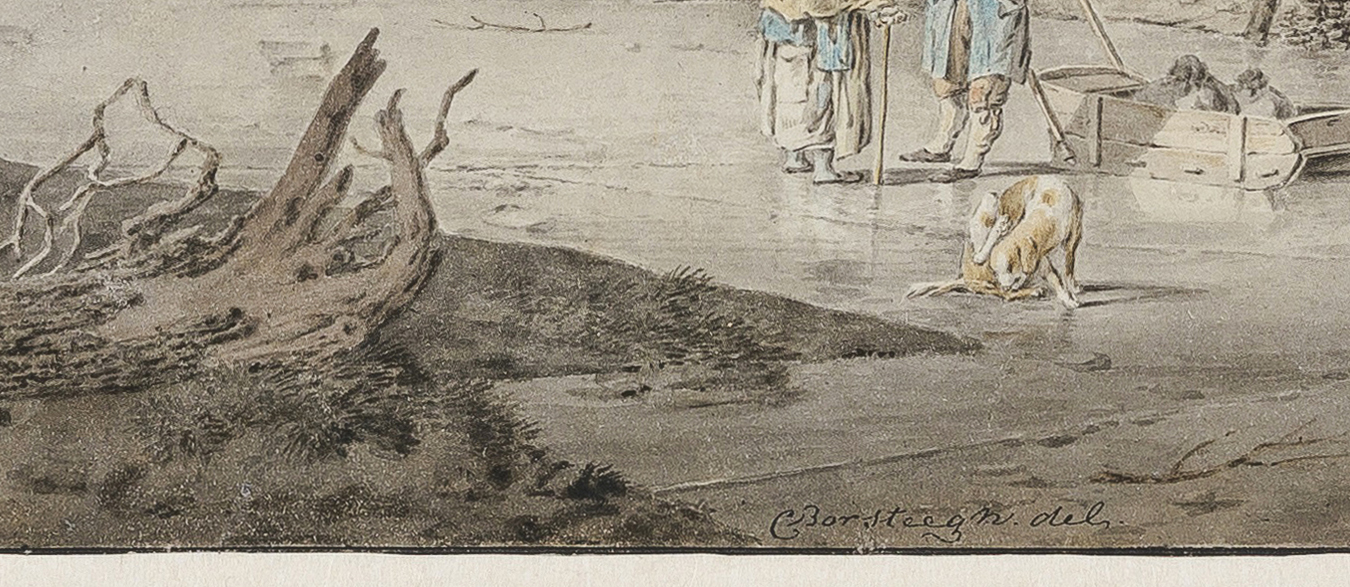
Signed ‘C Borsteegh del.’ (lower centre)
Provenance
~ Anonymous auction, Sotheby Mak van Waay, Amsterdam, 14 November 1983, lot 101, repr. (together with three other drawings of different sizes)
~ Private collection, The Netherlands
***
Born in the small town of Ameide, west of Vianen, Cornelis was the son of Nicolaas Borsteegh, a painter originally from Dordrecht, and Johanna van Es.1 When he was four years old, the family relocated to Gouda, where he would spend most of his life and career. Showing a natural aptitude for the arts, he was originally educated by his father, and then travelled to Amsterdam where he was taught at the Stadsteekenacademie (drawing academy), where he studied alongside other notable Dutch artists of the ara. In November 1800 he married Maria Josepha Smees, and the couple settled in Gouda, where Cornelis was awarded the prestigious position of Stadsteekenmeester (town drawing master) in 1819, responsible for teaching drawing to talented local students and for recording notable local events.
Borsteegh specialised in capturing rural scenes, virtually always painted in watercolours on paper of frequently rather large sizes. A small number of drawings bear topographical annotations on the reverses, indicating that Borsteegh was accustomed to travelling in the picturesque countryside around Gouda, particularly along the Vlist river and towards Woerden.
Drawings by Borsteegh rarely come onto the art market, mainly because his extant works are excessively rare and most are in museum collections: a group of some dozen of his drawings is preserved in his home town, in the Museum Gouda, and a further two drawings are in the Boijmans Van Beuningen Museum in Rotterdam.
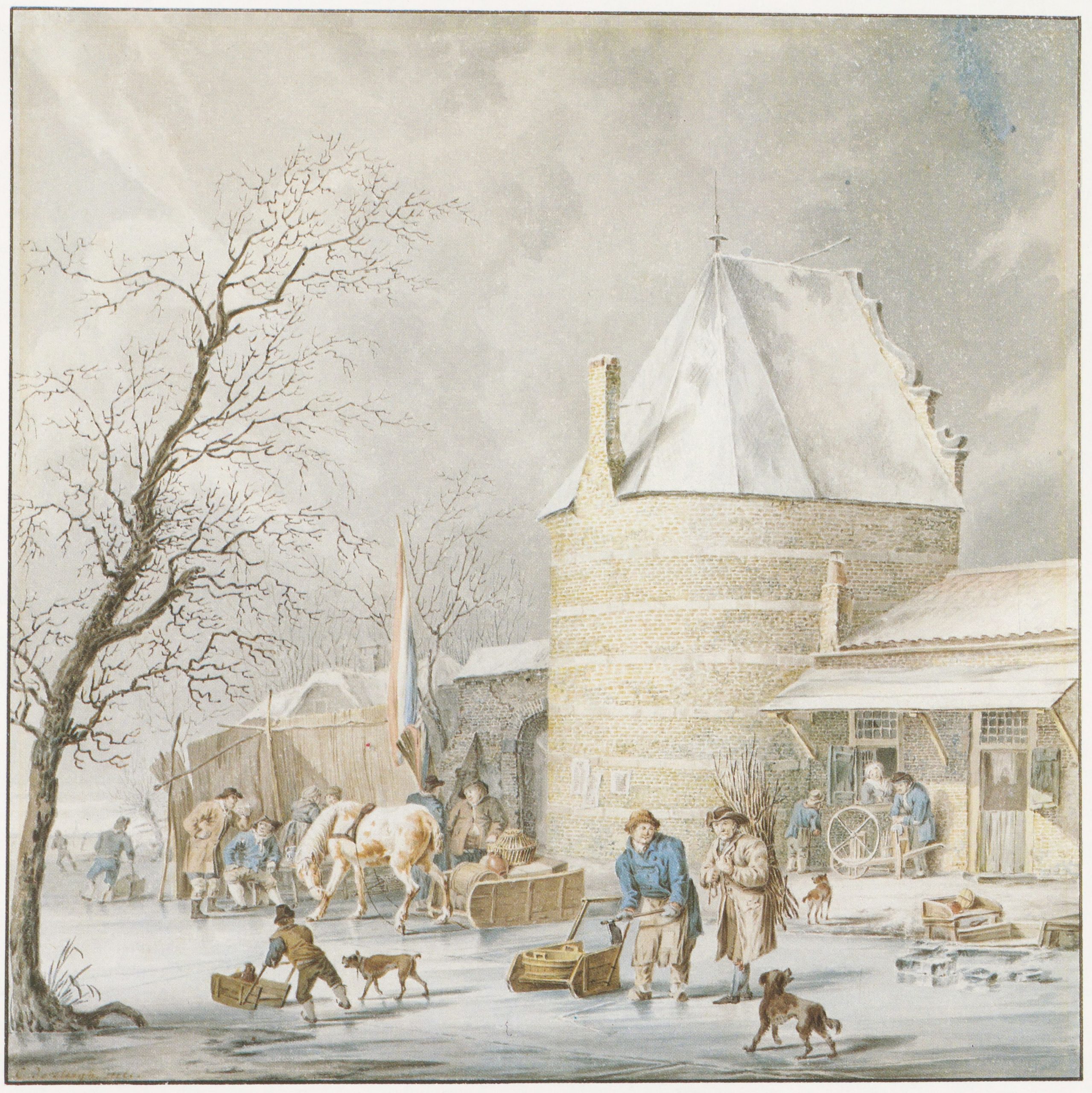
Winter scenes are among the most favoured eighteenth-century drawings, sometimes part of a series of the four seasons or the twelve months of the year. The present drawing is the largest winter scene known by Borsteegh, and two further sheets are extant, including a view of the Veerstalpoort in Gouda in the Boijmans Van Beuningen Museum in Rotterdam,2 and a drawing of the Vlamingpoort in Gouda, formerly on the art market (fig.).3 The present drawing is a particularly fine example of Borsteegh’s draughtsmanship and one of his largest known pieces. When it was offered at auction at Sotheby Mak van Waaij in 1983 it was accompanied by three other sheets, together described as the four seasons, but the three other works are of slightly different sizes and it is unlikely they originally formed a set, so it appears this drawing was made as an independent piece.
Borsteegh has rendered the rural architecture with astonishing detail, to the extent that nearly every brick of the seventeenth-century farmhouses has been individually delineated. The focal point of the composition is a wooden mill, known as a ‘wipmolen’ in Dutch – the addition of the watermill at lower level was intended for maintaining steady water levels in the Dutch cultivated ‘polder’ landscape, created from swamps. The mill in the present watercolour closely resembles the ‘Middelste Molen’ mill in the village of Cabauw, built in 1773, equidistant between Gouda and Vianen, and it is very possible that it served as Borsteegh’s model (fig.).4 Another ‘wipmolen’ of c.1600, not quite as similar as that at Cabauw, is located at Bonrepas, also near Gouda.5 Farmhouses of the type can still be encountered in villages near to Cabauw today, such as Benschop, Polsbroek and Polsbroekerdam. However, even if the houses shown in the present drawing may be based on actual buildings, it is likely that Borsteegh has assembled these realistic elements in a composition of his own design, as was customary during the period. Although the stream is frozen and there are figures with a sledge, it is noteworthy that there are no skaters, who appear in most other winter scenes of the period – one can only speculate why, but it is possible that they were less normal than thought today, and their absence adds to Borsteegh’s realism.
1. For the artist, Johannes Immerzeel Jr, De levens en werken der Hollandsche en Vlaamse kunstschilders (…), 2 vols., Amsterdam 1842-42, vol. 1 (1842), p. 77 and Pieter A. Scheen, Lexicon Nederlandse beeldende kunstenaars, 1750-1880, The Hague 1981, p. 60.
2. Pencil, pen and grey ink, watercolour, 460 x 585 mm, signed ‘C. Borsteegh’, Museum Boijmans van Beuningen, Rotterdam; exhib. cat. Nederland bouwt in baksteen, Rotterdam, Museum Boijmans Van Beuningen, 1941, cat. no 1, repr.
3. Pencil, pen and grey ink, 268 x 268 mm, signed ‘C. Borsteegh’ and apparently dated 1800; anonymous auction, Glerum, The Hague, 31 January 1994, lot 78, repr. (colour).
4. See Rob Alkemade and Erik Stoop, De middelste molen bij Cabauw: vijfhondervijftig jaar molens in het waterschap Lopik, Lopikerkapel en Zevenhoven, Bussum 2004.
5. https://www.molendatabase.nl/molens/ten-bruggencate-nr-01475.