PIETER JANSZ (Amsterdam 1612 – 1672 Amsterdam)
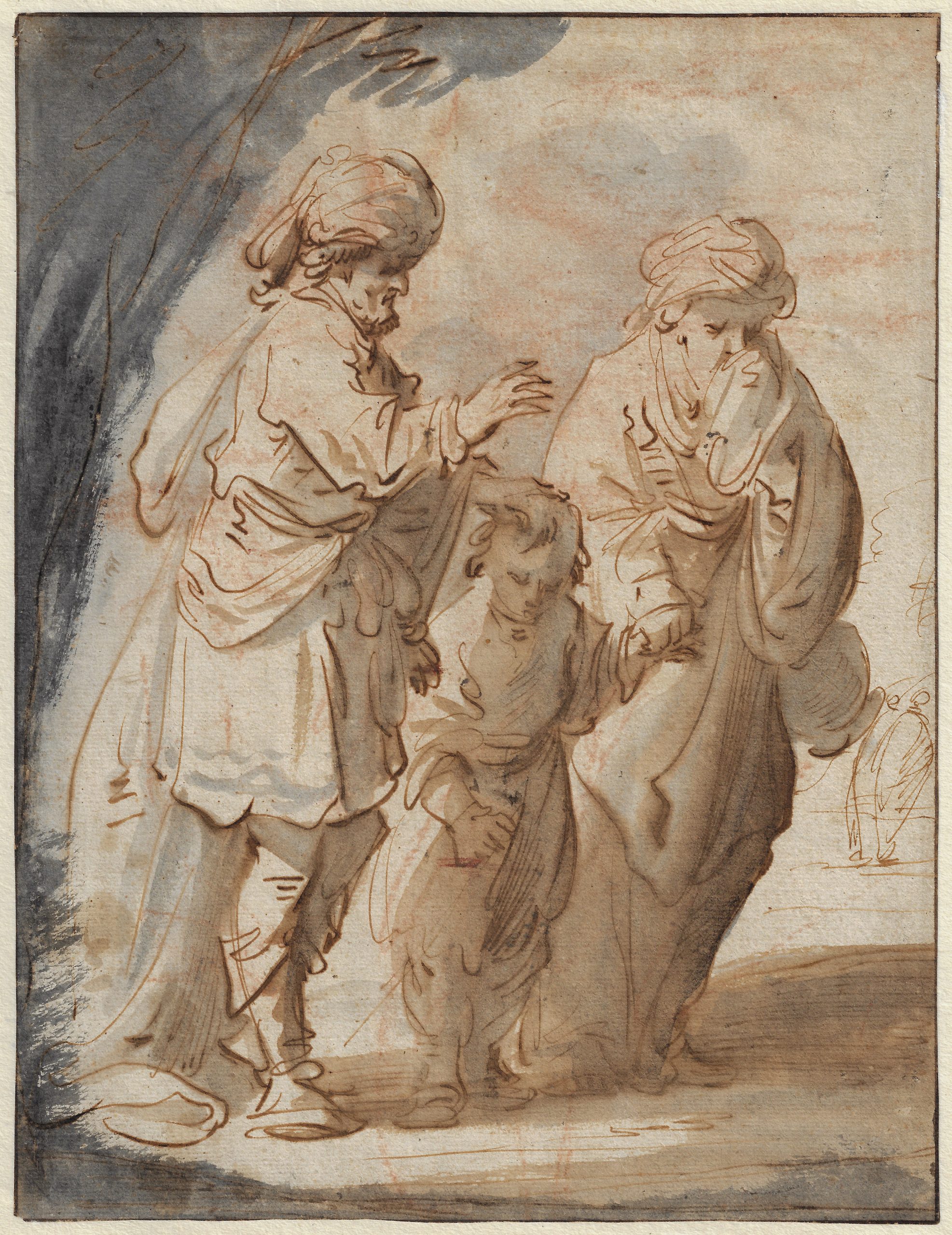
Pieter Jansz (Amsterdam 1612 – 1672 Amsterdam)
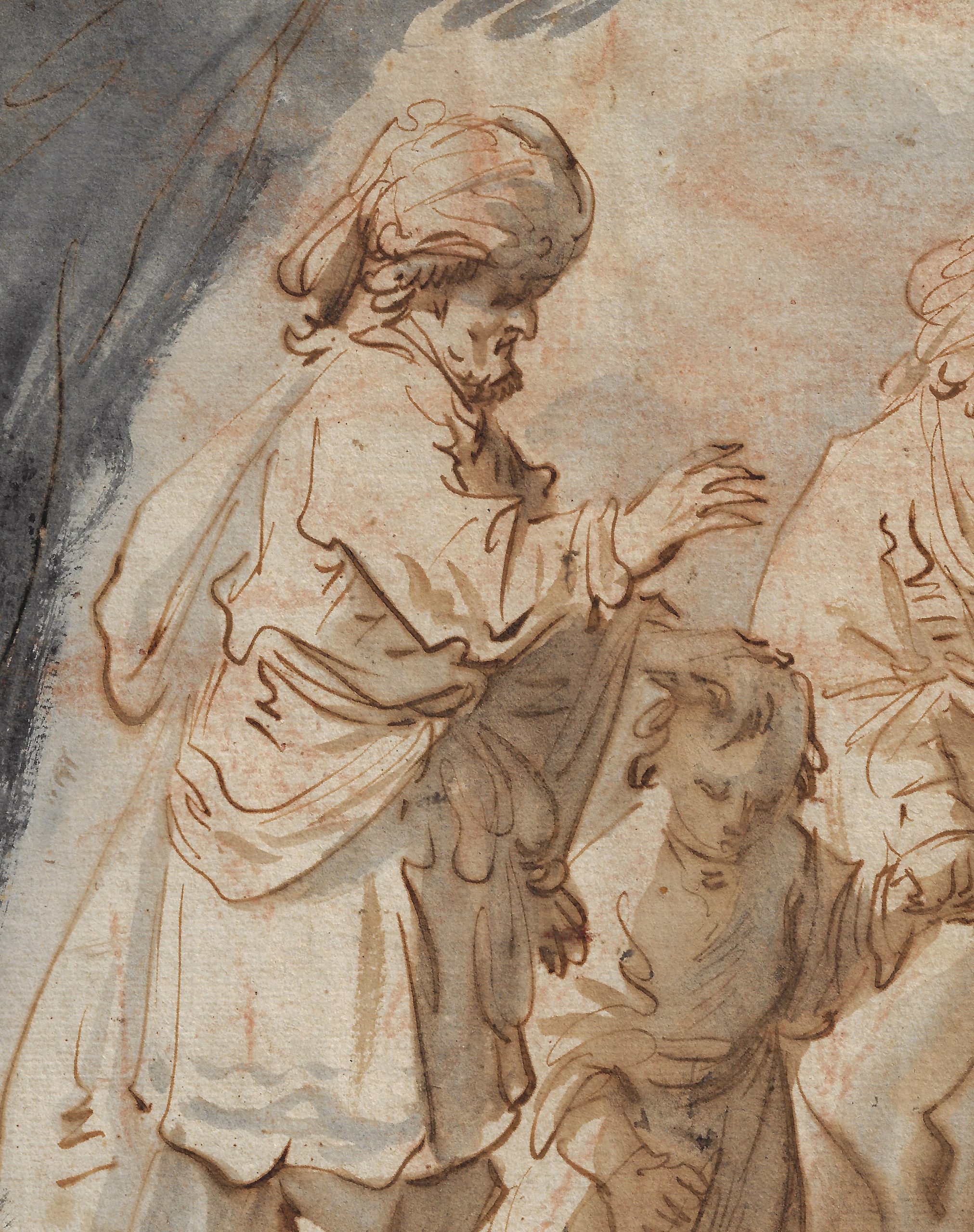
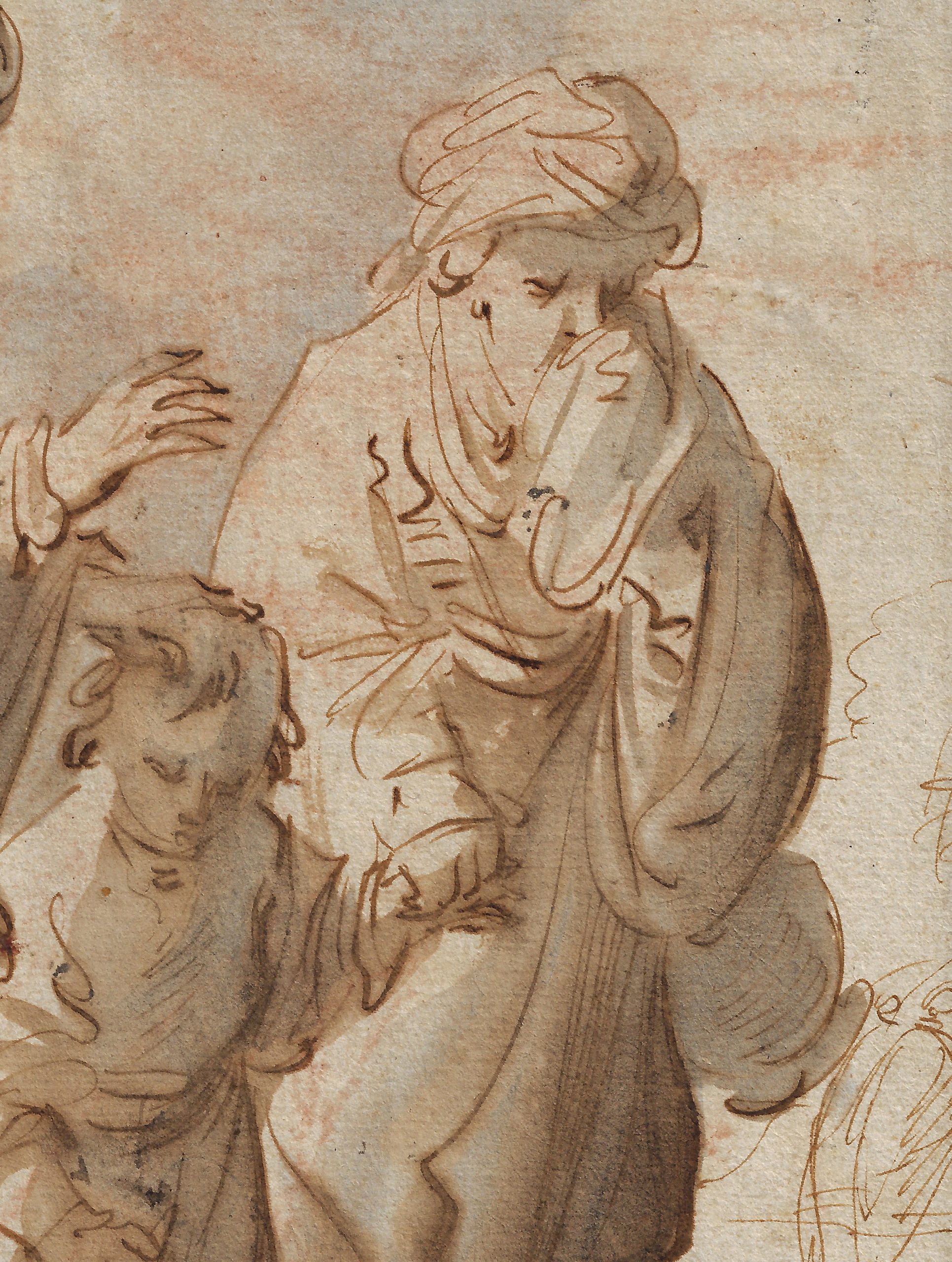
Abraham Banishing Hagar and Ishmael
Pen and brown ink, grey wash, traces of red chalk, brown ink framing lines, fragmentary watermark grapes (?), 253 x 193 mm (10 x 7.6 inch)
Provenance
~ Collection Bernard Houthakker (1884–1963) (Lugt 1272) (as Pieter Lastman)
~ Sotheby Mak van Waay, Amsterdam, 17/18 November 1975, lot 183, repr. (as Pieter Lastman)
~ Sotheby’s, Amsterdam, 14 November 2006, lot 69, repr.
Literature
~ K. Bauch, ‘Entwurf und Komposition bei Pieter Lastman’, in: Münchner Jahrbuch der bildenden Kunst, vol. VI, 1955, p. 217
~ W. Sumowski, ‘Zeichnungen von Lastman und aus dem Lastman-Kreis’, in: Giessener Beiträge für Kunstgeschichte, vol. III, 1975, note 57
~ M. Schapelhouman, ‘Tekeningen van Pieter Jansz, Konstig Glasschrijver’, in: Bulletin van het Rijksmuseum, vol. XXXIII, 1985, p. 86, fig. 20
Exhibited
~ Oude Kunst, Amsterdam (Rijksmuseum), 1929, cat. no. 229 (as Pieter Lastman)
~ Bernard Houthakker, Amsterdam, 1952, cat. no. 47, repr. (as Pieter Lastman)
~ De Verzameling van Bernard Houthakker, Amsterdam (Rijksmuseum), 1964, cat. no. 50, repr. pl. 10 (as Pieter Lastman)
***
Pieter Jansz was born in 1602 in Amsterdam as the son of a cooper, who died in the year of his birth.1 Pieter married Oetje Jacobs in 1633, and lived first in the Wolvestraat and then in a house on the fashionable Herengracht, which he had inherited from his uncle Jacob Jacobs. He was buried in Amsterdam’s Nieuwe Kerk on 8 April 1672. According to the artists’ biographer Arnold van Houbraken, who wrote about Jansz in his Groote schouburgh of 1718–1721, Pieter was a glass-painter and a ‘konstig teekenaar op papier’ (‘an artful draughtsman on paper’), and had been trained in Haarlem by Jan Philipsz van Bouckhorst (c.1588–1631), who also specialised in glass painting. An important group of seventeen windows painted by Jansz survives in the Nederlands Hervormde Kerk in Oudshoorn, near Alphen aan den Rijn, installed between 1666 and 1671.2 Eleven designs by Jansz for these windows are preserved in the Rijksprentenkabinet, precisely drawn and coloured, which would have served as ‘vidimus’, presented to the church authorities for approval.
Among Jansz’s pupils was Jan Pietersz Zomer (1641–1724), who commenced his career as a glass painter and was also active as print maker. He is however most celebrated for his activities as a collector: at the end of his life, he published a catalogue of his collection, which included some 30,000 works on paper, devided over 139 portfolios of drawings and 93 albums of prints. These included three folders with drawings and designs by Jansz, in total some several hundred sheets, and it would appear that Zomer somehow acquired most if not all of his former teacher’s drawn oeuvre, which formed part of his studio holdings.3 They included ‘kapitale’ (large) coloured drawings, presumably like the designs for the Oudshoorn windows, but also ‘raare Crabbelinge, vlug met de pent getekent’ (‘strange sketches, quickly drawn with the pen’).4
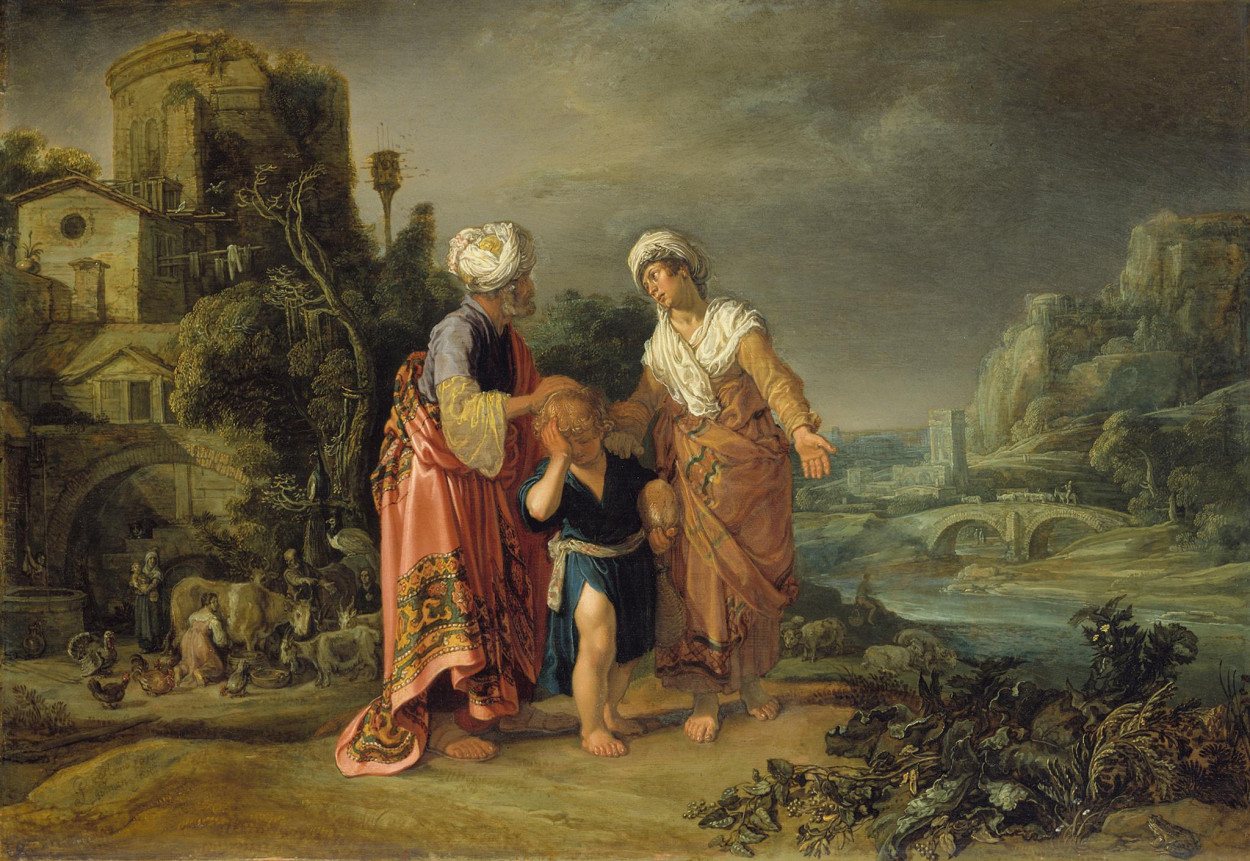
The present drawing would appear to fall into the latter category; these spontaneous sketches have been called the ‘Lastman group’, as some of these sheets were previously attributed to Pieter Lastman, before Jansz’s authorship became accepted. Our fantastic and well preserved drawing has long been known and was exhibited in an important exhibition in the Rijksmuseum nearly a century ago, also as a work by Pieter Lastman (1583–1633), Rembrandt’s teacher; the identification as a rare drawing by Jansz was made by Marijn Schapelhouman in 1985.4 The composition of the drawing is indeed close to a painting by Lastman of 1612, now in the Kunsthalle in Hamburg (fig.).5 This painting must have been intimately known to Jansz, but in this drawing he embellished Lastman’s composition of the three figures, keeping the general grouping of Abraham, Ishmael and Hager, but changing all hand gestures and re-positioning Ishmael and Hagar. Jansz was so impressed by Lastman’s painting that he made another drawing based on its composition, again changing hand gestures and also the direction of the group, from left- to right-wards, also formerly in the Houthakker collection (fig.).6 Nothing is known about the early provenance of the Lastman painting, but given its influence on Jansz one might speculated that he could have indeed owned it himself.
Drawings by Jansz rarely come onto the market. Small groups of his drawings are preserved in the Rijksprentenkabinet (Amsterdam), the Kunsthalle (Bremen), the Herzog Anton Ulrich-Museum (Braunschweig) and the Kupferstichkabinett of the Staatliche Museen (Berlin).
1. For the artist, see Marijn Schapelhouman, ‘Tekeningen van Pieter Jansz., ‘Konstig Glasschrijver’, Bulletin van het Rijksmuseum, 1985, 33, pp. 71-92.
2. Dick Peters, De zeventien gebrandschilderde glazen in de Oudshoornse kerk, Oudshoorn 2003, passim.
3. Schapelhouman, op. cit., p. 71.
4. Schapelhouman, op. cit., p. 86.
5. Oil on panel, 48.3 x 71.4 cm, inv. no. HK-191. Thomas Ketelsen, Hamburger Kunsthalle. Die niederländischen Gemälde 1500-1800, Hamburg 2001, pp. 153-154, repr.
6. Pen and brown ink, 194 x 159 mm, Sotheby’s, Amsterdam, 4 November 2003, lot 83, repr.