JACOB DE WIT (Amsterdam 1695 – 1754 Amsterdam)
Jacob de Wit (Amsterdam 1695 – 1754 Amsterdam)
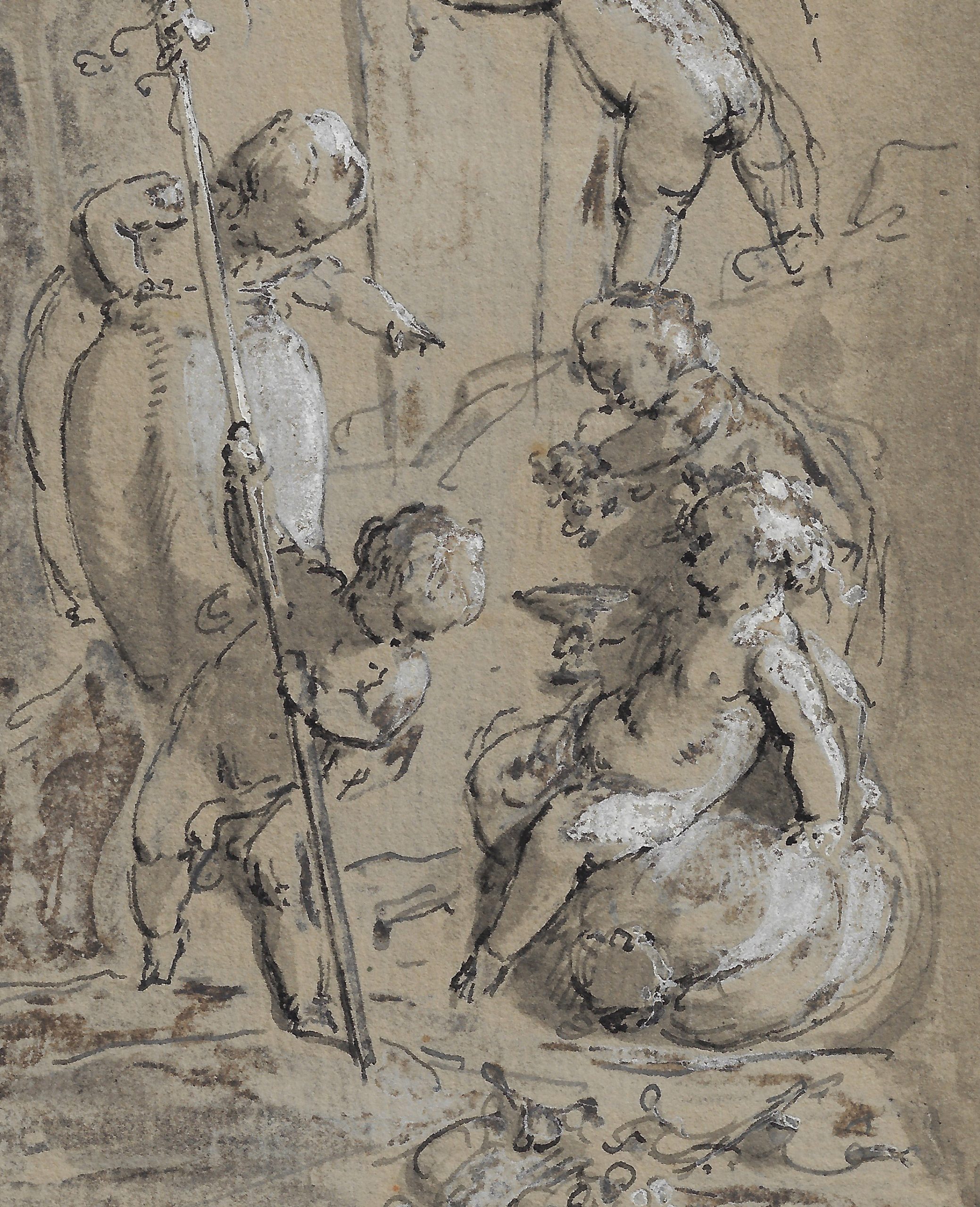
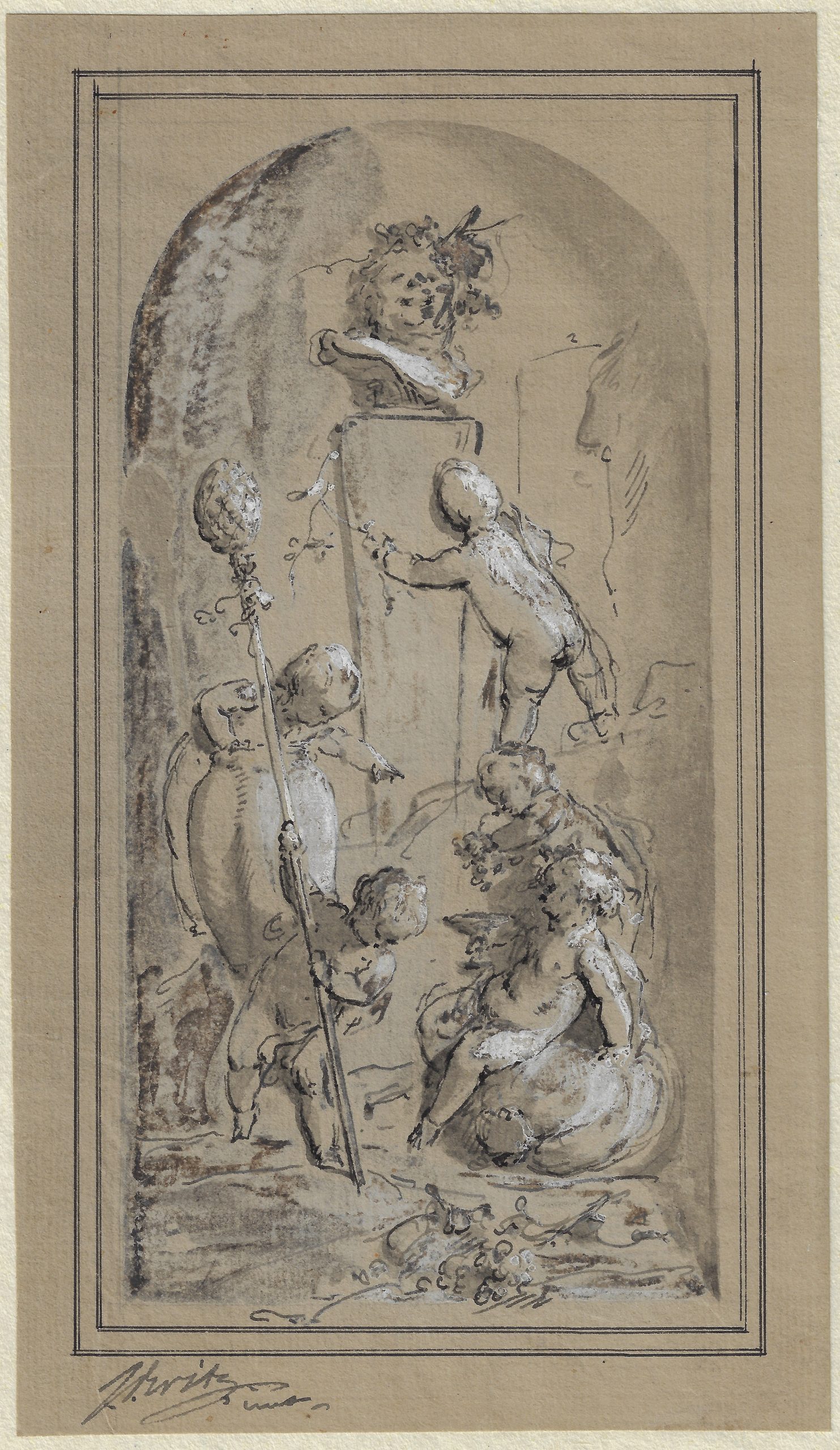
Five Putti around a Bust of Bacchus – a Representation of Autumn
Pen and grey ink, grey wash, heightened with white, black ink framing lines, 240 x 137 mm (9.45 x 5.4 inch)
Signed ‘JdeWit invt’ (grey ink, lower left)
Indistinctly annotated on the reverse ‘voor d’Hr Schouten’ (graphite, verso)
Provenance
~ With Bob Haboldt & Co
~ With Robert Noortman, Maastricht, from whom acquired by
~ Private collection, Germany
***
Jacob de Wit was born in Amsterdam and received his early training when he was only nine years old from the painter Albert Spiers.1 At the age of thirteen he left for Antwerp to study with Jacob van Hall and became an admirer of Rubens and Van Dyck. De Wit quickly developed into the leading decorative painter in Amsterdam. From 1717 on De Wit had so much work on his hands ‘that he scarcely knew were to begin’, according to the artist’s biographer Jacob van Gool in 1750.
One of De Wit’s specialities were grisaille paintings, giving the illusion of marble reliefs. These grisailles are knowns as ‘Witjes’, after the artist to whom they had brought such fame. Many of the houses along the Herengracht and Keizersgracht canals of Amsterdam are still adorned with ceiling paintings and wall panels by De Wit. Together with Cornelis Troost, De Wit is rightly considered among the most important and gifted artists of the Dutch 18th century, the Silver Age.
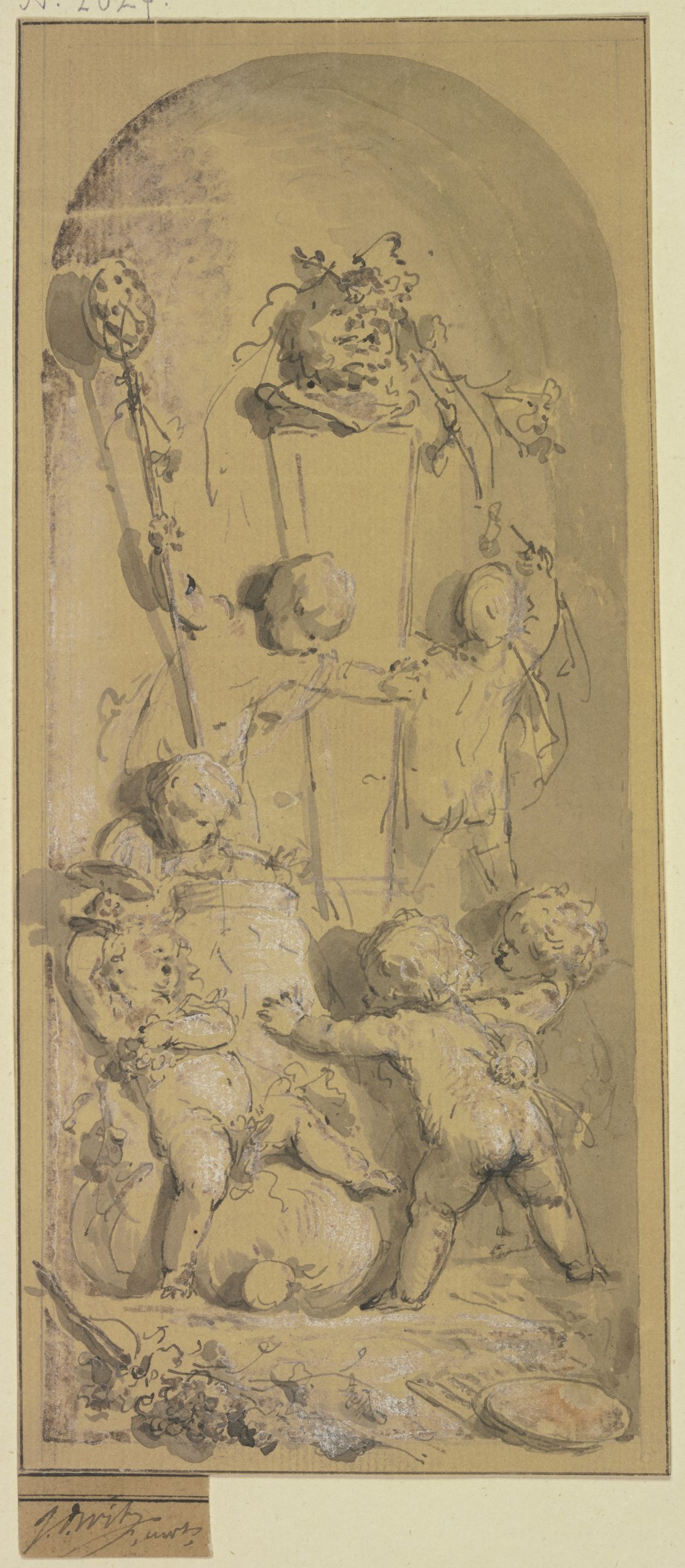
The present beautifully preserved drawing illustrates perfectly why De Wit was so highly favoured – the virtuoso handling of the sheet is almost un-Dutch in flavour and can be compared to contemporary Venetian draughtsmen, notably Tiepolo. De Wit shows five putti playing with various attributes around a central plinth with a bust of Bacchus, god of wine. Bacchus is frequently associated with the season autumn, and our drawing is thought to be a representation of that season. Series of the four seasons were beloved subjects for large-scale interior decorations, and the present drawing is probably a preparatory design for such a scheme. Fascinatingly, another version of the drawing survives in the Städel Museum in Frankfurt-am-Main, in which the putti are placed in different positions (fig.).2 Such variants were sometimes made in order to provide a variety of proposals to a prospective client. The back of our drawing is annotated in an early hand ‘Voor d’Hr Schouten’, ‘for Mr Schouten’, who would have commissioned the scheme. Schouten is not a rare name and it is not clear to which member of this family the inscription refers.
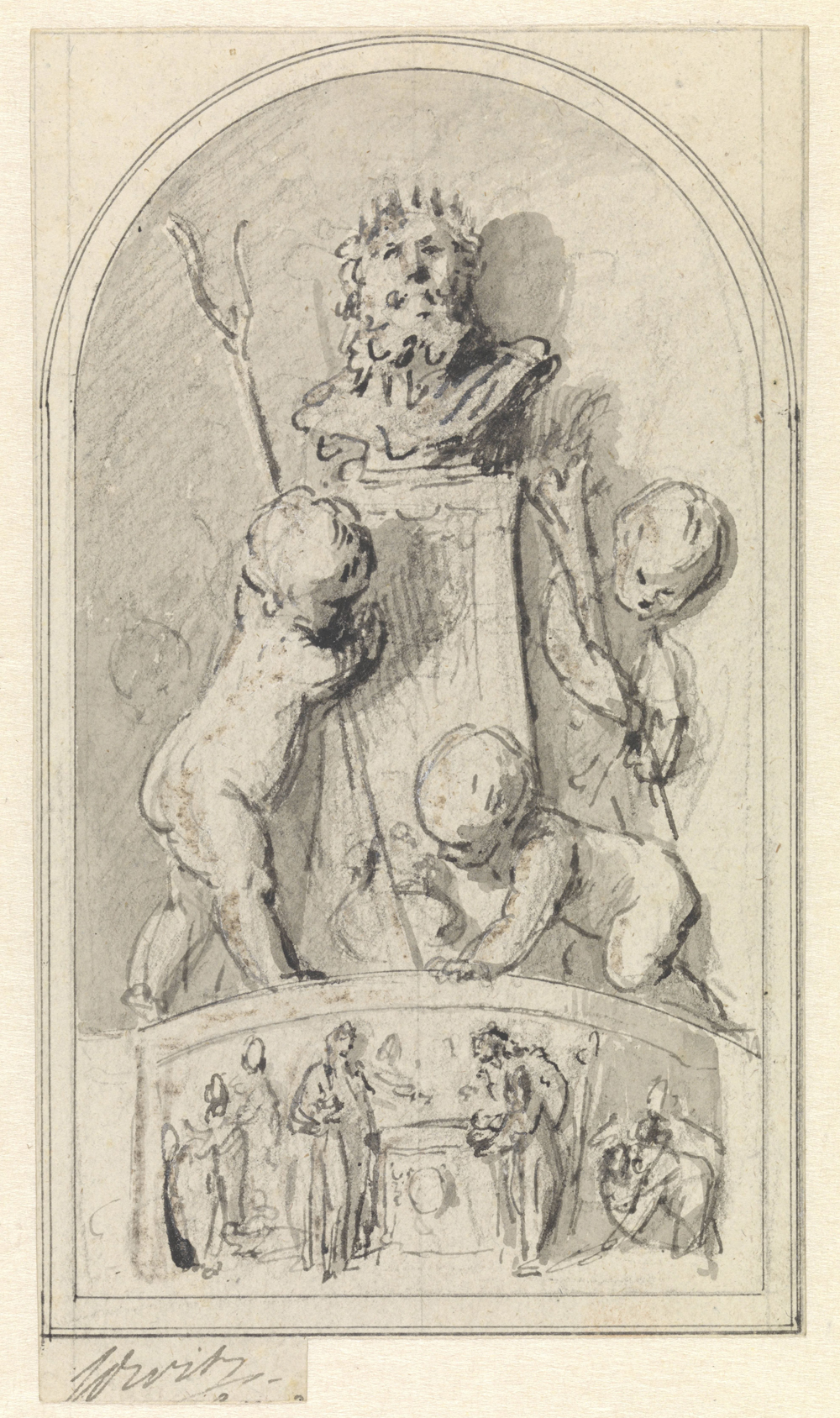
A comparable drawing with an arched top by De Wit of three putti playing underneath a bust is preserved in the Rijksmuseum in Amsterdam (fig.).3
1. For the artist, see: A. Staring, Jacob de Wit: 1695–1754, Amsterdam 1958, J. Huisken, Jacob de Wit: de Amsteltitiaan, Amsterdam 1986 and G. van den Hout and R. Schillemans, Putti en Cherubijntjes: het religieuze werk van Jacob de Wit (1695–1754), Haarlem/Amsterdam 1995-96.
2. Pen and grey ink, grey wash, heightened in white, 235 x 70 mm; Graphische Sammlung im Städelschen Kunstinstitut, Frankfurt am Main, inv. no. 2027.
3. Pen and grey ink, grey wash, 218 x 127 mm, inv. no. RP-T-00-1145(V).