BENJAMIN CUYP(Dordrecht 1612 – 1652 Dordrecht)
Benjamin Cuyp (Dordrecht 1612 – 1652 Dordrecht)
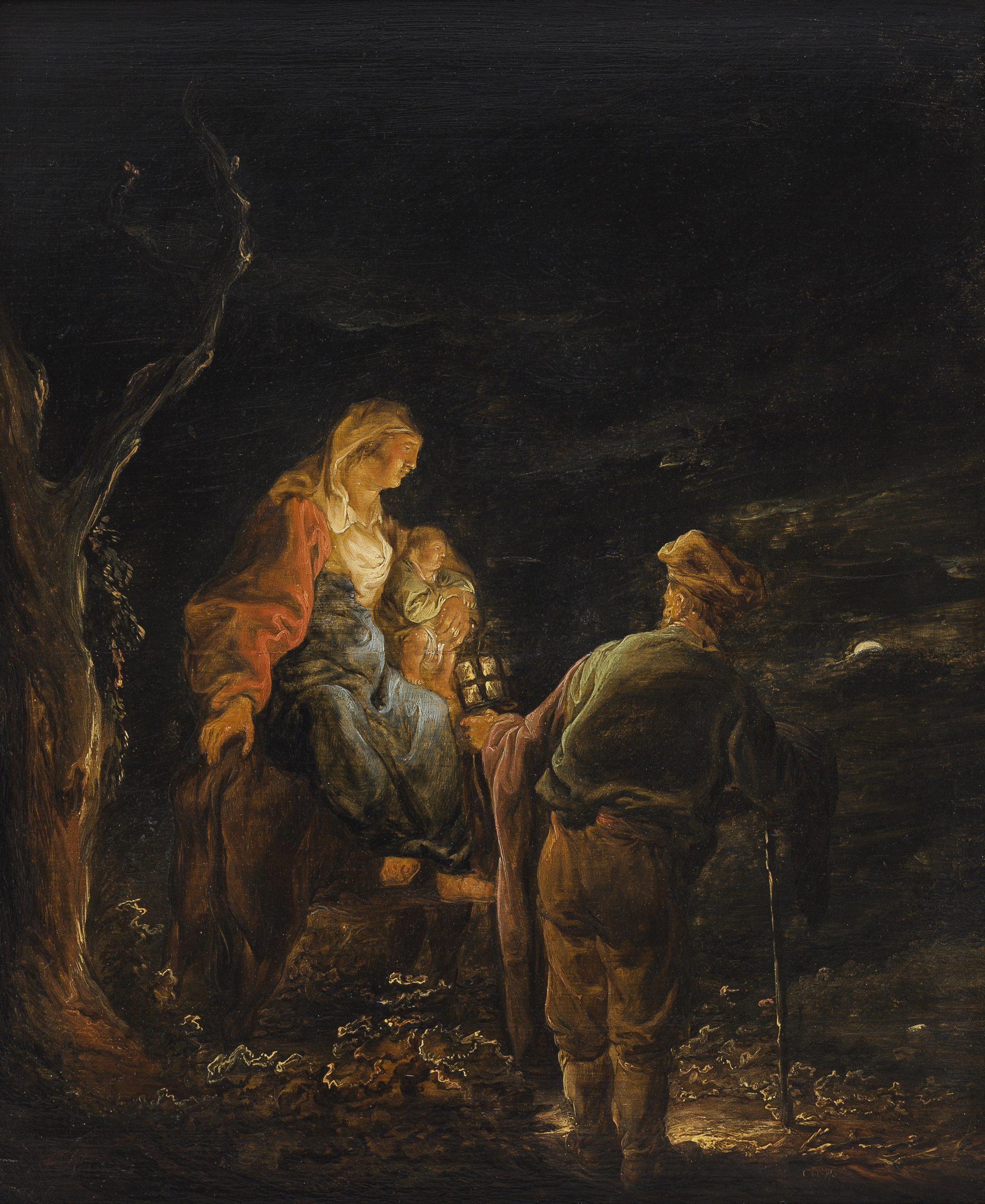
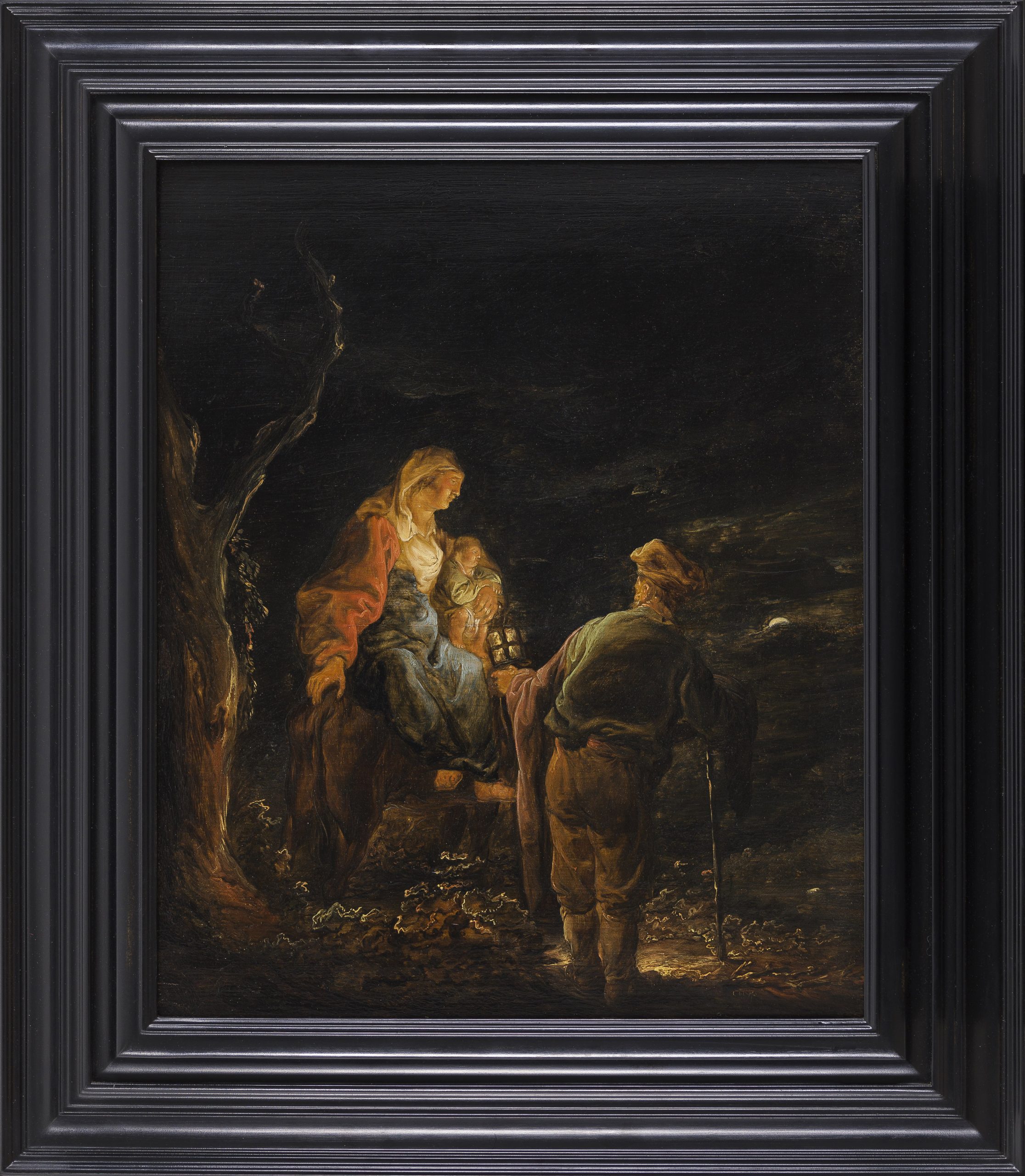
The Rest on the Flight to Egypt
Oil on panel, 50.7 x 42 cm (20 x 16.5 inch); contained in a modern ebonised frame of Dutch 17th-century model
Signed ‘cuyp’ (lower right)
Provenance
Probably James Hazard (1748–1787); his auction, Brussels, 14 April 1789, no. 40 (‘Benjamin Cuyp. La Fuite en Egypte. Haut 1 p. 6p., l. 1 p. 2 p.’), sold for f. 5.10 – Jules Porgès (1839–1921) collection, Paris, until 9.4.1910, when sold to art dealer Franz Kleinberger, by whom sold on 12.5.1910 to Adolphe Schloss (1842–1910) – by descent to Lucie Haas Schloss – Schloss heirs, deposited at Château de Chambon, Laguenne (Corrèze) from 20.8.1939 to 16.4.1943 – transferred to Banque de France, Limoges, 16.4.1943 to 9.8.1943 – transferred to CGQJ headquarters, Paris, 11.8.1943 (Banque Dreyfus inventory AMAE MH 117, p. 10, no. 62, with black/white photograph) – transferred to Jeu de Paume, 1.11.1943 – transferred to the Führerbau, Munich, 24.11.1943 (inventory B323/1212, p. 15, no. 45, with black/white photograph) – stolen from Führerbau, 29-30.4.1945 – private collection, Germany – Neumeister, Munich, 22 September 1993, lot 431 – Private collection, The Netherlands, from 2015
Literature
~ Ildikó Ember, ‘Benjamin Gerritsz. Cuyp (1612-1652)’, Acta Historiae Artium 25, 1979, no. 21
~ W. Sumowski, Gemälde der Rembrandt-Schüler, Landau/Pfalz 1983, vol. VI, p. 3526, repr. p. 3579
Exhibited
On loan to the Dordrecht Museum, August 2015 – April 2016
***
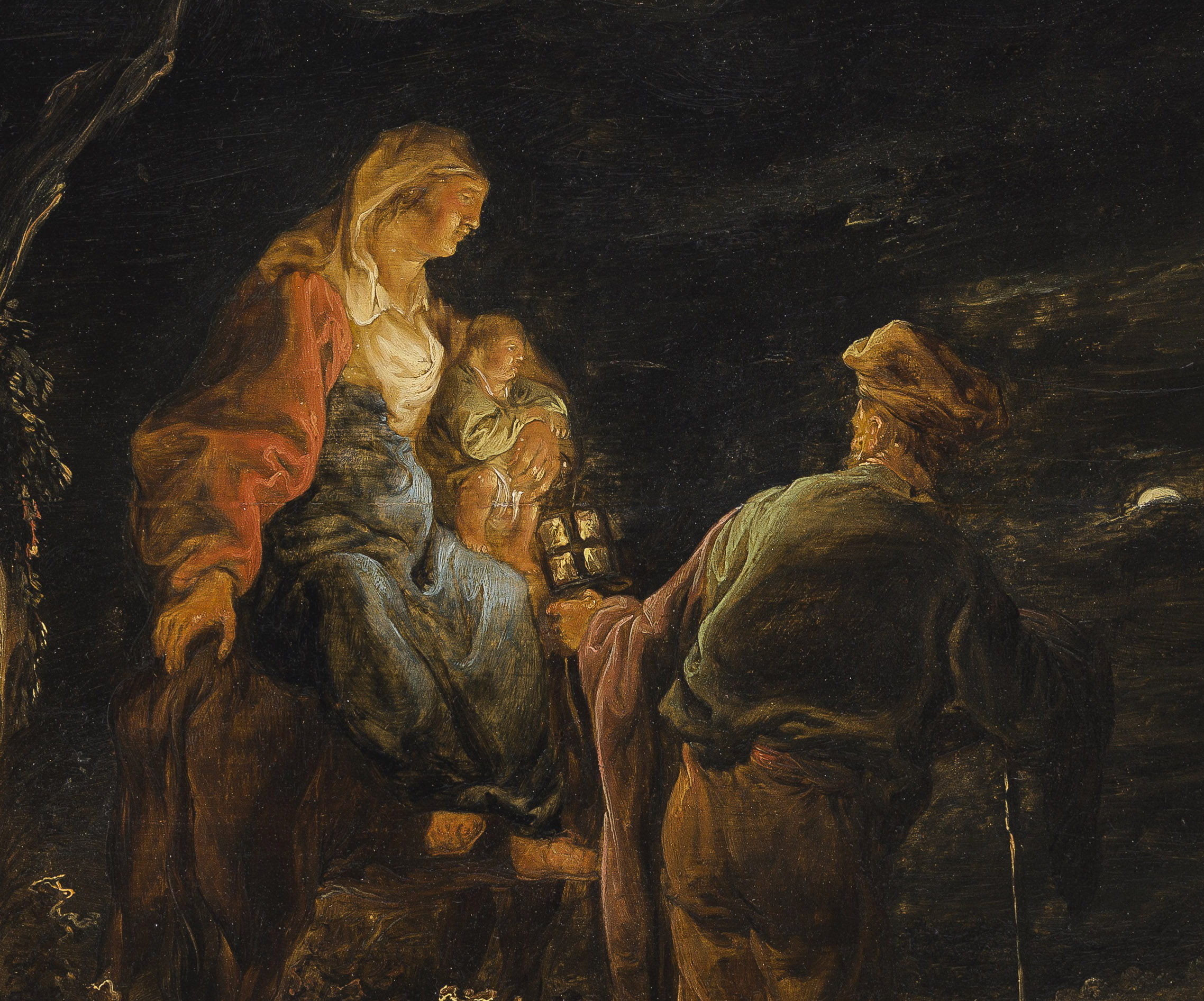
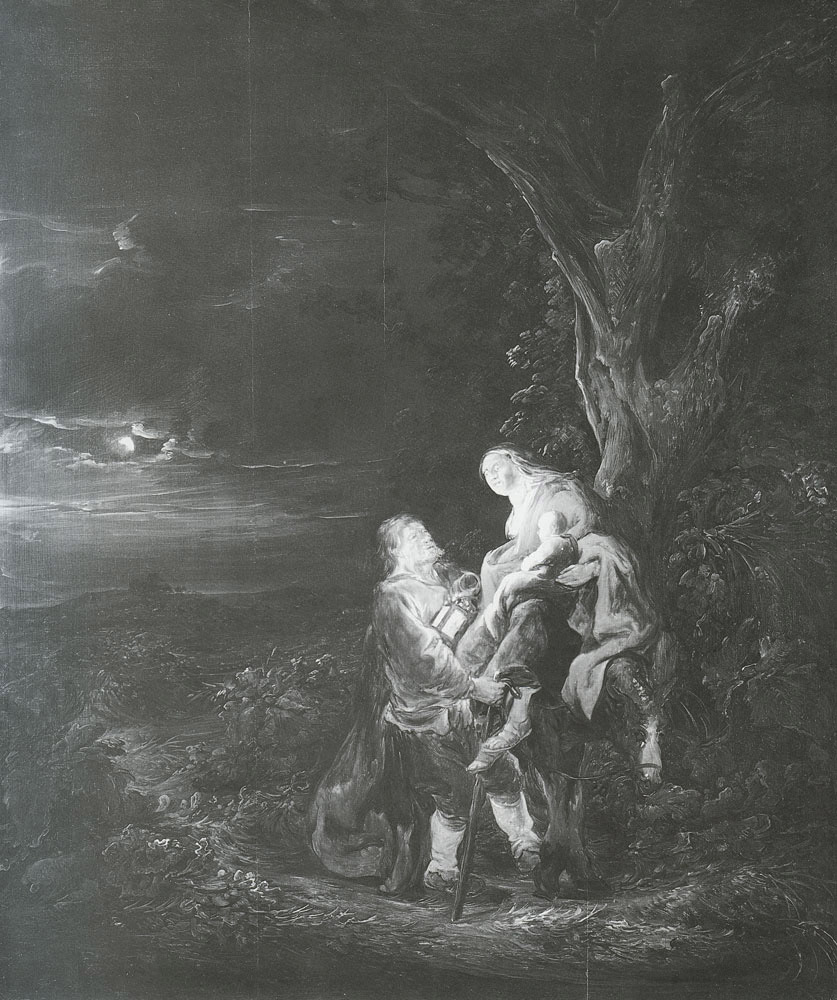
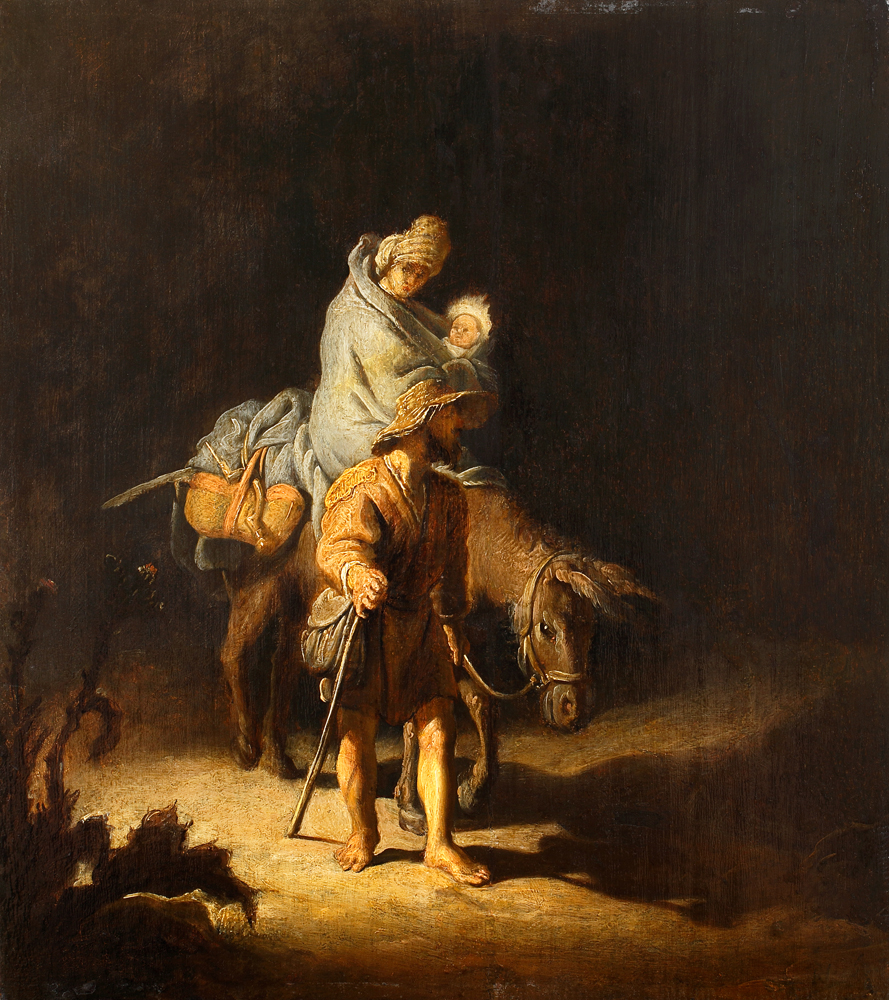
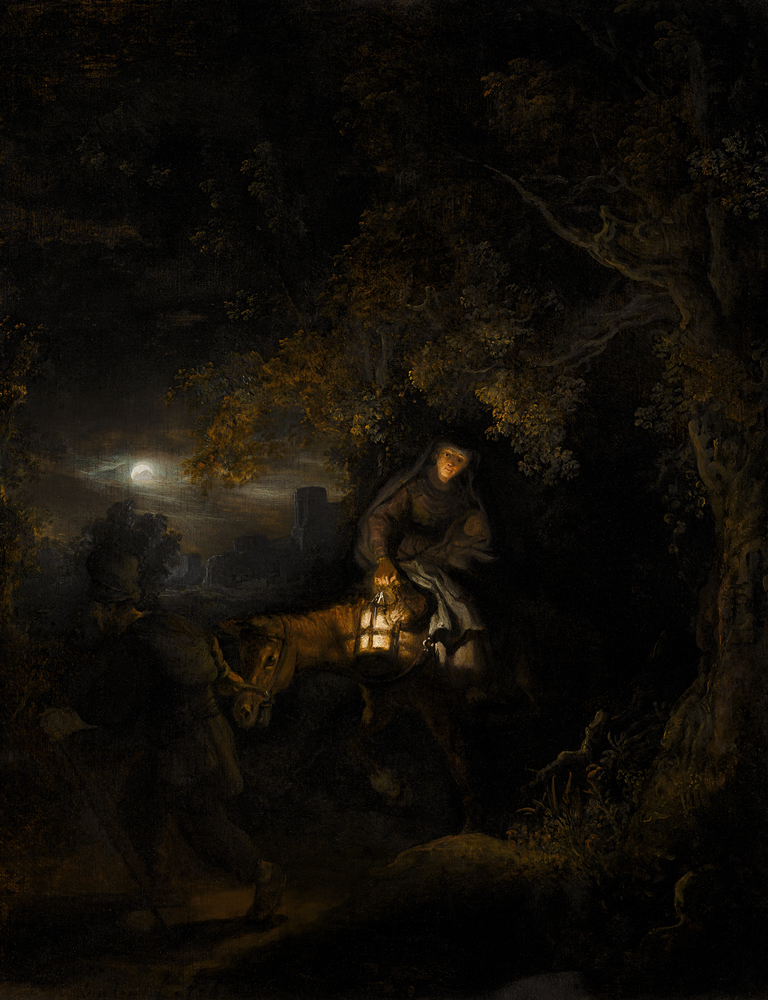
This extremely fluently painted work is a highlight in the oeuvre of the Dordrecht painter Benjamin Cuyp.1 The artist was trained by his half-brother Jacob Cuyp, but the spontaneous handling and chiaroscuro effects of his works display the strong influence of Rembrandt, particularly of his early period in Leiden. Our painting is executed with powerful, impasto brushstrokes and rich effects of dark and light. It was most likely produced during the 1630s, early in the artist’s career, when he was in his most original and talented phase. It is related to a painting by Cuyp of the same subject and similar handling, preserved in the Musée Municipal in Soissons (fig.).2 Cuyp seems to have been inspired by two paintings by Rembrandt and his immediate circle of the same subject, of 1627 in the Musée des Beaux Arts in Tours (fig.)3 and of 1634 in a private collection, which includes a full moon and a lantern comparable to those included in our painting (fig.).4 Benjamin was the uncle of the landscape painter Aelbert Cuyp.
This exceptional painting, one of Cuyp’s finest extant works, was part of the celebrated collection of the Bavarian-born Jewish banker Adolphe Schloss (1842–1910), who moved to France and obtained citizenship in 1871.5 His collection was one of the most famous in fin-de siècle Paris. Although it contained paintings by such giants as Rembrandt, Rubens and Hals, it was especially praised by connoisseurs for the outstanding works by ‘minor’ masters, such as the present work by Cuyp. The painting was acquired in the summer of 1910 and must be one of the last works to have entered the collection, as Schloss died on 31 December of the same year. The work was obtained via an art dealer from the equally famed collection assembled by Jules Porgès (1839–1921), a Paris-based financier, who was one of the founders of the South Africa Diamond industry; his company was acquired early on by De Beers.
Upon Schloss’s decease the collection passed to his wife, who kept it intact, and in 1938 it went by inherence to their children. As the clouds of war gathered over Europe, the famous collection was pre-emptively moved in 1939 to the Château de Chambon in the South of France. After the Nazi occupation of France this fell under Vichy control but the fame of the collection was such that an active search was ordered from Berlin for the pictures and the collection of more than 300 pieces was seized by the Vichy government in 1943. Extraordinarily, because of the fame of the collection, the paintings were individually photographed in the Louvre in 1943 and therefore the Schloss collection is one of the best documented examples of looted art: 49 paintings went to the Louvre and 230 paintings were sent to the Führerbau in Munich, awaiting removal to the Führermuseum in Linz, including the present work; a further group of 22 paintings were given order to be sold. With the downfall of the Nazi regime and the ensuing chaos the Führerbau was looted and many pictures disappeared; after the war some were restored to the heirs and auctioned off, but not all pictures have been recovered. Many paintings from the Schloss collection are now in leading museums all over the world.
A legal arrangement has been reached with the heirs of the Schloss Collection, and the ownership will pass in full to the future owner.
SOLD
1. For the artist, see Ildikó Ember, Benjamin Gerritsz. Cuyp (1612-1652), Budapest 1979.
2. Oil on panel, 50 x 40 cm, Musée Municipal, Soissons.
3. Oil on panel, 27.5 x 24.7 cm, Musée des Beaux Arts de Tours, inv. no. 1950-13-1; E. van de Wetering et al., A corpus of Rembrandt paintings (…), Boston/Lancaster/Dordrecht, vol. I (1982), cat. no. C 5.
4. Oil on panel, 52 x 41.2 cm, private collection; Van de Wetering et al. (op. cit.), cat. no. C 47.
5. See Collection Schloss: oeuvres spoliées pendant la deuxième guerre mondiale non restituées (1943-1998), Paris (Ministère des affaires étrangères) 1998.