VICTOR WOLFVOET II and Studio (Antwerp 1612 – 1652 Antwerp)
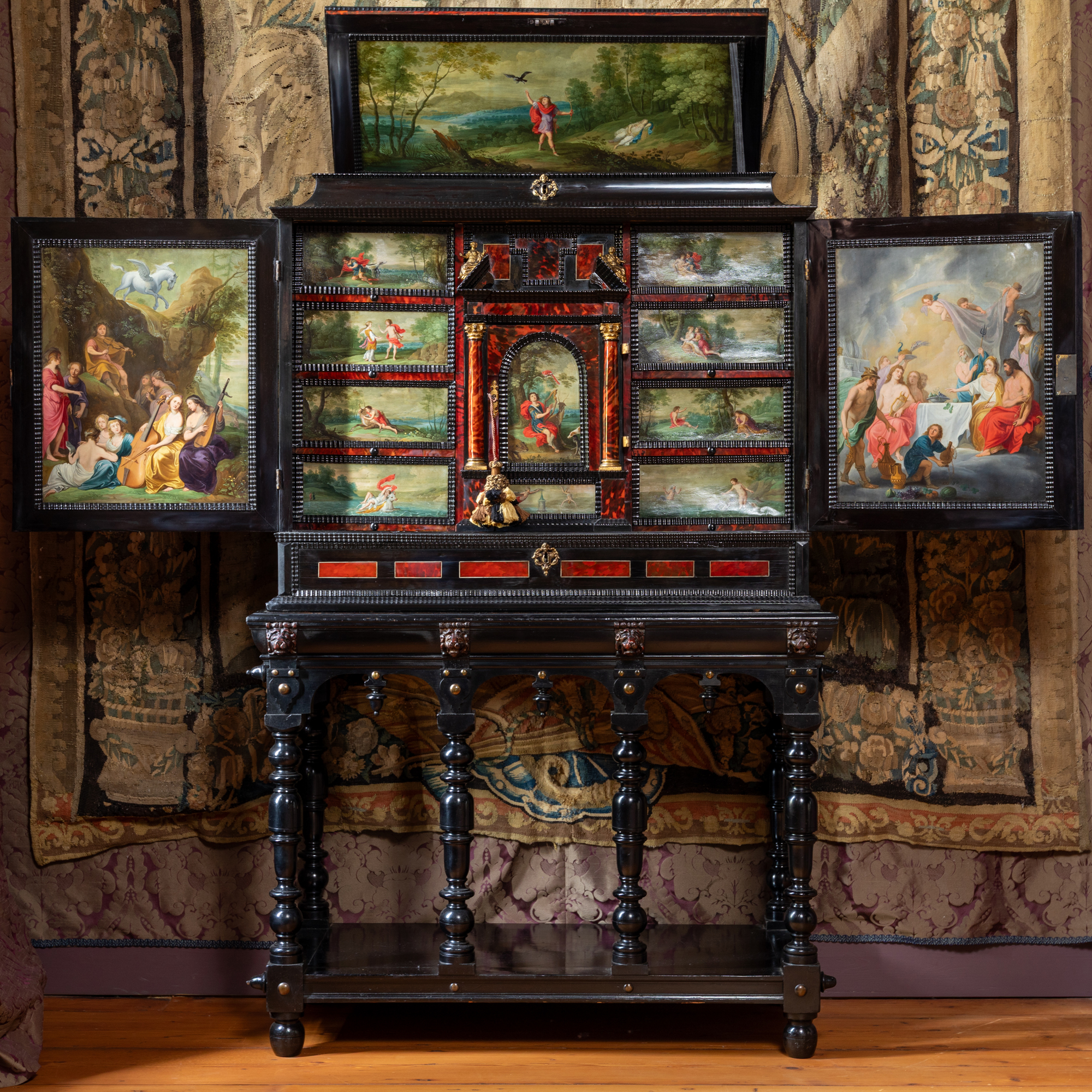
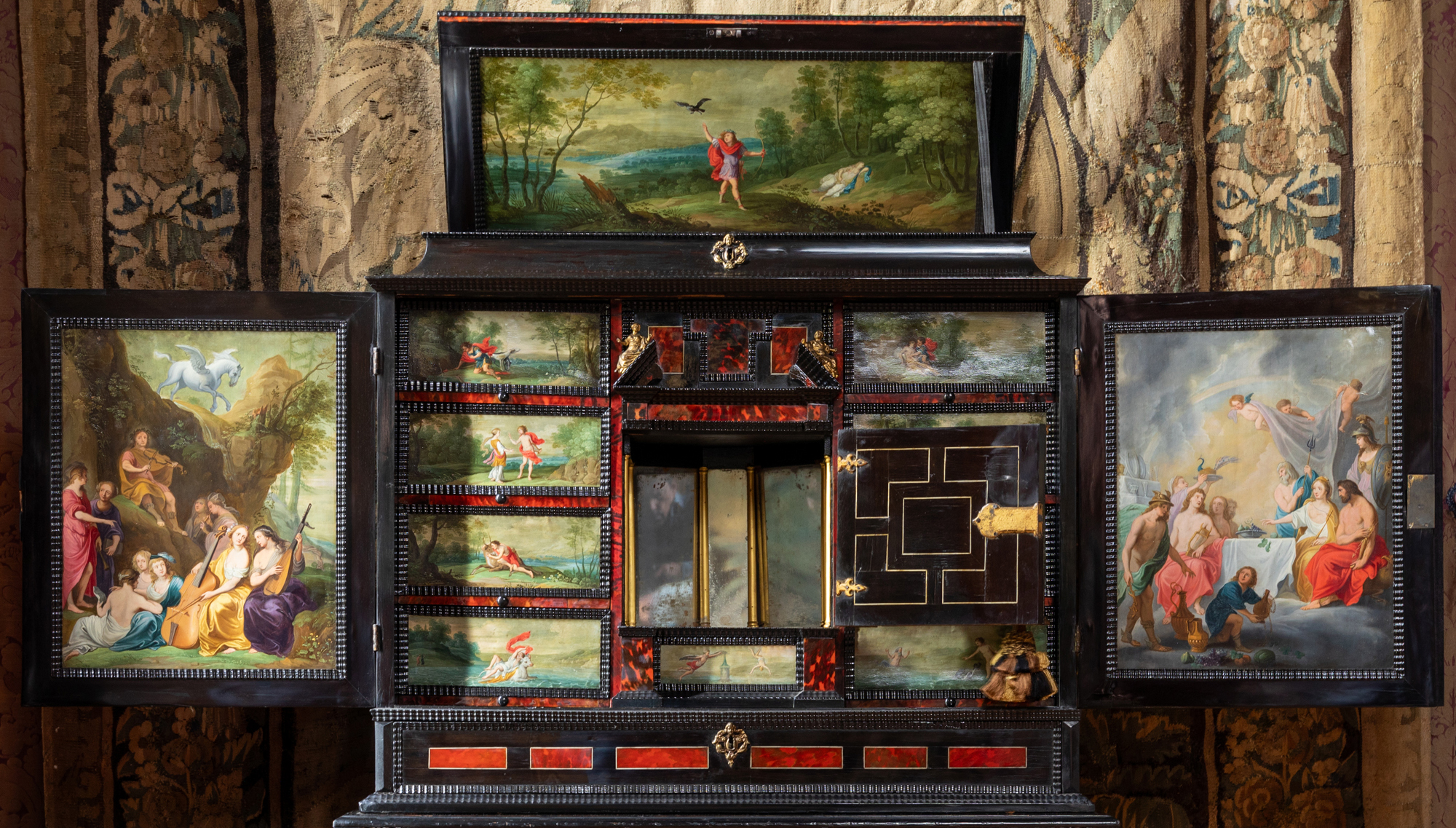
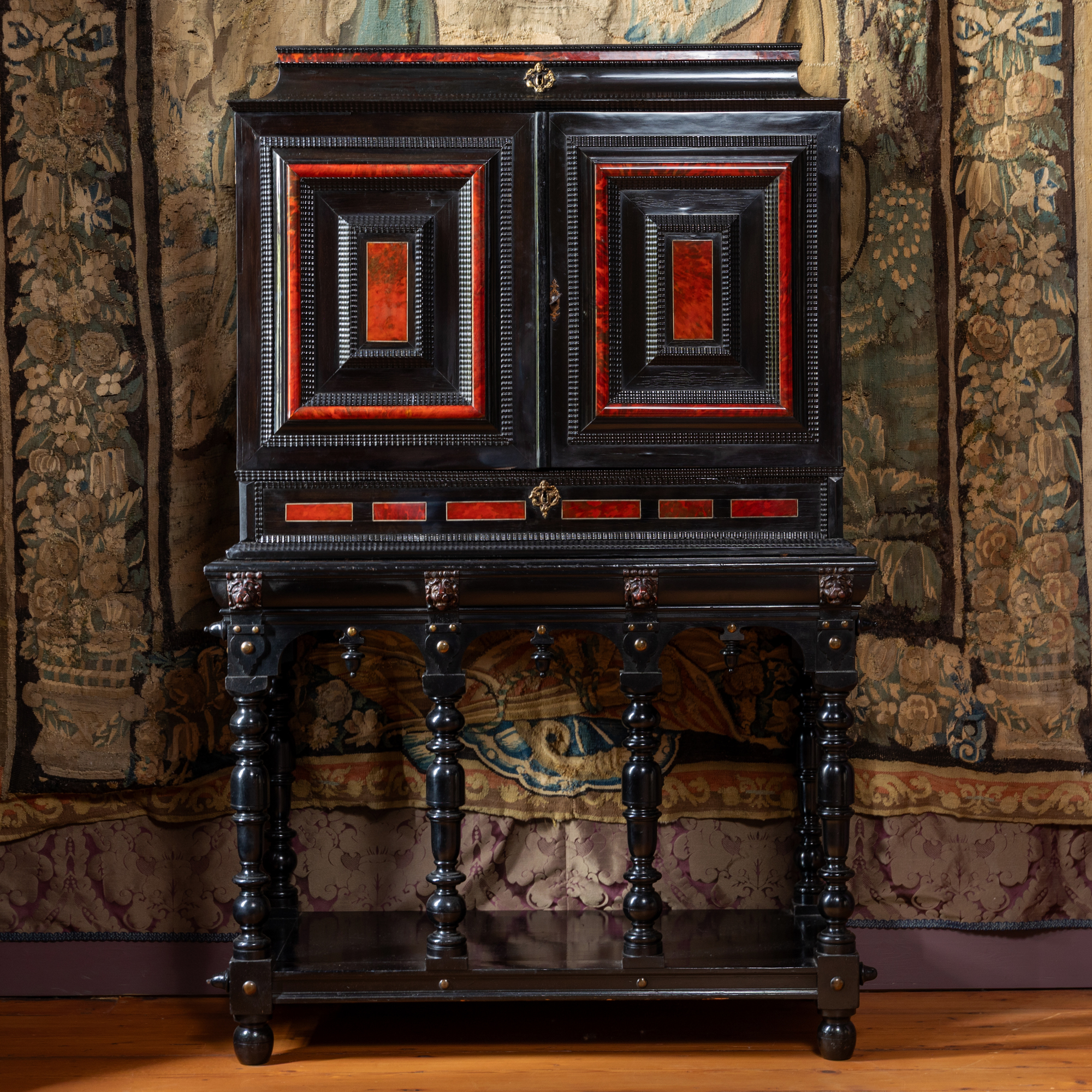
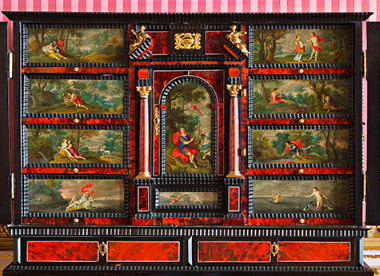
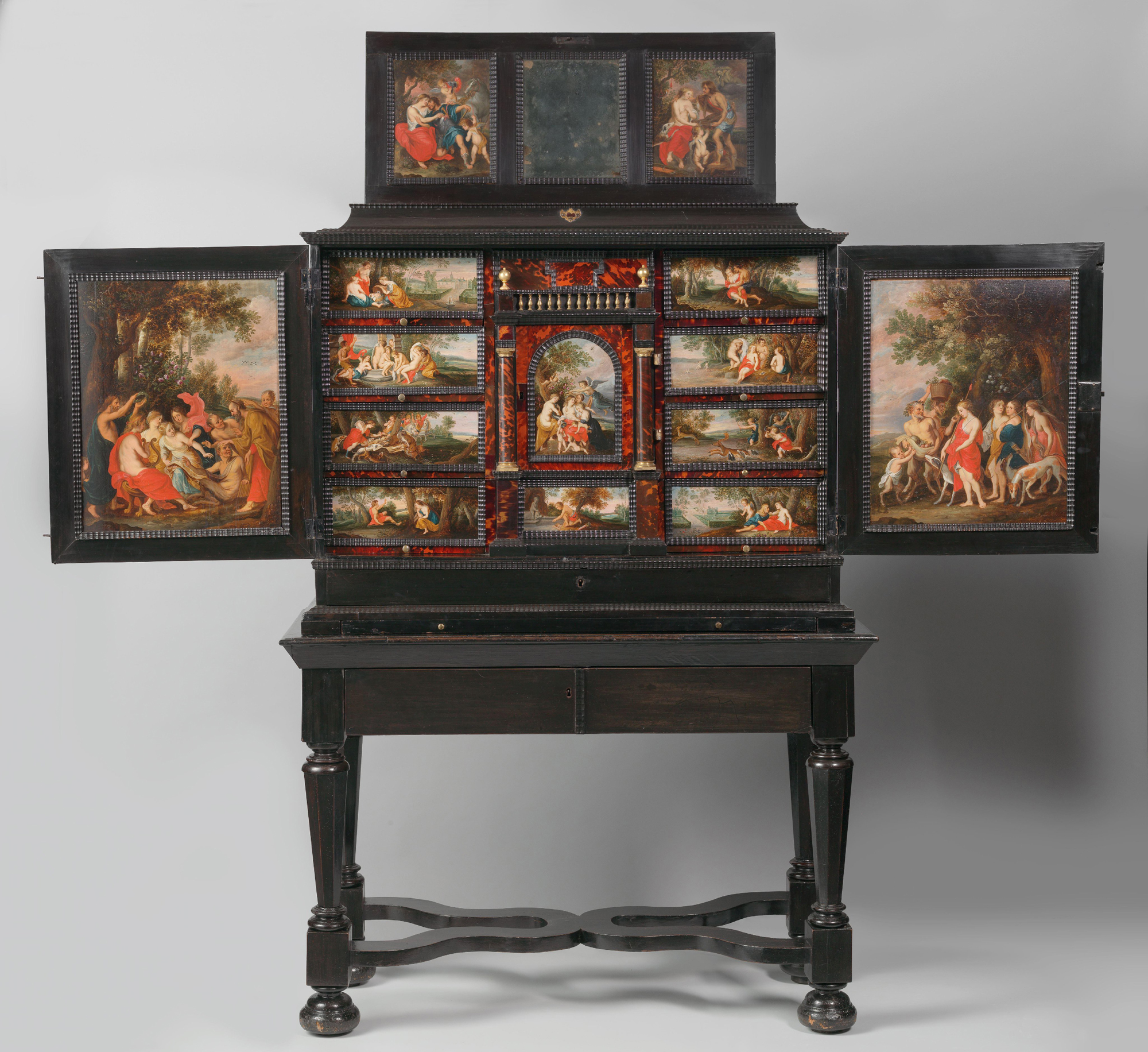
A Flemish tortoiseshell and ebony cabinet, circa 1645, the interior with scenes from Ovid’s Metamorphoses by Victor Wolfvoet II and studio
The cabinet veneered on the exterior and interior with ebony, bone and tortoiseshell, brass handles, gilded brass cast sculptures, the interior decorated with paintings in oil on copper
Cabinet closed dimensions: height 86 cm (33.9 inch), width 104.5 cm (41.1 inch), depth 48.5 cm (19.1 inch); when opened width 199 cm (78.4 inch)
On a later ebonised stand of c.1900, total height with cabinet: 170 cm (66.9 inch)
Provenance
~ With dealer Lefèvre, Courtrai (Kortrijk), Belgium
~ Private collection, The Netherlands
***
This recently discovered cabinet belongs to a group of four similar cabinets of which the paintings decorating the interior were made by Victor Wolfvoet II and his studio (Antwerp 1612 – 1652 Antwerp). The other cabinets are in the Rijksmuseum in Amsterdam, the Rubenshuis in Antwerp, and Burghley House, Stanford, all three discussed below. It is rare to be able to attribute paintings in such cabinets to particular artists or workshops, and therefore the emergence of the present cabinet, hitherto unknown to scholars, is a highly valuable addition to the connoisseurship of Antwerp cabinet making. Cabinets of this type spread the fame of the town of Antwerp as an art center and were the most sought-after luxury goods throughout Europe. Very few pieces of this quality have been preserved and the cabinet presented here is a particularly precious example.
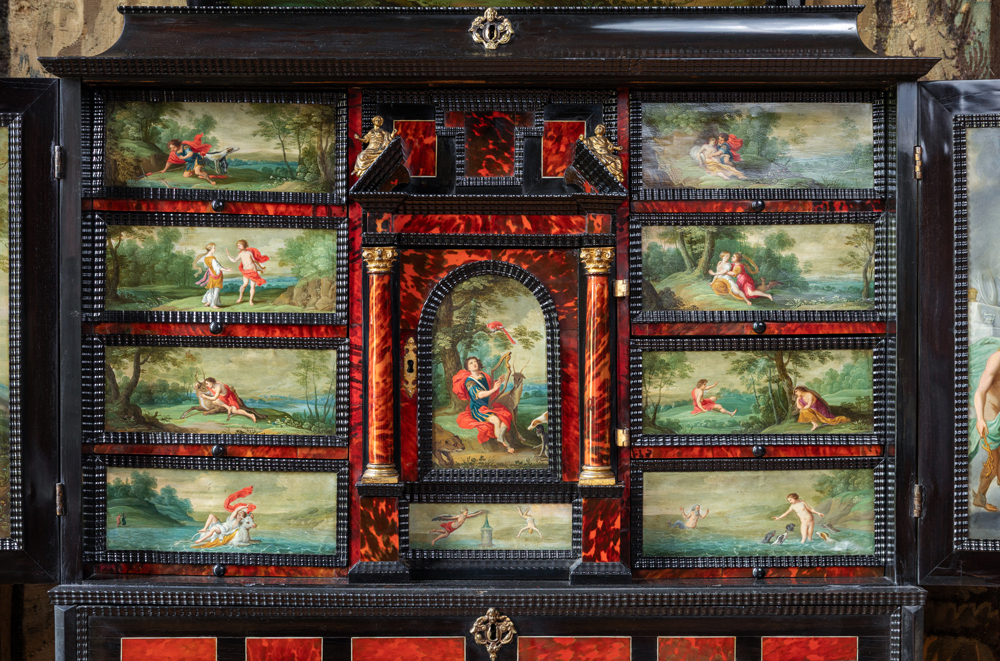
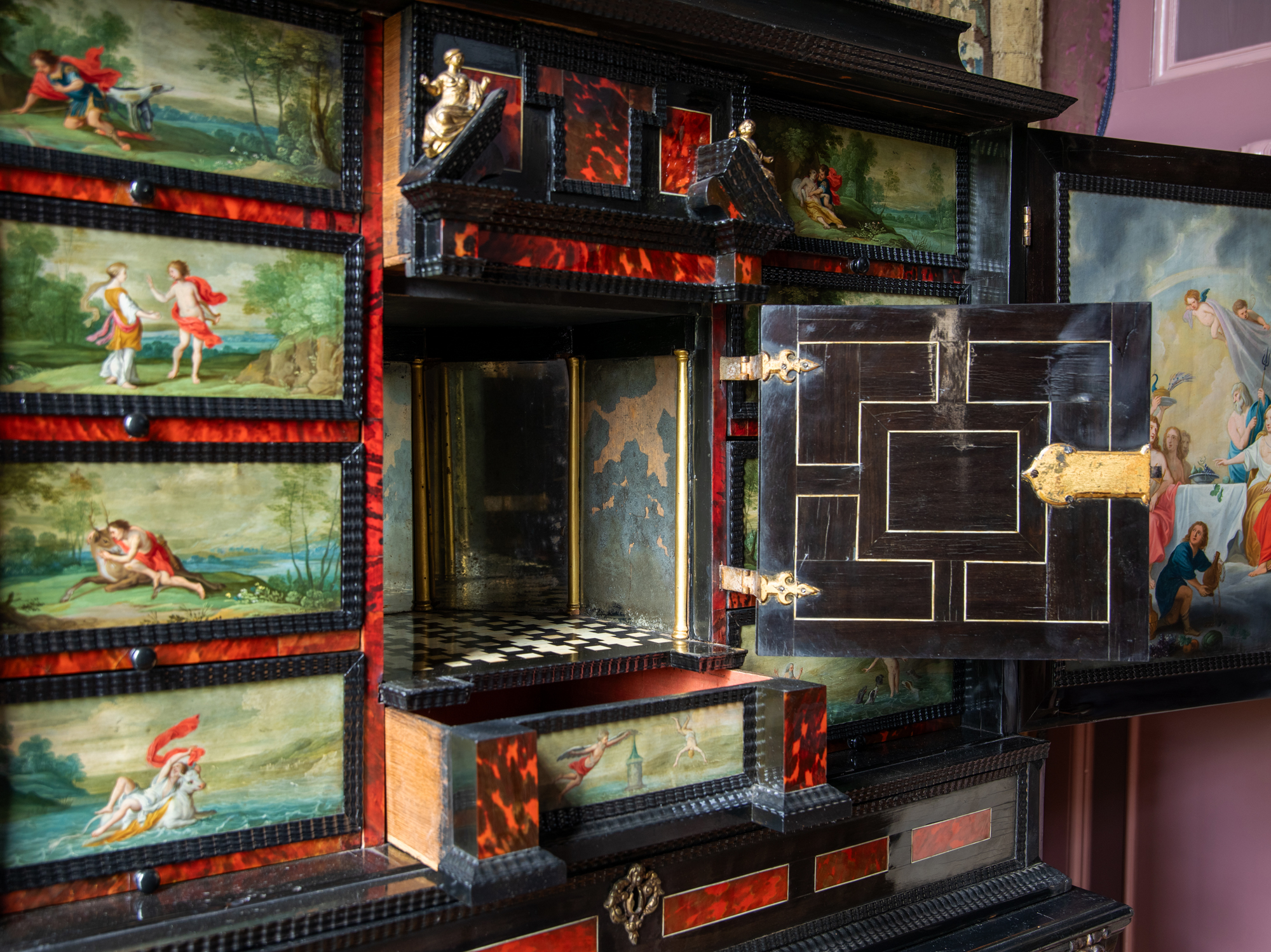
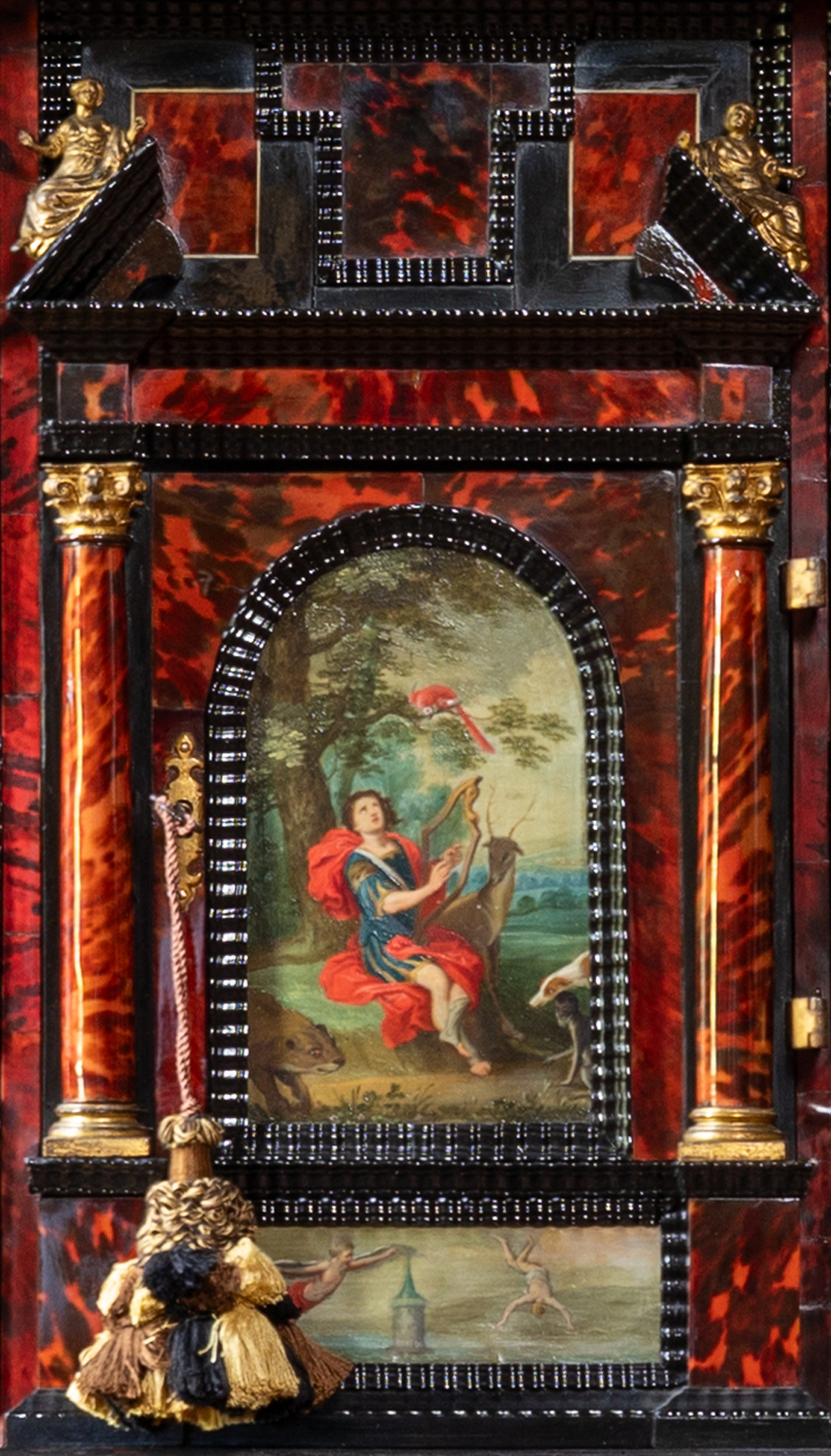
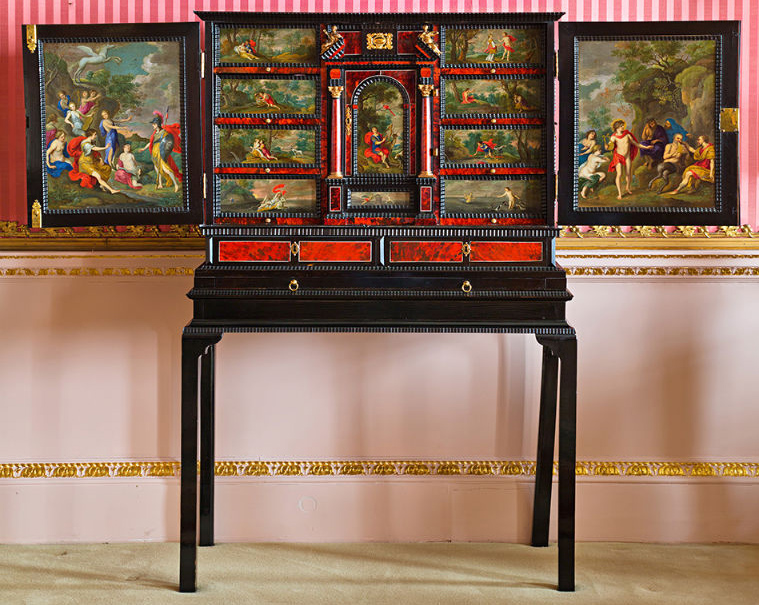
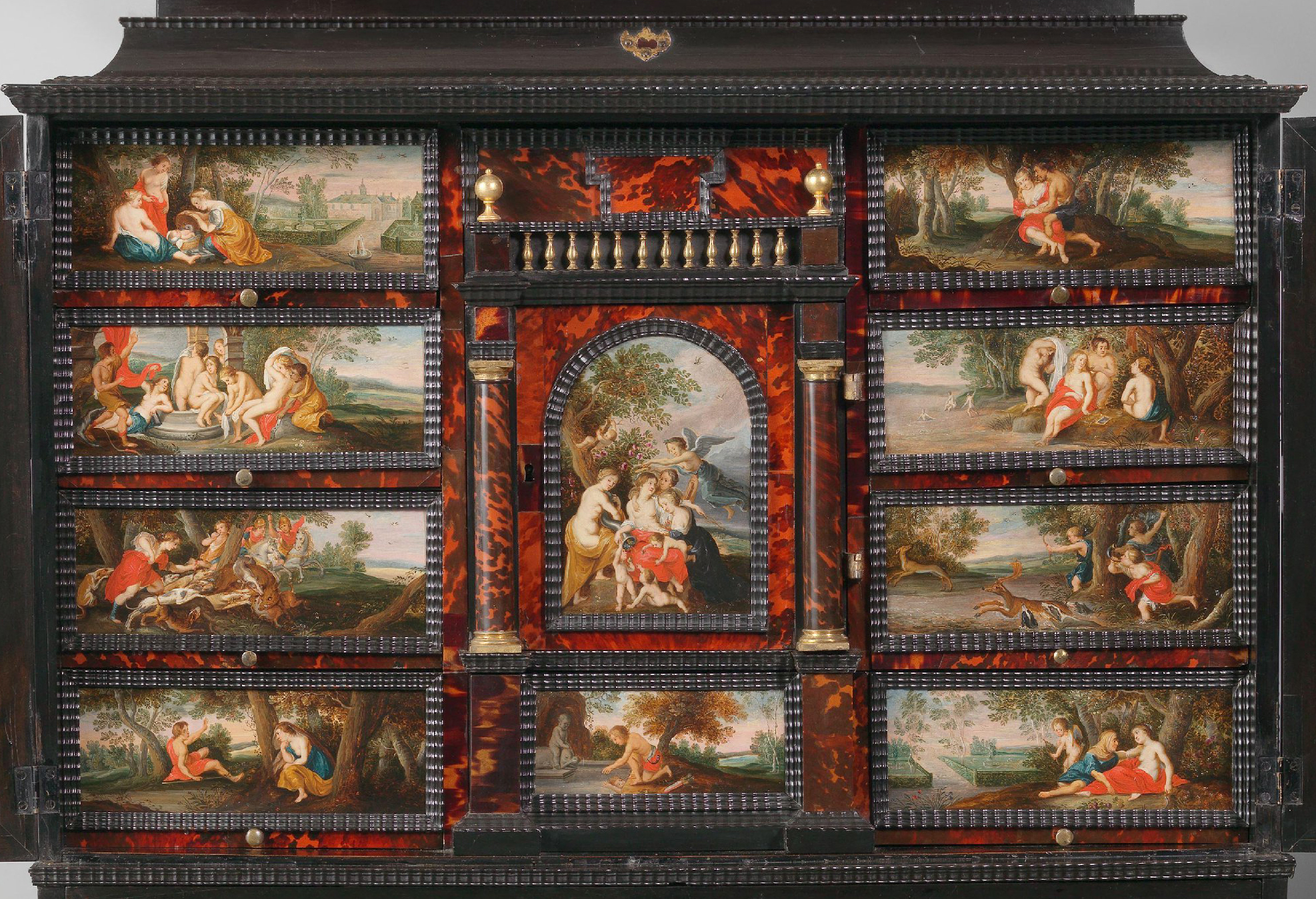
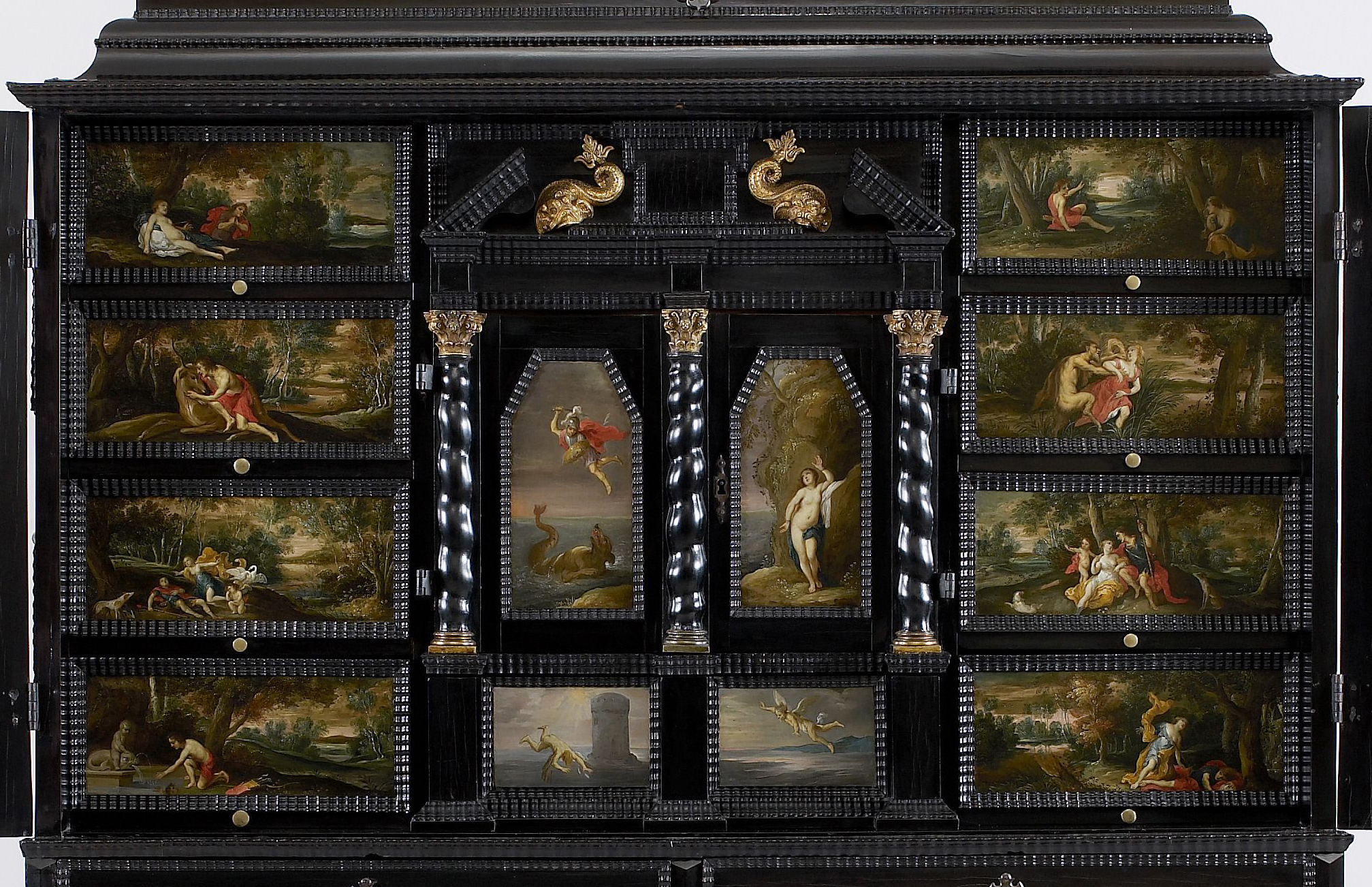
The present cabinet is veneered with ebony, tortoiseshell and subtle fillets of bone and ebony ripple mouldings. When the two doors are opened, an interior consisting of eight horizontal drawers grouped around a central compartment with a broken pediment on the architrave, with gilded bronze cast resting draped figures. Behind the door is a so-called ‘perspective’, a small compartment with mirrored walls and a very refined patterned floor in bone and ebony, on which a small valuable piece of art or goldsmith’s work could be placed – such perspectives are distinctive of Antwerp art cabinets. Underneath the compartment is another horizontal drawer. The insides of the doors, the nine drawers and arched central door are all inset with paintings in oil on copper, with scenes taken from Ovid’s Metamorphoses.
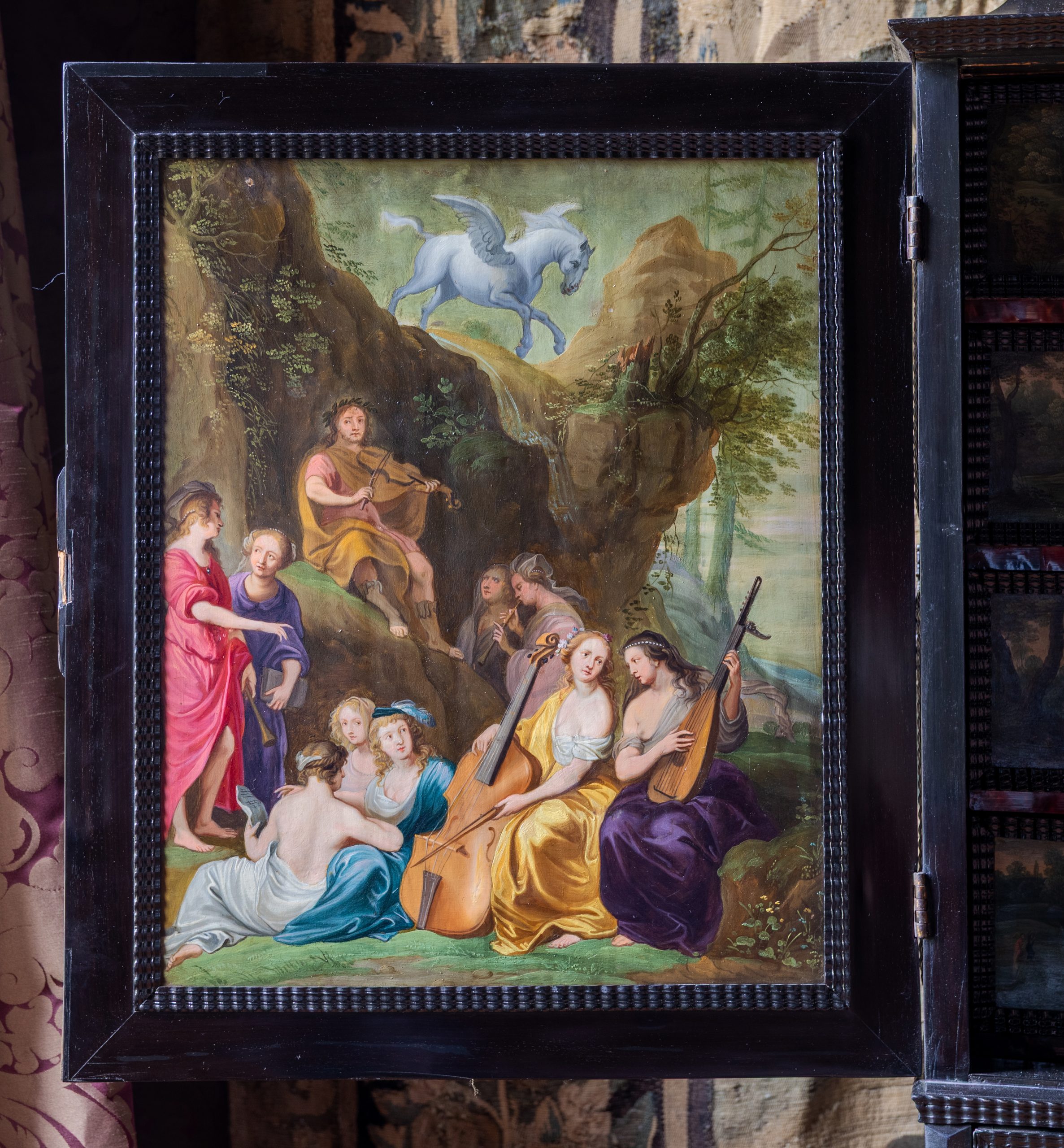
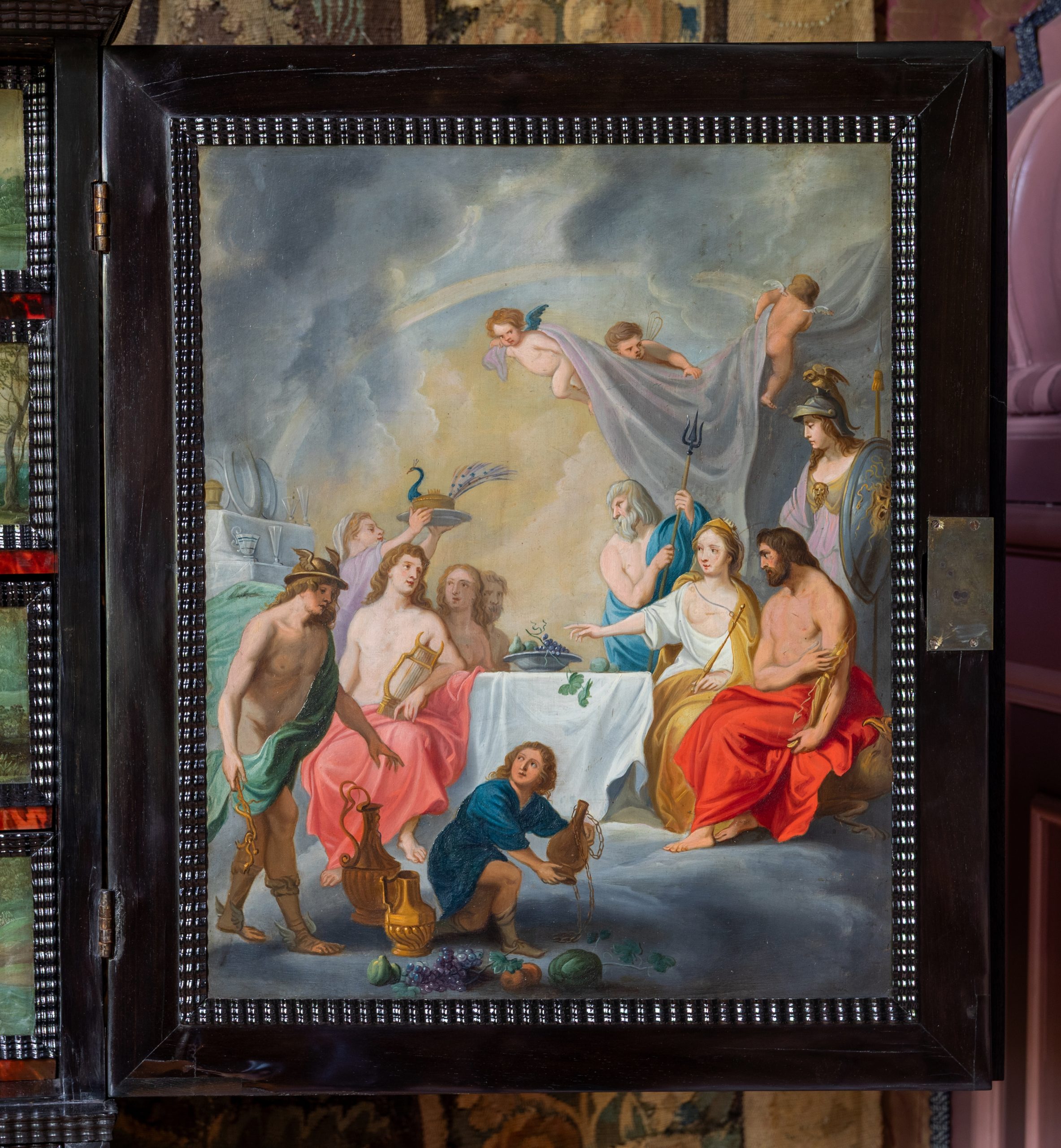
The left door has a painting of Apollo and the Nine Muses, while the right door depicts The Banquet of the Gods at the Wedding of Peleus and Thetis. Although paintings on the doors of Flemish cabinets of this period were frequently based on well-known compositions, these two scenes appear virtually unrecorded and would appear to be original compositions by Wolfvoet.1 The paintings on the drawers are somewhat lesser in quality, most if not all based on original compositions by Sir Peter Paul Rubens, and most appearing on drawers of the other aforementioned cabinets as well. This difference in pictorial quality between the paintings on the main doors and the smaller paintings on the drawers is frequently observed with Antwerp cabinets of this period.
The interior of the cabinet has four drawers at the left, decorated with scenes taken from Ovid’s Metamorphoses, including, from top to bottom, Narcissus at the Well, Apollo and Daphne, Cyparissus and the Stag and The Rape of Europa. The four drawers at the right depict, from top to bottom, Salmacis and Hermaphroditus, Diana and Callisto, Cephalus and Procris2 and Scylla and Glaucus. The arched scene on the central door represents Orpheus Enchanting the Animals, while the drawer underneath depicts Daedalus and the Fall of Icarus. Finally, the interior of the hinged top of the cabinet reveals a scene of Apollo and Daphne.
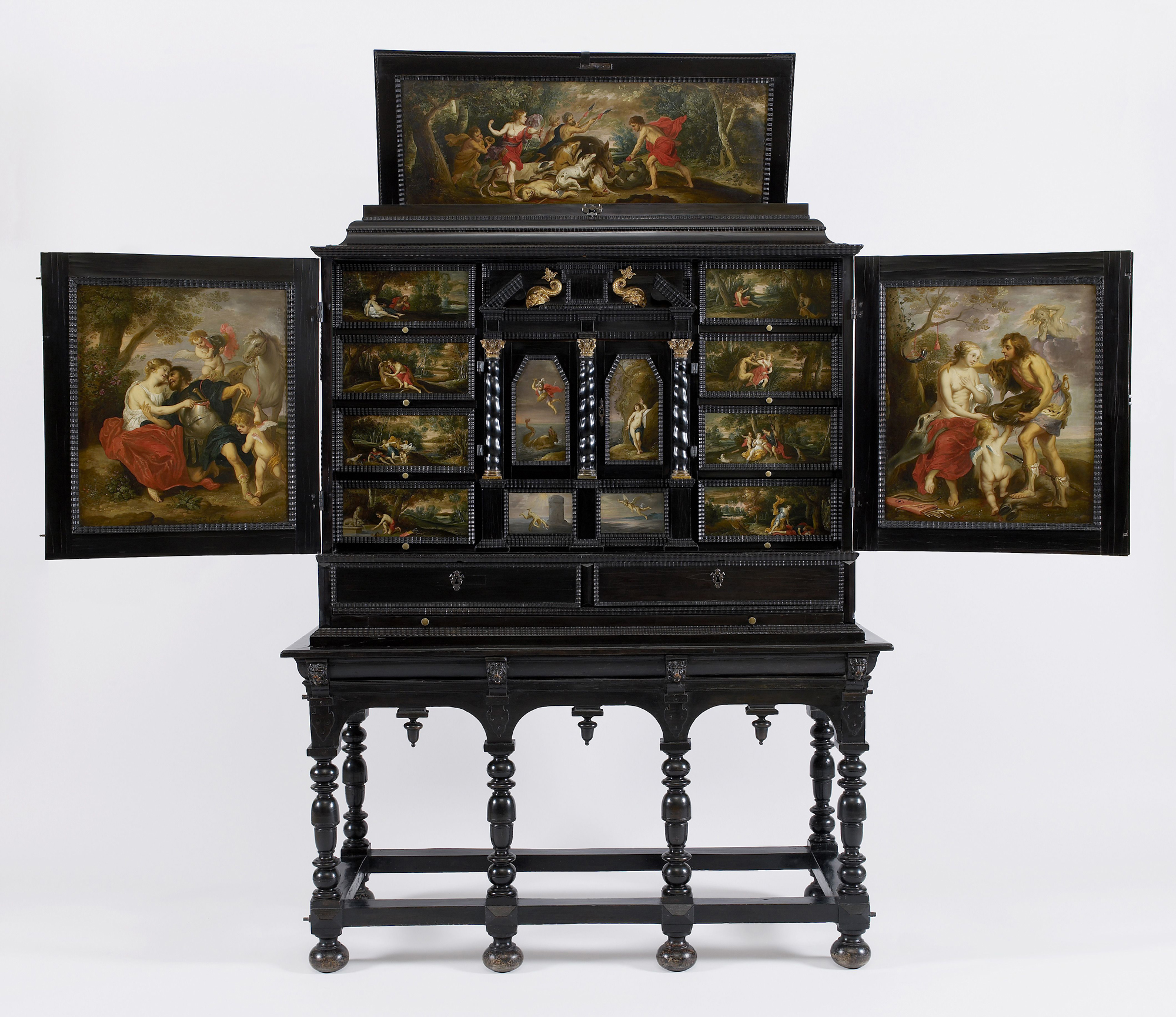
The compositions of the cabinet’s nine interior drawers and central arched door are most closely related to those on the cabinet at Burghley House, Stanford, where all ten compositions also occur, with slight variants, though arranged in a different order – the doors have different scenes and the Burghley cabinet does not have a painted top lid (fig.).3 The Burghley cabinet is recorded in the 1690 Devonshire Schedule, an inventory listing an enormous bequest from Elizabeth, Countess of Devonshire (1619-1689), to her daughter Anne, Countess of Exeter (1649-1703), as ‘A Large Ebony Cabinett painted with Landskipps and ffigures on the outside on a Guilt Carv’d fframe.’ – as such it is an extremely rare documented Flemish cabinet.
The Rijksmuseum cabinet, which also has nine painted drawers around an arched central door decorated with an Allegory of Piece, is also decorated with scenes of Ovid (fig.).4 It shares the compositions of Cephalus and Procris only. The Rubenshuis cabinet, whose main theme is the Hunt for the Caledonian Boar, again has four horizontal drawers to the left and right of the central door, underneath which is a drawer decorated with not one but two nearly square paintings, also representing The Fall of Icarus, but in a different composition (fig.).5 Of the horizontal drawers, the composition of Cephalus and Procris that also occurs in the Rijksmuseum cabinet makes yet another appearance, and the composition of Cyparissus and the Stag is also shared in both Rubenshuis and our cabinet.
The Rijksmuseum cabinet has been extensively researched in recent years by Gregory Martyn, which resulted in a dedicated article in The Burlington Magazine in 2016 and an extended article on the Rijksmuseum’s digital catalogue.6 This research yielded a wealth of new information about such painted cabinets. Antwerp became the leading international centre for the manufacture of cabinets in the seventeenth century, taking over from Augsburg, which had been the centre of such luxury furniture. One of Antwerp’s specialities was cabinets decorated with small oil paintings most of which were influenced in style by Peter Paul Rubens, who flourished in this city. In the late sixteenth century cabinets were already being made in Antwerp. It is however with a unique type of cabinet that Antwerp dominated the market, which was the ebony, and sometimes tortoiseshell, veneered cabinet decorated with oil paintings, which exploited the city’s fame as the foremost centre for artists. As early as 1617, Jan Bruegel the Elder and Frans Francken depicted ebony cabinets mounted with painted panels in their paintings and Francken himself is known to have painted panels for cabinets.
For the most valuable cabinets, the combination of ebony veneer, wavy moldings and tortoiseshell, backed with red foil to better show off the tortoise shell, is quite typical, the interiors decorcated with paintings in oil on copper, mostly with mythological themes. Martin notes that ‘artists responsible for panels decorating such cabinets (…) have been categorized as ‘humble’ and anonymous’, which makes the group of three, now extended to four, cabinets all the more interesting.7 He further noted on the Rijksmuseum cabinet that ‘the paintings on the drawers have a less idiosyncratic character than the larger ones on the wings, door and lid, as the figures are simplistically handled. In this respect the description of the contents of Wolfvoet’s workroom in his estate inventory may be relevant. Recorded are some sixty small paintings (‘schilderykens’) many described as bad (‘schlechte’), without frames and on panel. Possibly these were paintings destined to decorate the drawers of cabinets; they were unattributed in the inventory and thus could have been partly the work of an assistant or apprentice, one such having been registered by Wolfvoet in 1644/45. It is possible that the landscapes were by a different hand, in this case working in the tradition perhaps of Alexander Keirincx (1600–1652). It would seem that the landscapes were executed first, with the artist working from modelli that would have indicated where reserves were to be left for the figures’.8 There is contemporary documentary evidence that Wolfvoet supplied paintings for such cabinets in the accounts of the dealer Forchondt for 1651: one entry (in three versions) refers to ‘een cantoor … doer Fictor [Victor Wolfvoet] de deuren af geschildert heeft’ (‘a cabinet of which Fictor [Victor Wolfvoet] painted the doors’).9
Victor Wolfvoet was a pupil of Peter Paul Rubens who was active in Antwerp in the mid-seventeenth century as an artist and an art dealer. He joined the Antwerp guild in 1644/45, just seven years prior to his untimely death, so a relatively short career as an independent artist must account for the scarcity of his works – also allowing the currently four known cabinets attributed to him to be dated fairly precisely, as they must have been made between c.1645 and 1652. There are indications that Wolfvoet may have been more active as a dealer than as a painter, which also accounts of the scarsity of his extant works. An inventory of his estate made after his death lists over seven hundred items, including twenty oil sketches by Rubens, among them several designs for the ceilings in the Jesuit church in Antwerp and six sketches for Triumph of the Eucharist tapestry series. There were many other sketches by different artists, as well as copies after Rubens sketches, some of which must have been in Wolfvoet’s own hand.
1. A version of the left painting of considerably lesser quality appeared in an anonymous sale, Collin du Bocage (Drouot) Paris, 19 June 2026, lot 34: copper, 52 x 39.5 cm, with monogram ‘DT’ (for David Teniers), catalogued as ‘circle of Jacob van Loo’; the Pegasus shown in our painting is omitted in this version. A version of the right door painting, again of considerably lesser quality, was offered in an anonymous sale, Sotheby Parke Bernet, New York, 6 December 1980, lot 95, repr. (black/white), oil on copper, 50 x 39.5 cm, as ‘school of Hendrik van Balen’. It is possible that these two paintings were originally inserted into the doors of a dismembered cabinet.
2. This composition is based on an oil sketch by Peter Paul Rubens, oil on panel, 29 x 32 cm, Museo del Prado, Madrid, inv. no. 2459; J. Held, The oil sketches of Peter Paul Rubens, Princeton 1980, p. 254, cat. no. 177.
3. Height 168 cm, width 106 cm, including the George III ebonised stand with square chamfered legs, inv. no. FUR0871c. John Martin Robinson, Burghley House, New York 2025, fig. 193 and Corpus Rubenianum Ludwig Burchard, Brussels 1968 –, vol. 11-2 (2022), pp. 421-422, no. 85 (copy 4).
4. Height 164.5 cm, width 113.5 cm, depth 51 cm, inv. no. BK-NM-11906-1; Gregory Martin and Bert Schepers, ‘Two Antwerp cabinets decorated by Victor Wolfoet II’, The Burlington Magazine, vol. 158, 2016, no. 1363, pp. 793-802, figs 28, 32, 33 and Reinier Baarsen, 17th-Century Cabinets, Zwolle 2000, pp. 26-28, figs. 32, 33, 34.
5. Height 168 cm, width 129 cm, depth 56 cm, inv. no. RH.M.166; R. Fabri, ‘Meubelkunst’, in: H. Liebaers et al., Vlaamse kunst van de oorsprong tot heden, Antwerpen 1985, pp. 66-73 and Corpus Rubenianum (…), op. cit., pp. 384-85, no. 81 (copy 3).
6. Martin and Schepers, op. cit. and G. Martin, 2022, ‘anonymous and Victor (II) Wolfvoet, Cabinet Decorated with an Allegory of Peace Surrounded by Mythological Subjects, Antwerp, c. 1645’, in Flemish Paintings in the Rijksmuseum, online coll. cat. Amsterdam: https://data.rijksmuseum.nl/200142681
7. Martin, 2022, op. cit., and note 45.
8. Martin, 2022, op. cit., and notes 49 and 50.
9. Martin, 2022, op. cit., and note 51.