EGBERT VAN HEEMSKERCK I (Haarlem 1634 – c.1702/04 London)
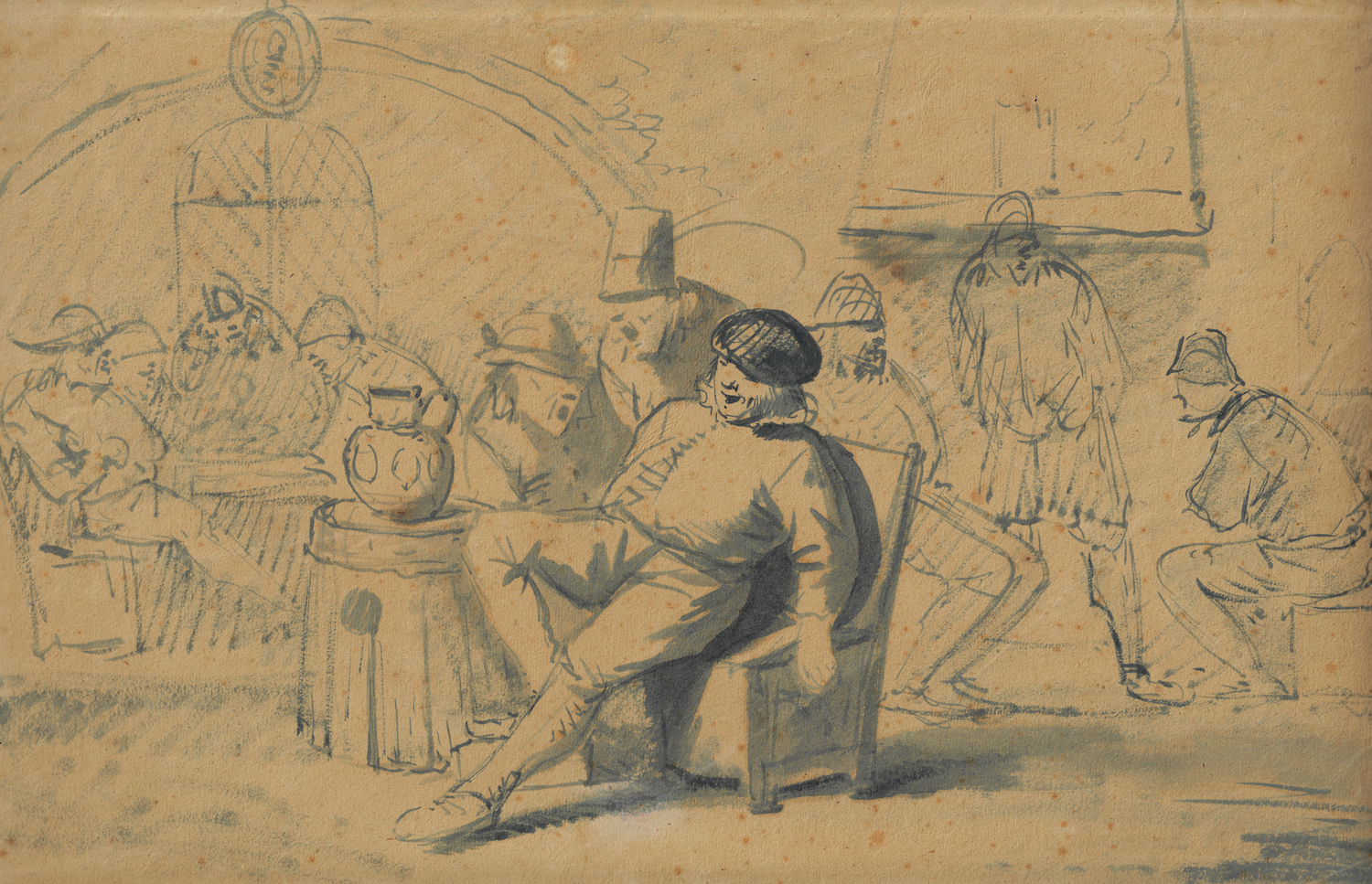
Egbert van Heemskerck I (Haarlem 1634 – c.1702/04 London)
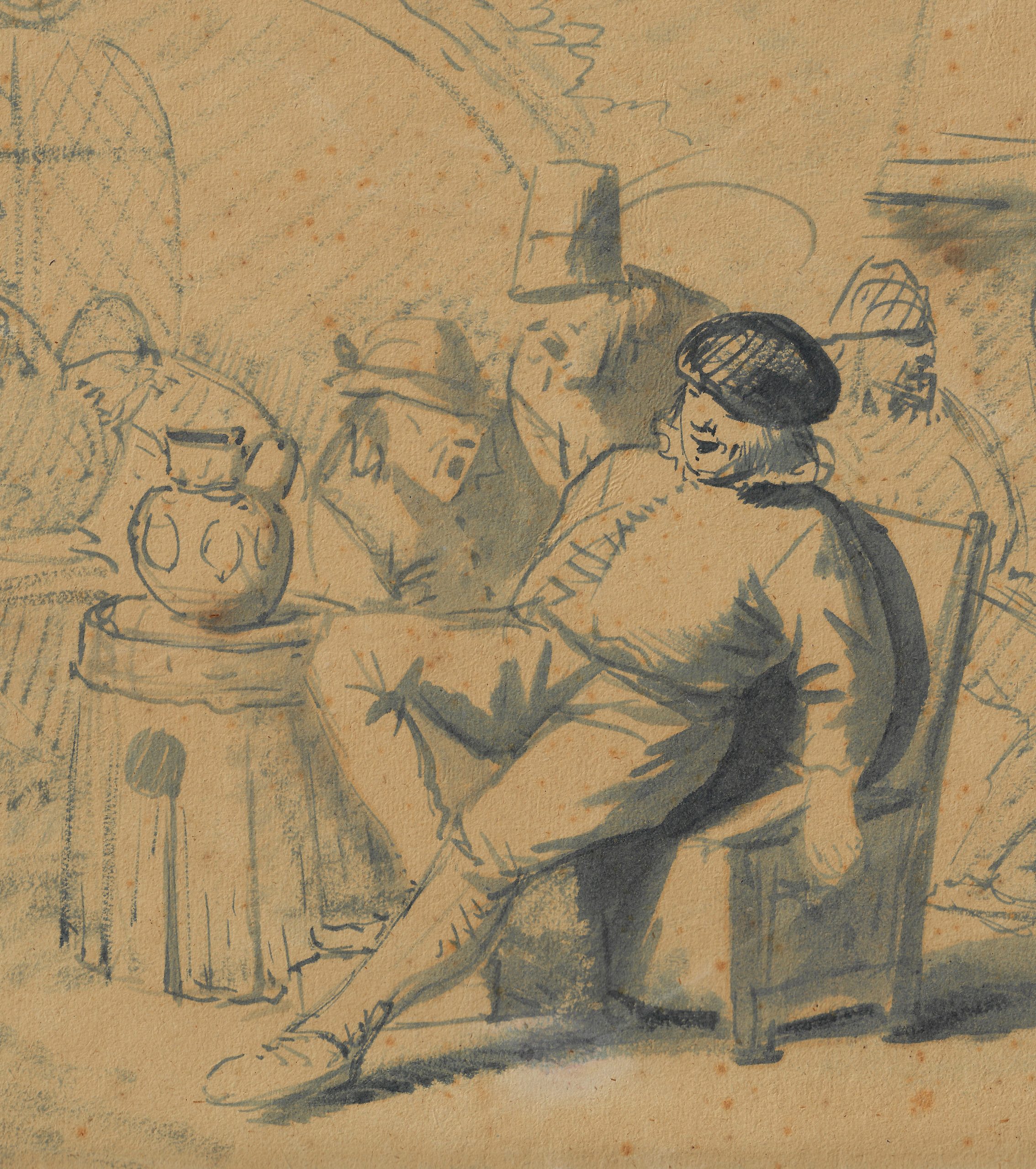
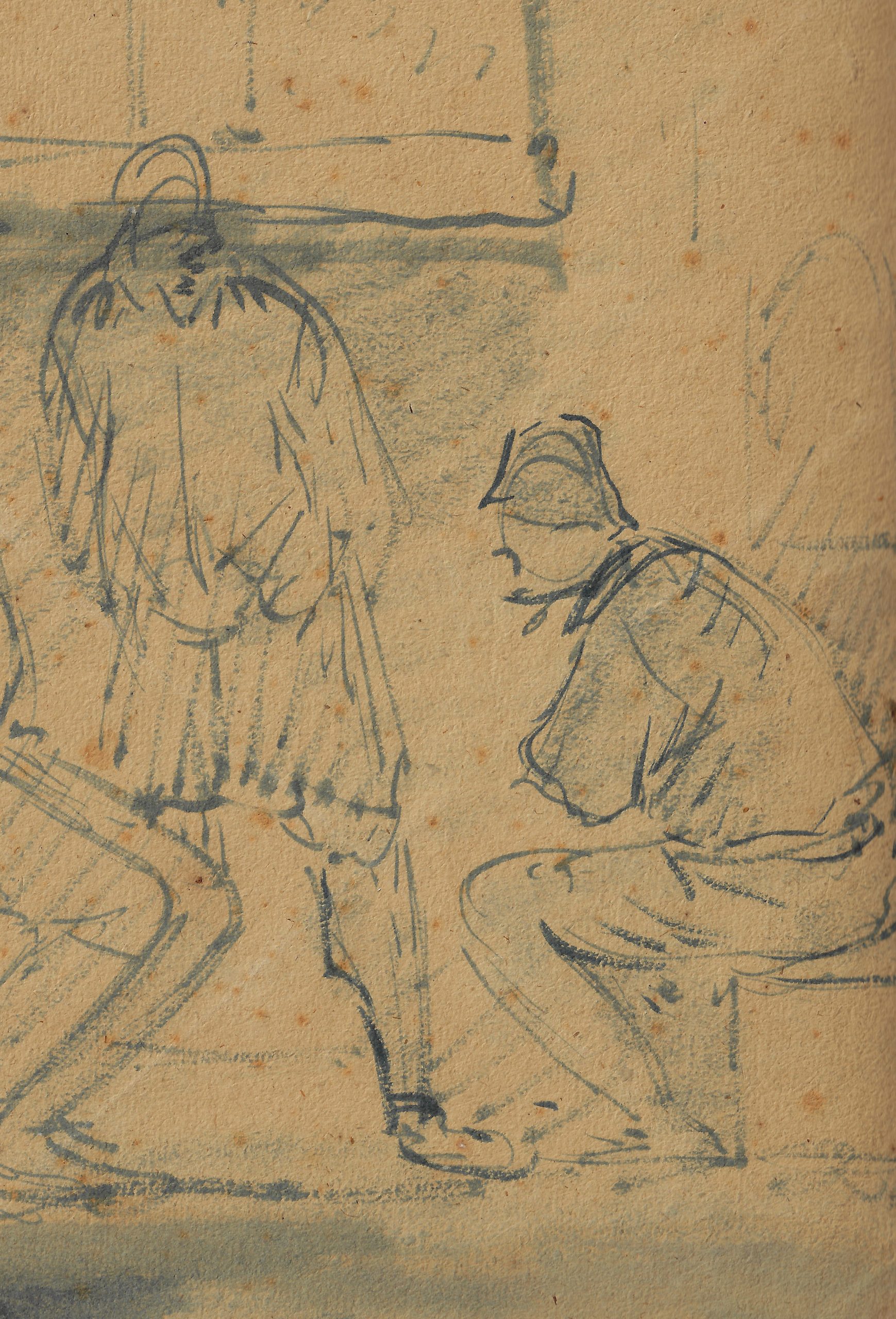
Tavern Interior with Peasants Making Merry
Pen and wash in grey-green on yellowish paper, 275 x 429 mm (10.8 x 16.9 inch)
Provenance
~ Anonymous sale, Frederik Muller, Amsterdam, 11 June 1912, lot 42 (as Adriaen Brouwer and described as ‘dessin magistral’), sold for 660 guilders to:
~ Collection Dr Cornelis Hofstede de Groot (1863–1930), The Hague, until sold at:
~ C.G. Boerner, Leipzig, 1 November 1931, lot 105 (repr. Tafel VIII) (as Egbert van Heemskerck)
~ Anonymous sale, Christie’s, London, 6 December 1972, lot 112
~ With C. G. Boerner, Düsseldorf, 1977
~ Anonymous sale, Christie’s, Amsterdam, 9 November 1999, lot 75, repr.
~ Anonymous sale, Sotheby’s, Amsterdam, 14 November 2006, lot 70, repr.
~ With Robert Noortman, Maastricht, where acquired by:
~ Private collection, Germany, until 2025
Literature
~ F. Becker, Handzeichnungen holländischer Meister aus der Sammlung Hofstede de Groot im Haag, Leipzig 1923, no. 8, repr. (as Adriaen Brouwer)
~ T.W. Muchall-Viebrook, Flemish Drawings of the Seventeenth Century, London 1926, no. 57, repr. (as Adriaen Brouwer)
~ Burlington Magazine, advertisement C.G. Boerner, August 1973, p. xvii, repr. (as Egbert van Heemskerck)
~ C.G. Boerner: Neue Lagerliste 68. Aus unseren Mappen 1977, Düsseldorf 1977, (unnumbered) repr.
~ C.G. Boerner, Aus unseren mappen 1989, Düsseldorf 1988, cat no. 20
***
Egbert van Heemskerck was born in Haarlem in 1634 as the son of a doctor, Jasper Jaspersz van Heemskerck; after his death, Heemskerck’s mother Marytge van Stralen married the innkeeper Jan Wijnants, father of the eponymous landscape painter (1632–1684), who therefore became Egbert’s step-brother.1 Heemskerck is thought to have trained in Haarlem with Jan Miense Molenaer (c.1610–1668), and specialised in low-life genre scenes in the manner of David Teniers and Adriaen Brouwer. In May 1655 he travelled to Italy to study the works of Antiquity and contemporary masters, and upon his return in March 1661 he settled in Amsterdam.
In the early 1670s Holland was invaded by French forces, which caused an economic downturn, and Heemskerck emigrated to England. There he worked for John Wilmot, Earl of Rochester, and for an art dealer who was based in the Strand. He later rented attic rooms in the house of a tobacco seller in Drury Lane. Heemskerck’s genre pieces were highly favoured by English patrons. The artist’s son Egbert II (c.1676– 1744) was trained by his father and worked in his manner, but did not possess his father’s talent.
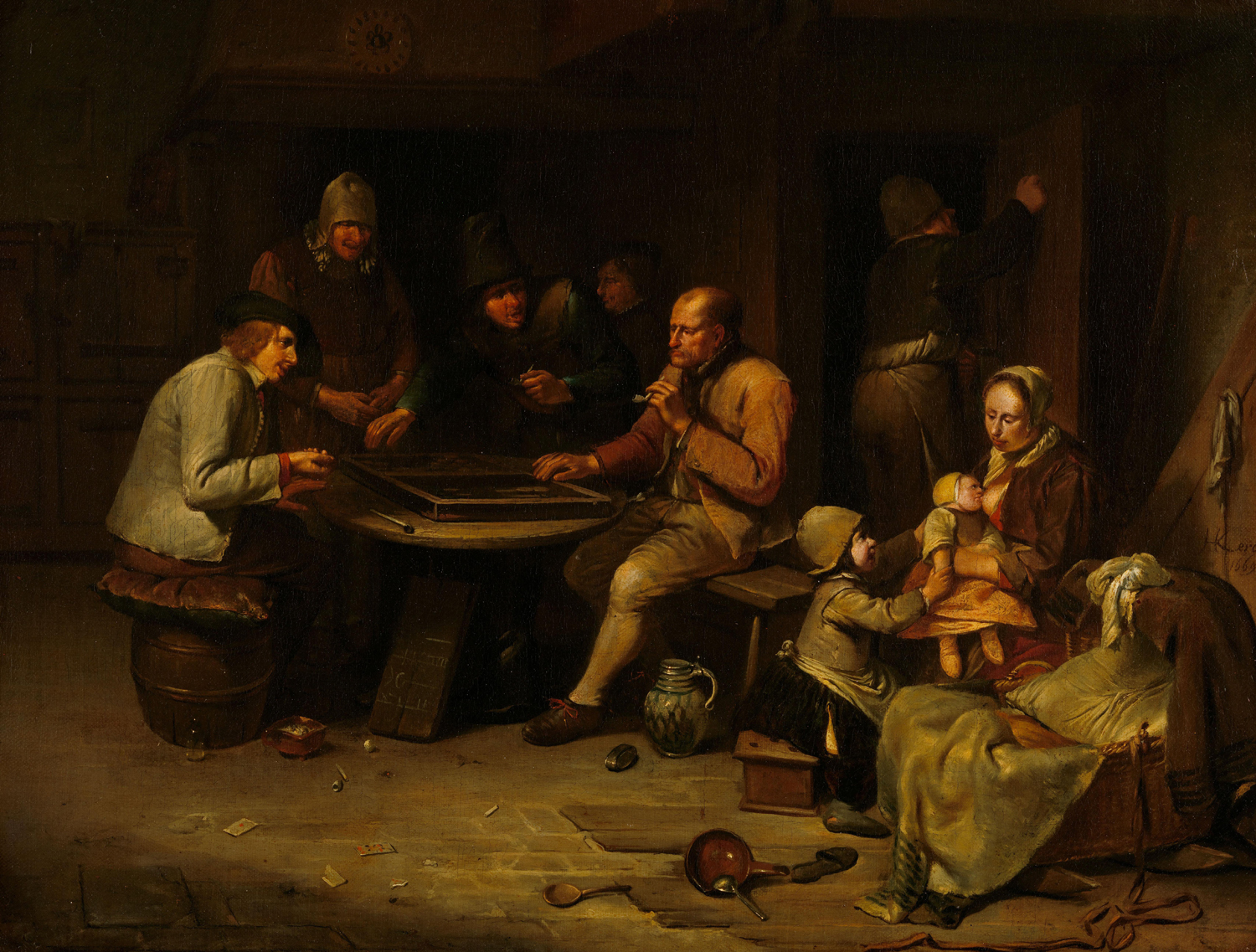
Paintings by Heemskerck are represented in many museum collections, including the Musée des Beaux Arts in Bordeaux, the Städel Museum in Frankfurt am Main, the Nationalmuseum in Stockholm and the Frans Hals Museum in Haarlem. One of Heemskerck’s most celebrated works is preserved in the Rijksmuseum in Amsterdam: a painting representing an Interior with Backgammon Players, dated 1669 (fig).2
A relatively small number of drawings by Heemskerck has survived. They are immensely spontaneous and vigorous in character, and entirely different for instance from the more polite drawings by Adriaen and Isaac van Ostade, his immediate predecessors as genre painters in Haarlem. In contrast to the Van Ostade brothers, who made drawings as commercial objects to be acquired by collectors, Heemskerck’s drawings were presumably made for his own benefit only, jotting down impressions he may have observed personally, as motifs for future paintings.
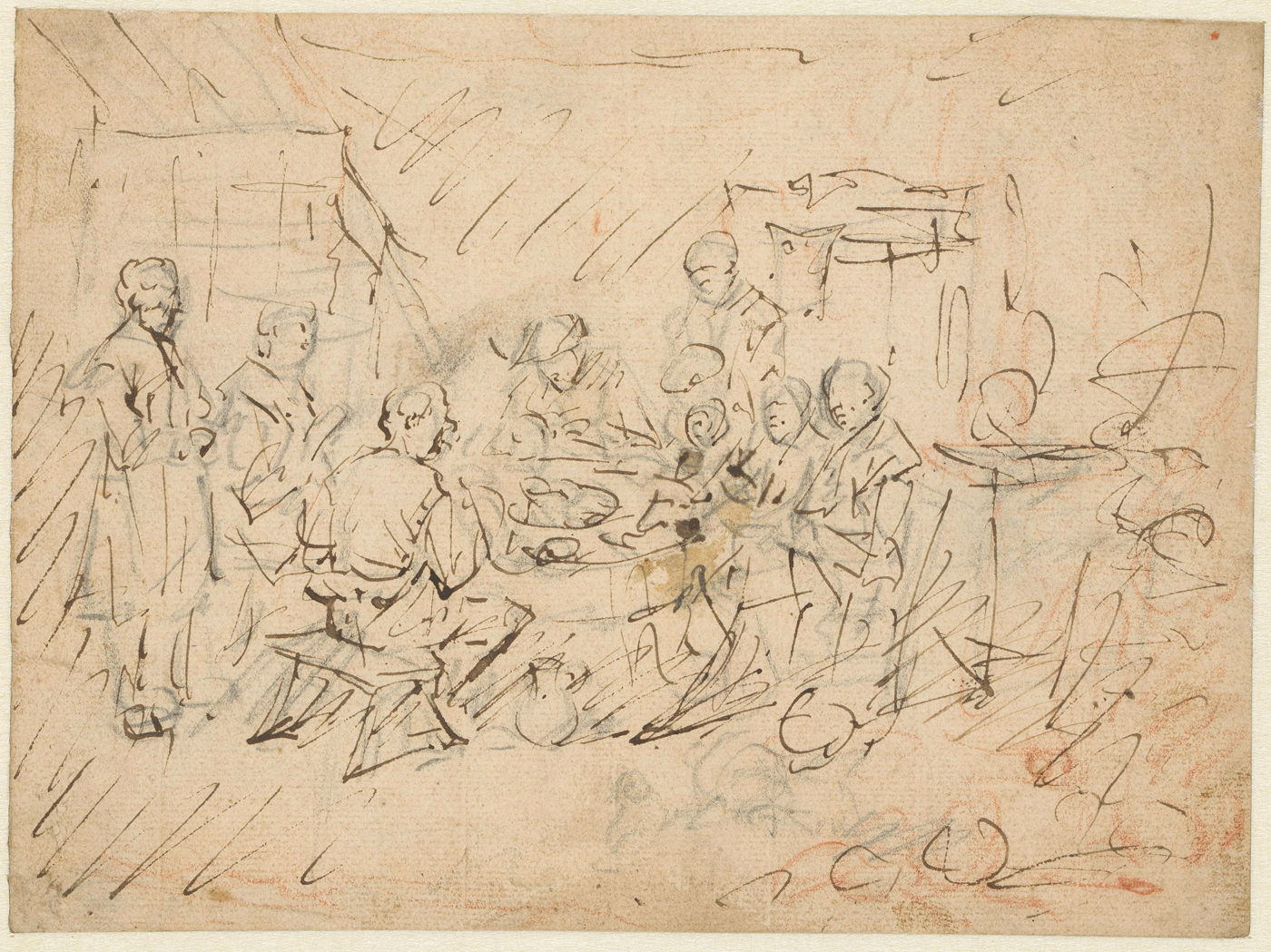
The present drawing is very ambitious in scale, probably the largest and most iconic drawing known by Egbert van Heemskerck the Elder. It has a long and distinguished history, previously thought to be a work by Adriaen Brouwer, but its former owner, the eminent art historian Dr Cornelis Hofstede de Groot (1863–1930) realised it to be a work by Van Heemskerck. It can for instance be compared to his sketch of an Interior Scene in the Rijksmuseum, Amsterdam (fig.).3
1. For Heemskerck, see: R. Raines, ‘Notes on Egbert van Heemskerck and the English Taste for Genre’, The Walpole Society 53 (1987), pp. 119-142 and H. Mount, ‘Egbert van Heemskerck’s ”Quaker Meetings” revisited’, Journal of the Warburg and Courtauld Institutes 56 (1993), pp. 209-228.
2. Oil on canvas, 40 x 53 cm, signed and dated ‘HKerck 1669’, inv. no. SK-A-2180; P.J.J. van Thiel a.o., All the paintings of the Rijksmuseum in Amsterdam: a completely illustrated catalogue, Amsterdam/Maarssen 1976, p. 264, repr.
3. Black chalk, pen and brown ink, 138 x 187 mm, inv. no. RP-T-1954-141.