JOOS DE MOMPER II (Antwerp c.1564 – 1635 Antwerp)
Joos de Momper II (Antwerp c.1564 – 1635 Antwerp)
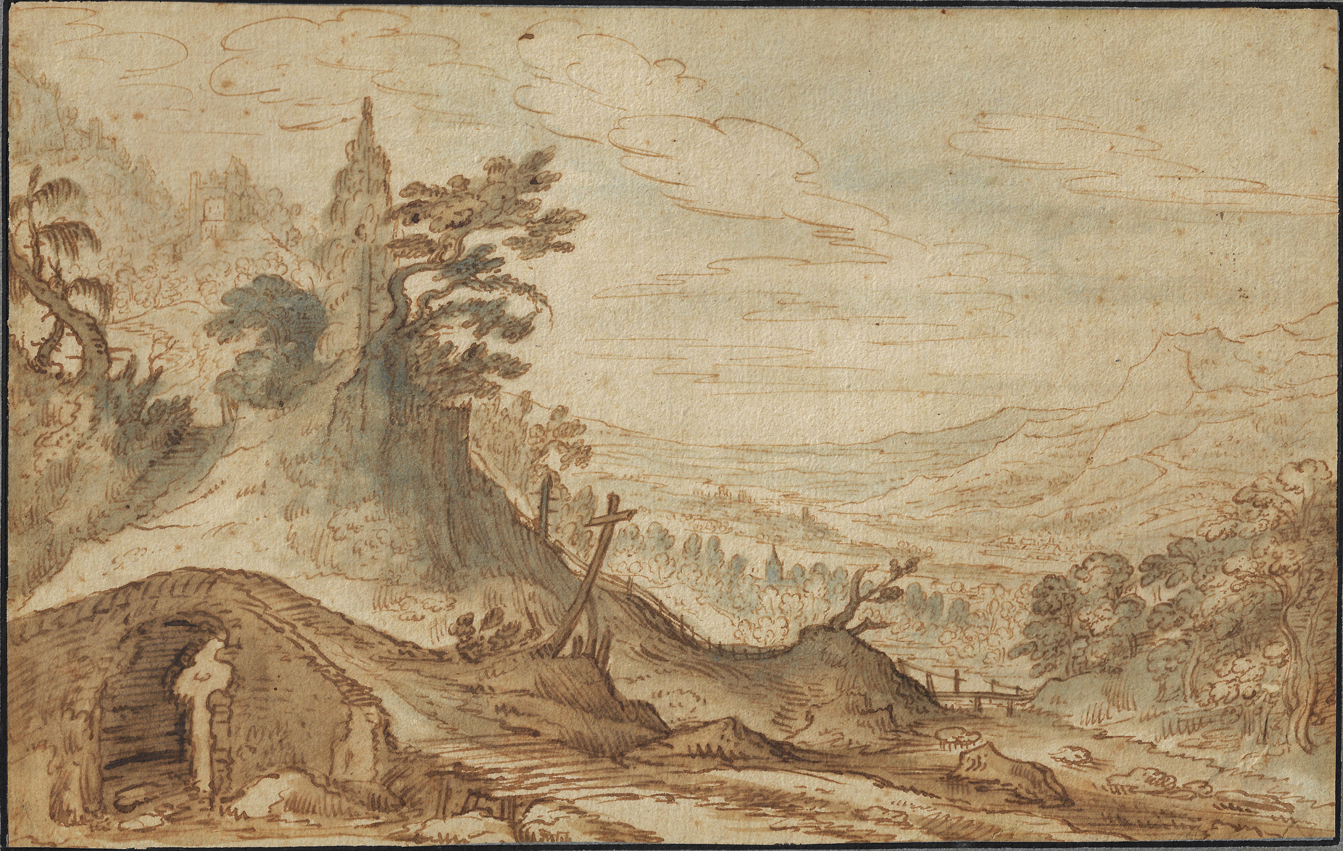
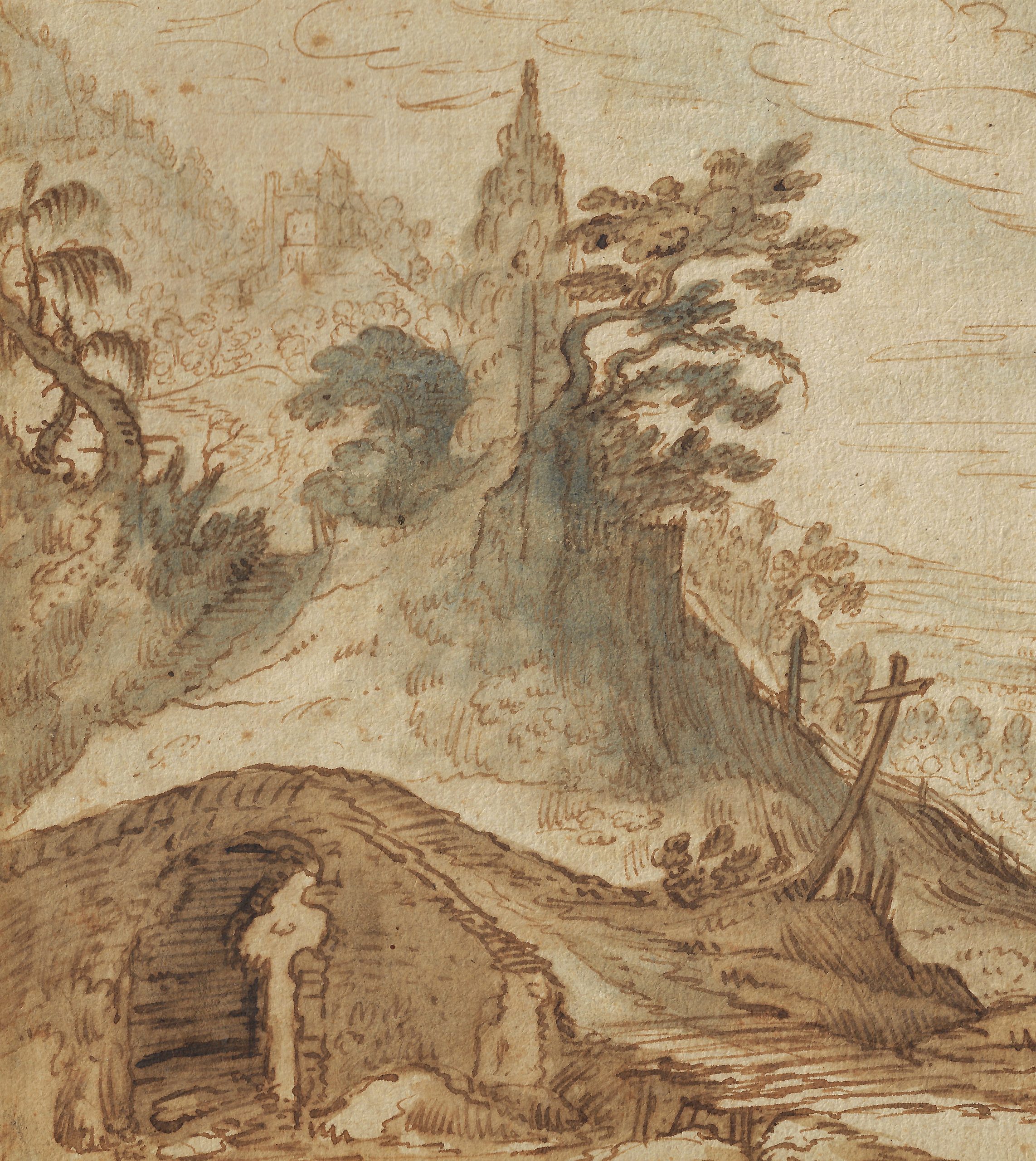
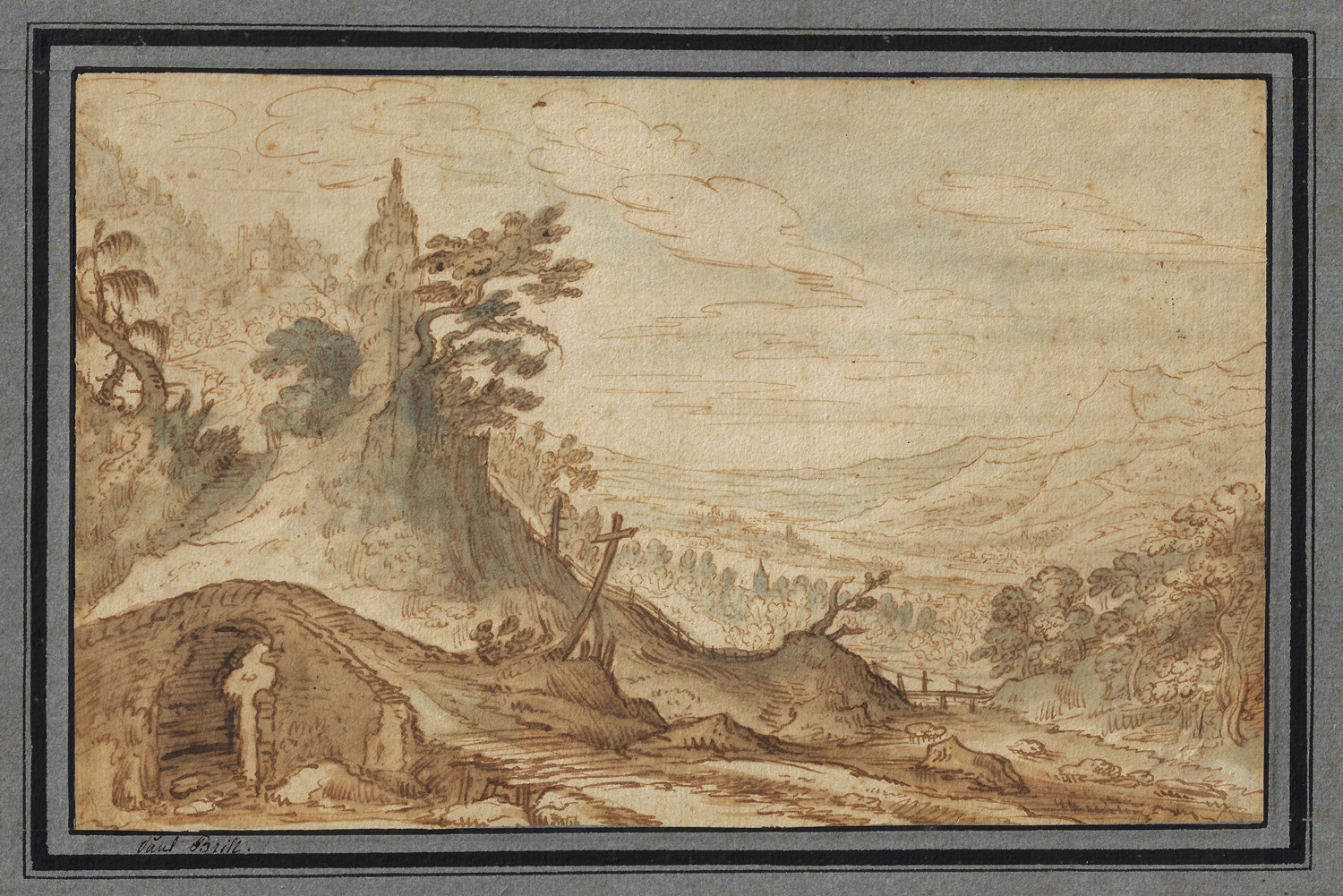
An Extensive River Landscape with a Bridge in the Foreground
Pen and brown ink, blue-grey wash, black ink framing lines, 198 x 312 mm (7.8 x 12.3 inch); laid down onto a blue paper mount with black ink framing lines
The blue mount inscribed ‘Pául Brill.’ (pen and black ink, lower left)
Provenance
~ With Gebroeders Douwes, Amsterdam, 1966, where acquired by:
~ Collection Dr. J.A. van Dongen (1887–1972), Amsterdam
~ With Robert Noortman, Maastricht, where acquired during the 1990s by:
~ Private collection, Germany, until 2025
Exhibited
Schilderijen, tekeningen en beeldhouwwerken uit de verzameling van Dr. J.A. van Dongen, Amsterdam (Museum Willet Holthuysen) 1968, cat. no. 62
***
Joos de Momper the Younger was a Flemish landscape painter active in Antwerp between the late 16th century and the early 17th century.1 His work is situated at the transition from late 16th-century Mannerism to the greater realism in landscape painting that developed in the early 17th century. Joos was born as the son of the painter and art dealer Bartholomeus de Momper I and Suzanna Halfroose and was named after his grandfather, the landscape painter Joos de Momper I. In 1590 he married Elisabeth Gobijn, with whom he had ten children, of whom Philippe de Momper also became a painter. Among his pupils were Louis de Caullery and his nephew Frans de Momper.
De Momper was taught the art of painting by his father and finished his artistic education during a journey to Italy around 1598–1601, visiting Rome and other places. Although he was patronised by some of the leading collectors of the day, including Archduchess Isabella Clara Eugenia, governess of the Southern Netherlands, he died in 1635 leaving large debts, and his possessions were sold off by his creditors. De Momper was mentioned as a landscape painter by Karel van Mander in his Schilder-boeck of 1604 and his portrait was engraved by Anthony van Dyck.
De Momper’s works are chiefly inspired by the steep craggy Alpine slopes and high rock masses depicted in Pieter Brueghel the Elder’s oeuvre. This is also seen in some of the motifs of De Momper’s work which go back to Pieter Bruegel’s inventions, such as winter landscapes and grain harvests. Another influence on De Momper was the work of the Flemish landscape specialist Lodewijk Toeput, who went on to make a career in Italy. De Momper emphasized stylization over naturalistic effects and used depth and atmosphere to achieve his goal of spatial construction. De Momper led a successful studio with many collaborators. Figures in his paintings were frequently painted by specialists such as Frans Francken II, Peter Snayers, Jan Brueghel the Elder and the Younger.
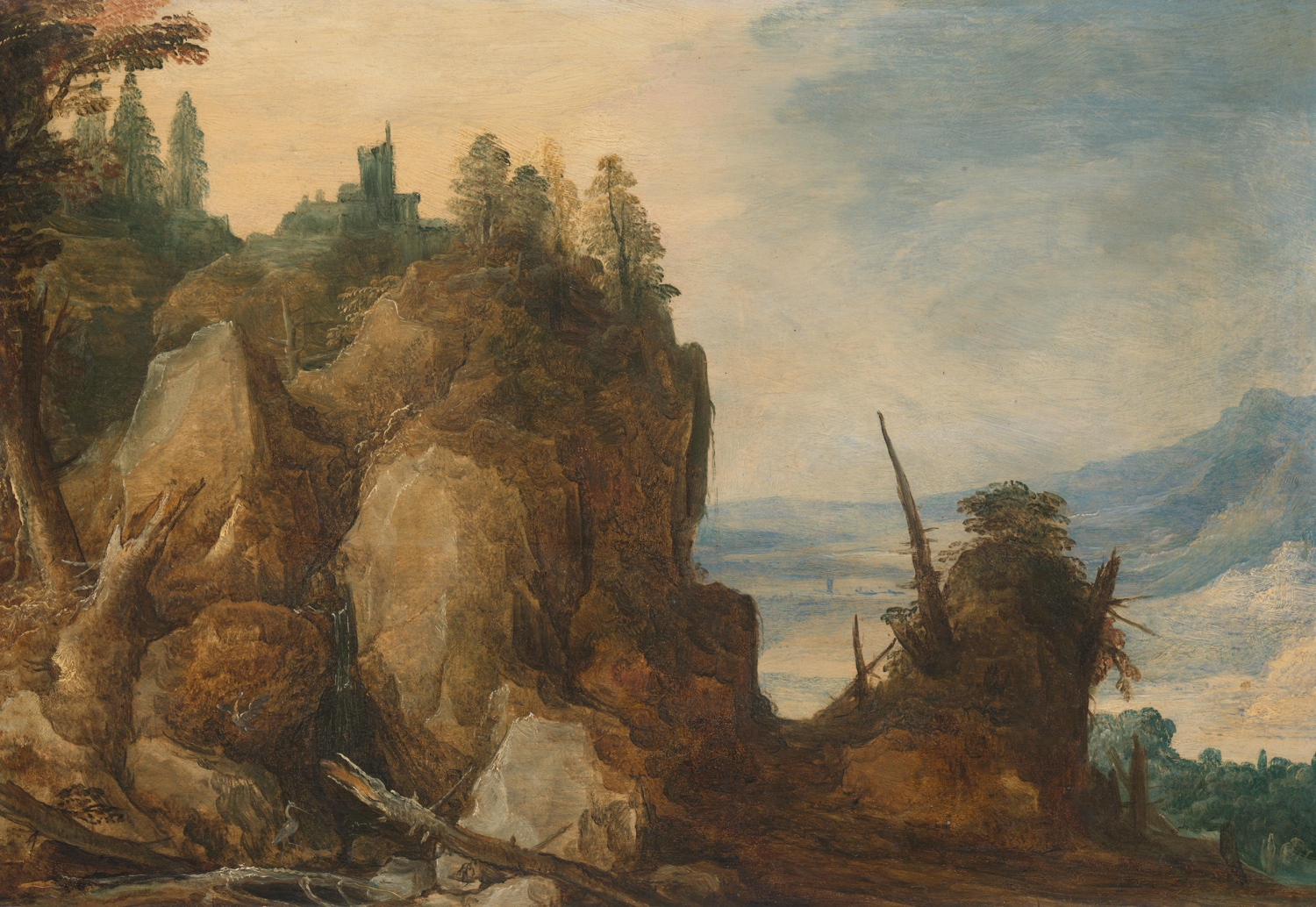
De Momper was one of the most prolific and successful landscape painters of his time, and his pictures were in high demand, by both Netherlandish and international audiences. The artist typically depicted wide panoramas of wooded and mountainous landscapes, which to a large extent were inspired by the artist’s travels through the Alps and Italy. Although the possibility exists that De Momper based his landscapes on observations from real-life, it is more likely that his composition sprung largely from the artist’s imagination. Elements such as the flimsy wooden bridges, little waterfalls and meandering roads were romantic pictorial devices which De Momper and his contemporaries frequently included. A painted landscape by De Momper with a similar panoramic view at the left, contrasted by a rocky hill at the right is preserved in the Rijksmuseum, Amsterdam (fig.).2
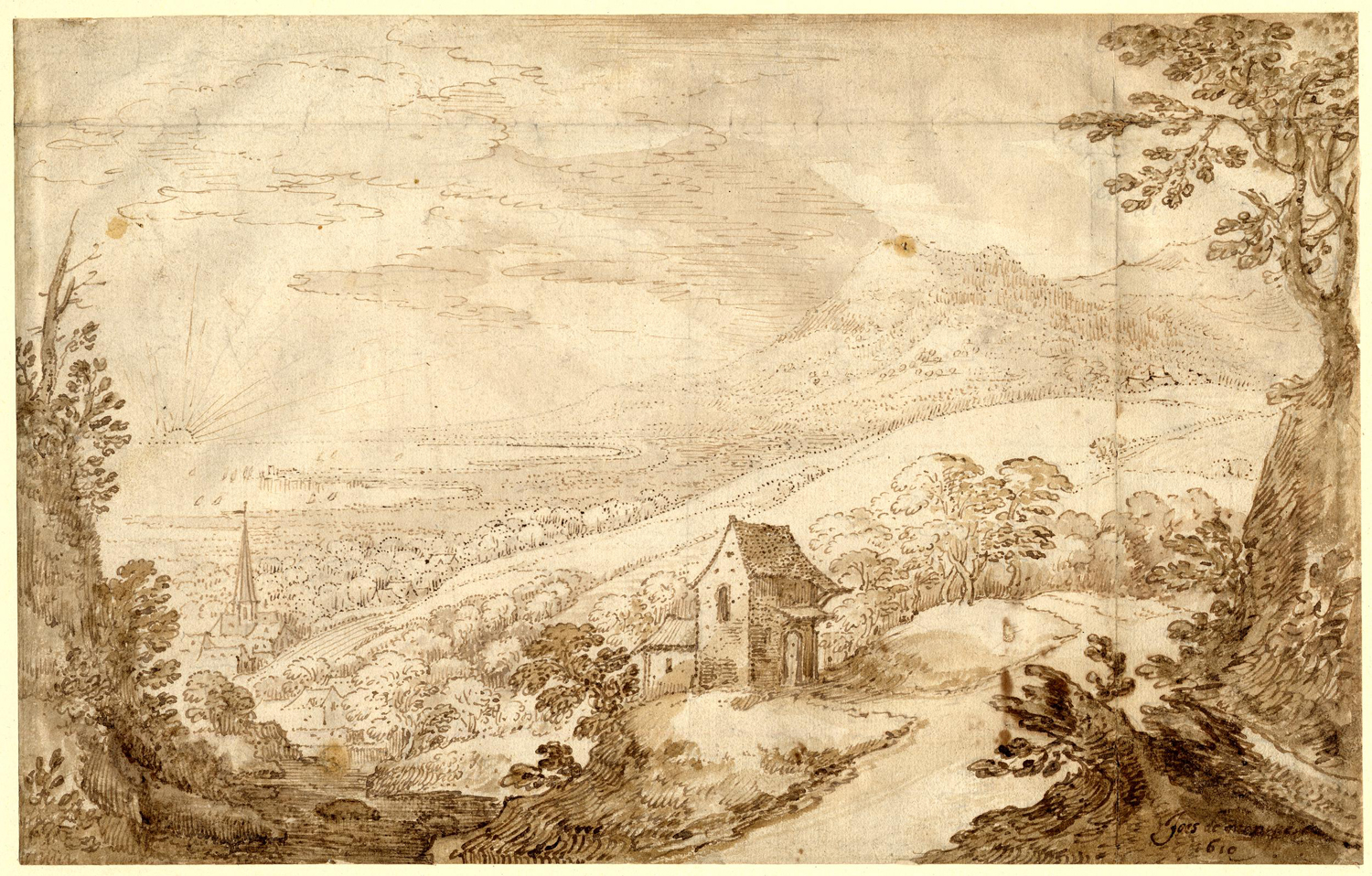
Joos de Momper was a prolific draughtsman and several dozens of his drawings are still known, many in the leading print rooms and museums of the world, including the Rijksmuseum, Amsterdam, the National Galleries of Scotland, Edinburgh, the Metropolitan Museum, New York, the Albertina, Vienna.3 A comparable drawing with a panoramic landscape is preserved in the British Museum, London, a rare example of a signed and dated drawing by De Momper (fig.).4
1. For the artist, see K. Ertz, Josse de Momper the Younger (1564 – 1635): the paintings with critical catalogue raisonné, Freren 1986 and O. Koester, ‘Joos de Momper the Younger. Prolegomena to the Study if his Paintings’, Artes. Periodical of Fine Arts, 2 (1966), pp. 5-70.
2. Oil on panel, 46.5 x 65 cm, inv. no. SK-A-3100.
3. For drawings by the artist, see T. Gerszi, ‘Joos de Momper als Zeichner, Teil 1’ and ‘Joos de Momper als Zeichner, Teil 2’, Jahrbuch der Berliner Museen, Berlin 1993.
4. Pen and brown ink, 223 x 354 mm, inv. no. Oo,9.48; signed and dated, in pen and brown ink, in lower right corner: “Joes de Momper / 1610“; T. Gerszi, op. cit. (‘Teil 2’), p.186.